



Fire alarm systems are safety networks that perform detection of smoke or heat and activate alerts through sensors and a control panel.
Modern fire alarm technology protects building occupants by identifying smoke, heat, or flame conditions and activating notification devices throughout protected spaces. These networks use advanced smoke detection devices and sensors to identify combustion indicators and transmit signals to control panels. Panels evaluate signals for response coordination and safety. Building owners rely on fire alarm coverage for occupant safety in commercial, residential, and industrial occupancies per NFPA 72 requirements. Proper fire alarm and safety system design ensures code compliance through integrated detection and notification throughout all protected areas.
Sensors monitor protected spaces continuously for combustion byproducts including particles and temperature rise throughout occupied buildings. When environmental conditions exceed programmed thresholds, panels activate notification appliances immediately. Addressable loops enable precise location identification for faster emergency response. Integrated building systems coordinate HVAC shutdown and elevator recall automatically upon alarm confirmation.
What Is Fire Alarm System and How It Works
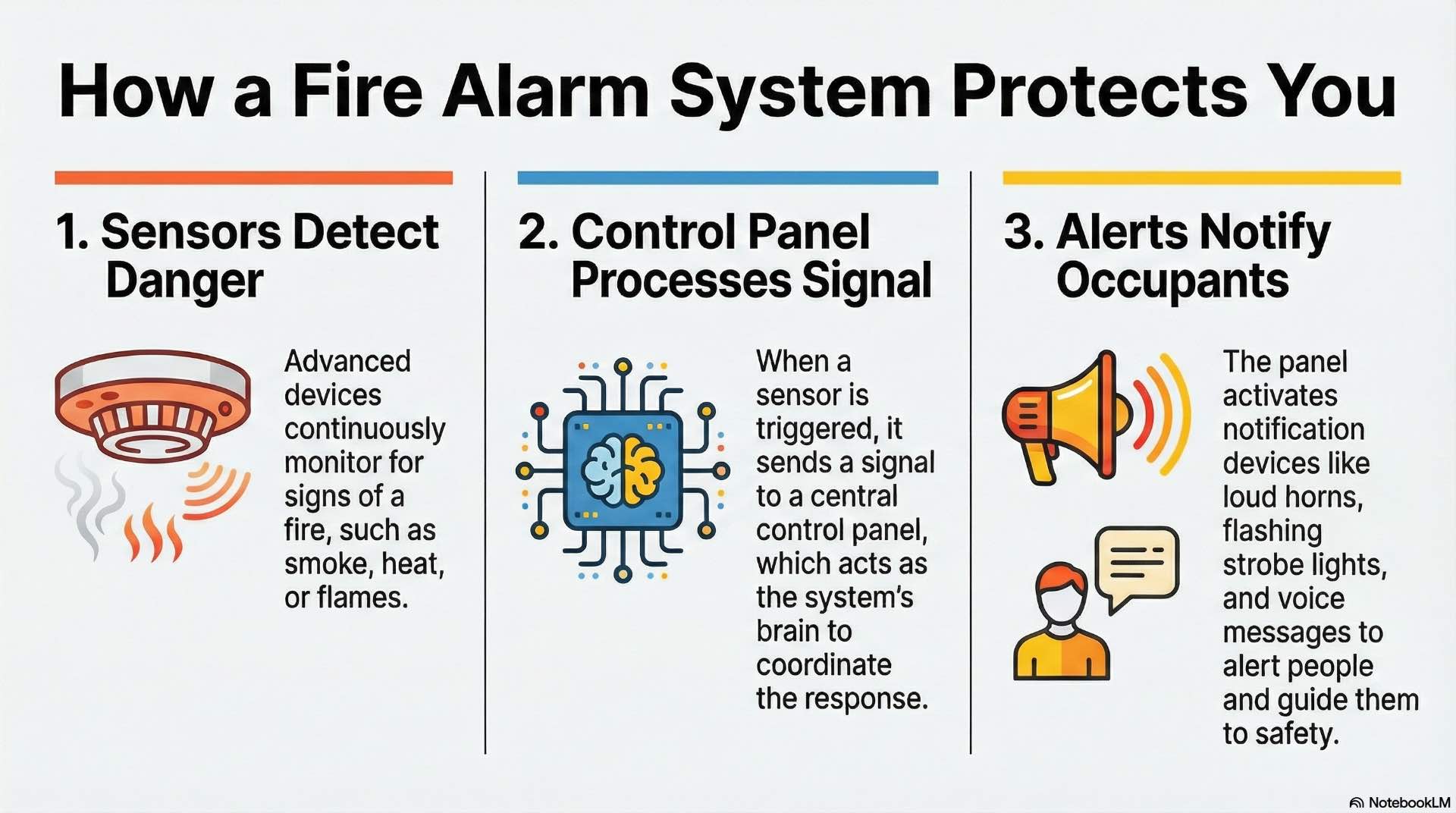
These systems operate as coordinated networks with three functional layers working together continuously for occupant safety. Sensors monitor spaces for combustion indicators including particles and temperature changes using various detection technologies. Control panels evaluate incoming detection signals against programmed thresholds before activating notification appliances throughout buildings.
Notification devices provide audible and visual alerts upon alarm confirmation for occupant safety. Horns produce sound levels exceeding ambient noise by 15 dB minimum per NFPA 72 code requirements. Strobe lights meet ADA accessibility requirements for hearing-impaired occupants in public spaces. Voice systems deliver intelligible evacuation instructions directing occupants toward exits for safety.
Modern systems interface with building automation platforms for coordinated response and safety integration. Integration enables smoke control sequences based on alarm location and building configuration. Cross-zone detection verification reduces nuisance activations in critical applications requiring high reliability. System performance depends on proper design and ongoing maintenance throughout operational life for safety.
How Fire Detection Technologies Identify Early Fire Conditions
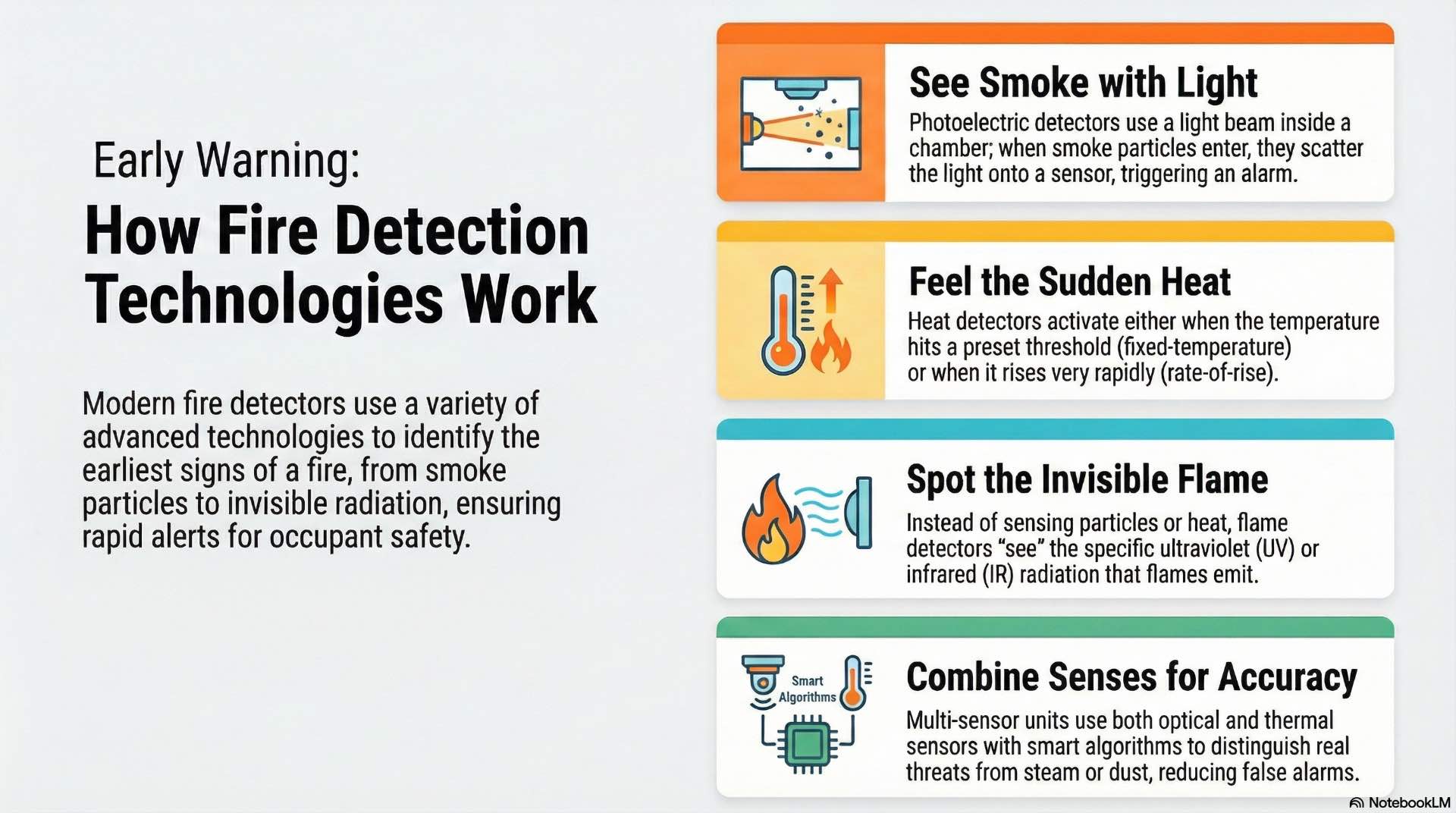
Detection technologies form the foundation of fire alarm systems providing occupant safety protection continuously. Sensor selection ensures proper coverage matched to specific hazards and environmental conditions present in protected spaces. Technology choice affects safety performance based on anticipated scenarios and potential nuisance sources in each application.
Smoke detection technologies
Smoke sensors are common in commercial and residential buildings for early detection and safety warning. Photoelectric detection units use light-scattering principles inside chambers containing light sources and photosensitive receivers for particle identification. UL 268 governs smoke detector performance testing and listing requirements.
When particles enter chambers, they scatter light onto receiver elements triggering detection signals. Optical smoke detection responds to smoldering fires producing larger visible particles from slow combustion processes effectively for safety. Most installations specify photoelectric detection devices for general applications. Modern units show comparable performance to ionization technology in safety testing.
Smoke stratification affects detection in high-ceiling spaces above 30 feet. Hot smoke rises but may cool and stratify before reaching ceiling-mounted sensors. High-ceiling detection requires specialized approaches including projected beam units or stratified sampling at multiple elevations. NFPA 72 provides spacing modifications for ceilings exceeding standard heights.
Modern fire alarm detectors incorporate drift compensation algorithms that automatically adjust sensitivity thresholds as chambers accumulate contamination over time. Drift compensation maintains detection reliability by tracking baseline changes and alerting when cleaning or replacement becomes necessary for safety. UL 268 requires drift compensation capability in listed devices.
Heat detection technologies
Heat sensors provide fire alarm protection where smoke detection devices produce excessive nuisance alarms. Fixed-temperature detection activates at preset thresholds including 135°F and 200°F ratings per UL 521 listings for specific safety applications.
Rate-of-rise detection triggers on rapid temperature changes exceeding 12-15°F per minute indicating fast-developing fires requiring immediate safety response. Spacing follows manufacturer listings typically allowing 50 feet between detection devices per UL 521. Thermal lag affects detection performance in dusty environments requiring careful application engineering for safety.
Flame detection technologies
Flame sensors respond to electromagnetic radiation rather than combustion byproducts in fire alarm applications. Ultraviolet units sense hydrocarbon fire radiation in specific wavelength bands produced during combustion processes for safety.
Infrared sensors identify carbon dioxide emission wavelengths characteristic of burning materials in protected spaces. UV/IR combination units require both wavelengths simultaneously for improved safety reliability. These devices remain susceptible to interference from welding and sunlight requiring environmental safety analysis.
Multi-sensor detection and advanced algorithms
Multi-sensor units combine optical and thermal elements for improved accuracy in single housings using correlated signal analysis. Modern algorithms evaluate CO levels, particle signatures, and temperature profiles simultaneously for safety.
Advanced processing distinguishes actual threats from steam, dust, and cooking aerosols effectively for safety. These devices reduce false activations significantly in challenging environments. Carbon monoxide sensing adds another discrimination layer for improved safety.
Aspiration detection (VESDA) methods
Aspiration systems actively sample air through pipe networks connected to laser-based analyzers for measurement. Sensitivity varies by manufacturer and model selection based on application class requirements for safety.
These systems offer multiple thresholds including Alert, Action, Fire 1, and Fire 2 levels enabling staged safety responses. High-sensitivity units suit critical asset protection applications including data centers and archives. Clean rooms commonly specify aspiration technology for contamination safety concerns.
Beam smoke detection for large open areas
Beam units project infrared light across open spaces between transmitter and receiver components effectively for safety. Coverage varies by model from 15 to 100+ meters depending on specific configurations.
Reflective units typically span shorter distances between 50 and 70 meters maximum. High-ceiling spaces benefit from beam technology where spot sensors are impractical to install and maintain for safety. Warehouses, atriums, and hangars use this approach. Alignment stability affects long-term performance.
Fire Alarm System Architecture and Signal Flow
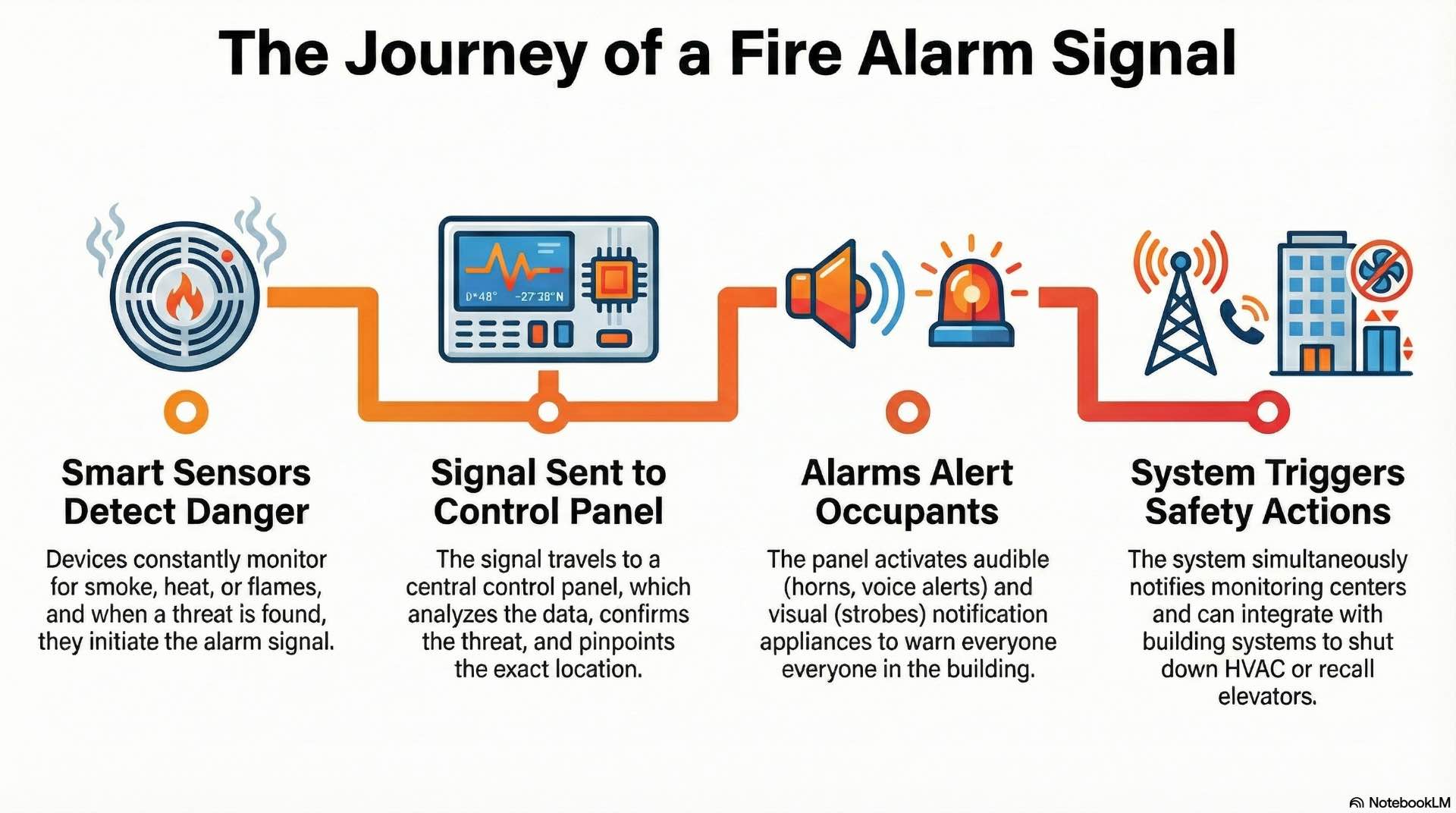
Architecture defines component interconnection and communication methods for coordinated operation and safety throughout buildings. System design affects detection reliability and maintainability throughout operational life in protected facilities. Proper architecture ensures safety and survivability during fault conditions maintaining protection when components fail unexpectedly.
Conventional and addressable system topologies
Conventional systems group sensors into zones with multiple devices sharing single circuit inputs for monitoring purposes. Zone-based systems identify general locations rather than specific devices when activations occur.
Addressable systems assign unique identification to devices on signaling loops enabling precise location reporting to operators and responders. Each sensor transmits its specific address for faster response and efficient troubleshooting capabilities. Most commercial installations specify addressable technology for larger facilities requiring safety.
Zones, loops, sectors, and mapping principles
Zone configuration organizes coverage logically throughout protected buildings for emergency coordination. Proper mapping enables rapid localization and evacuation coordination during emergency events requiring immediate action.
Graphic displays show device locations on floor plans for operator awareness during incidents. Color-coded indicators show status clearly. Operators identify alarm sources immediately for faster response coordination.
Power supplies, battery backup, and survivability
Fire alarm systems require continuous power for reliable protection around the clock in occupied buildings. Main supplies convert AC to 24 VDC for panel operation and device circuits throughout installations.
Battery backup provides standby power during outages per NFPA 72 requirements for all installations. Standard requirements include 24 hours standby plus 5 minutes alarm operation. Some jurisdictions require 60-hour standby for high-rise buildings. Batteries require regular load testing for verification.
Network topology and panel-to-panel communication
Large facilities network multiple fire alarm panels together for coordinated operation across buildings. Topology defines panel communication paths using various configurations and wiring methods.
Class A wiring provides circuit redundancy through supervised return paths maintaining communication during faults. Class B circuits use single paths without return conductors. Class X circuits provide performance equivalent to Class A using different methods. Class N circuits allow non-simultaneous operation. NFPA 72 pathway survivability levels range from Level 0 through Level 3. Level 3 provides two-hour fire-rated protection using mineral-insulated cables or dedicated raceways for critical circuits.
Signaling Line Circuits carry addressable device communications between panels and field equipment. SLC circuits support hundreds of detection devices on single loops with individual addressing. Notification Appliance Circuits power horns, strobes, and speakers during alarm conditions. NAC circuits require proper voltage drop calculationsensuring adequate power reaches end-of-line devices for safety. SLC circuits operate at low current for polling while NAC circuits draw significant current during activation.
Redundancy, fail-safe design, and fault monitoring
Fault-tolerant design maintains protection when components fail through redundant paths and automatic failover capabilities. Dual power supplies significantly improve reliability.
Supervision circuits monitor wiring integrity continuously throughout all signaling circuits for immediate fault identification. Fire alarm panels identify opens, shorts, and ground faults. Trouble signals alert operators before emergencies occur.
Fire Alarm Detectors and Device Functions
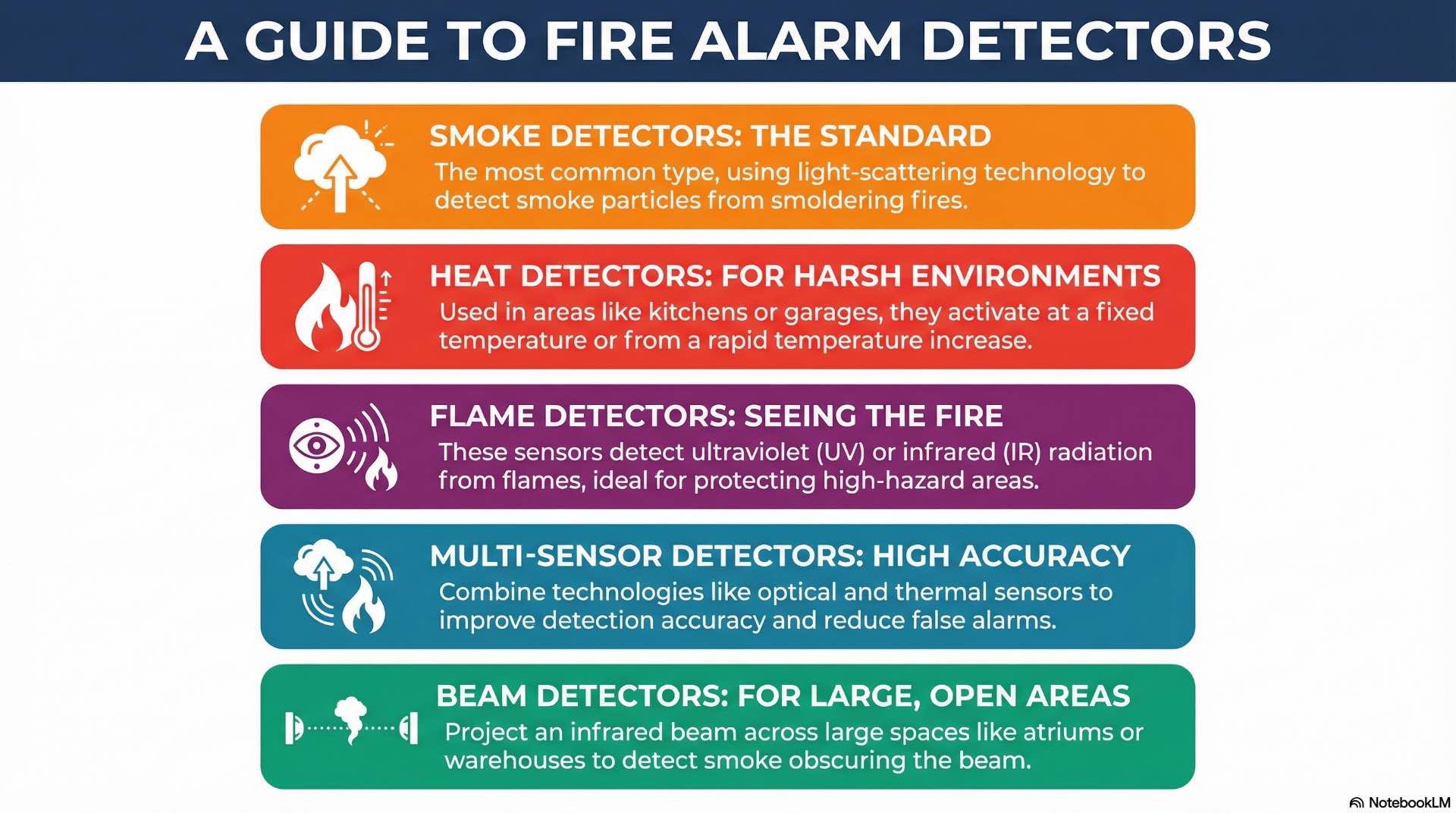
Field devices interface between systems and protected environments requiring monitoring for combustion indicators. Each device type addresses specific requirements for comprehensive building coverage. Proper selection ensures effectiveness for intended applications.
Smoke detectors (optical and ionization)
Optical sensors remain standard for most commercial fire alarm applications requiring early warning. Light-scattering provides reliable response to typical combustion scenarios while minimizing nuisance activations.
NFPA 72 establishes spacing at 30 feet on center maximum for coverage. Placement accounts for ceiling obstructionsincluding beams, joists, and HVAC diffusers. High airflow configurations may require reduced spacing.
Heat detectors (fixed temperature and rate-of-rise)
Heat units provide fire alarm protection where smoke sensors cause excessive nuisance alarms in challenging environments. Fixed-temperature units activate at specific thresholds per device listings.
Spacing follows manufacturer listings allowing 50 feet between devices depending on ceiling height. Combination units provide dual sensing methods. These devices suit garages, kitchens, and industrial spaces effectively.
Flame and multi-sensor detectors
Flame units require clear sightlines to protected areas for electromagnetic radiation sensing. Conical patterns cover 90-120 degrees depending on device model.
Multi-sensor units combine optical and thermal elements for improved reliability through correlated signal analysis. Microprocessors analyze signals before activation. This approach reduces nuisance activations while maintaining sensitivity.
Manual call points and human-initiated alarms
Manual stations allow occupant-initiated fire alarm activation upon discovering fire conditions. Pull stations install near exits per NFPA 72 spacing requirements. Addressable stations report precise locations for faster response.
Notification appliances (sounders, strobes, voice alerts)
Notification devices alert occupants during emergencies throughout protected buildings effectively. Audible appliances produce 15 dB above ambient or 75 dBA in sleeping areas per code requirements. Low-frequency 520 Hz sounders are required in sleeping areas per NFPA 72 for improved detection by sleeping occupants.
Visual notification through strobes meets ADA requirements for hearing-impaired occupants. Strobe candela ratings must match room dimensions per NFPA 72 tables. Candela selection ranges from 15 to 185 cd based on room size and mounting height. Strobes require synchronization within the same field of view to prevent seizures in photosensitive individuals. UL 1971 governs strobe performance testing and safety listing.
Voice evacuation systems provide intelligible instructions during emergencies. EVACS design requires Speech Transmission Index testing with minimum 0.50 STI for life safety messaging per NFPA 72. Speaker placement, tap settings, and acoustic treatment affect intelligibility. Firefighter’s telephone systems integrate with EVACS for emergency communications. UL 864 governs fire alarm control panel listings including voice evacuation functions.
Gas detectors for CO, LPG, and industrial hazards
Gas sensors identify hazardous atmospheres in protected spaces beyond smoke and heat sensing. CO sensors interface through relays, 4-20 mA, and addressable modules. Combustible gas units protect against leaks.
Fire Alarm Control Panels and System Hardware

Control panels coordinate all system functions for protected buildings throughout operational periods. Panel hardware processes incoming signals and activates appropriate outputs based on programming. Panel selection affects capabilities and expansion options. UL 864 establishes testing and listing requirements for fire alarm control units.
Main control panels and processing logic
Main panels contain microprocessors executing programming and cause-and-effect sequences for coordinated responses. Capacity varies from small units to enterprise systems supporting thousands of devices. Programming defines response sequences for each input condition.
Fire alarm panels prioritize events hierarchically for proper annunciation and response. Alarm signals take highest priority followed by supervisory and then trouble conditions. Alarm events indicate fire conditions requiring immediate evacuation. Supervisory events indicate abnormal conditions such as valve closures. Trouble events indicate system faults requiring maintenance but not emergency response.
Cause-and-effect matrices define relationships between initiating devices and output functions. Matrix programming links detection zones to specific notification circuits, relay outputs, and building system interfaces. Smoke detection in elevator lobbies triggers elevator recall. Detection in air handling units activates duct detector shutdown sequences for safety.
Loop cards, expanders, and interface modules
Loop cards connect addressable circuits supporting hundreds of addresses on each signaling loop. Each card supports one or two loops depending on manufacturer specifications.
Expander modules increase panel capacity through additional inputs and outputs for growing systems. This modular approach supports expansion over time.
Remote annunciators and repeater panels
Fire alarm annunciators display system status at secondary locations throughout buildings. Graphic units show device locations on floor plans with color-coded indicators. Repeater panels duplicate displays at remote locations.
Power supply units and charging circuits
Power supplies convert 120/240 VAC to 24 VDC for system operation and device circuits. Sizing accounts for notification appliance loads and expansion capacity requirements. Battery chargers maintain backup capacity continuously.
Input/output devices and integration hardware
Input modules monitor external devices including sprinkler flow switches and duct sensors for integrated monitoring. These modules enable comprehensive monitoring across building systems effectively.
Output modules control external equipment. Protocol gateways enable BACnet and Modbus integration with building automation platforms.
Fire brigade interface requirements
Brigade interfaces provide standardized connections for emergency responders per local requirements. Displays show system status for responders during emergency operations. Interfaces remain accessible when buildings are secured.
Fire Alarm Communication and Signaling Methods
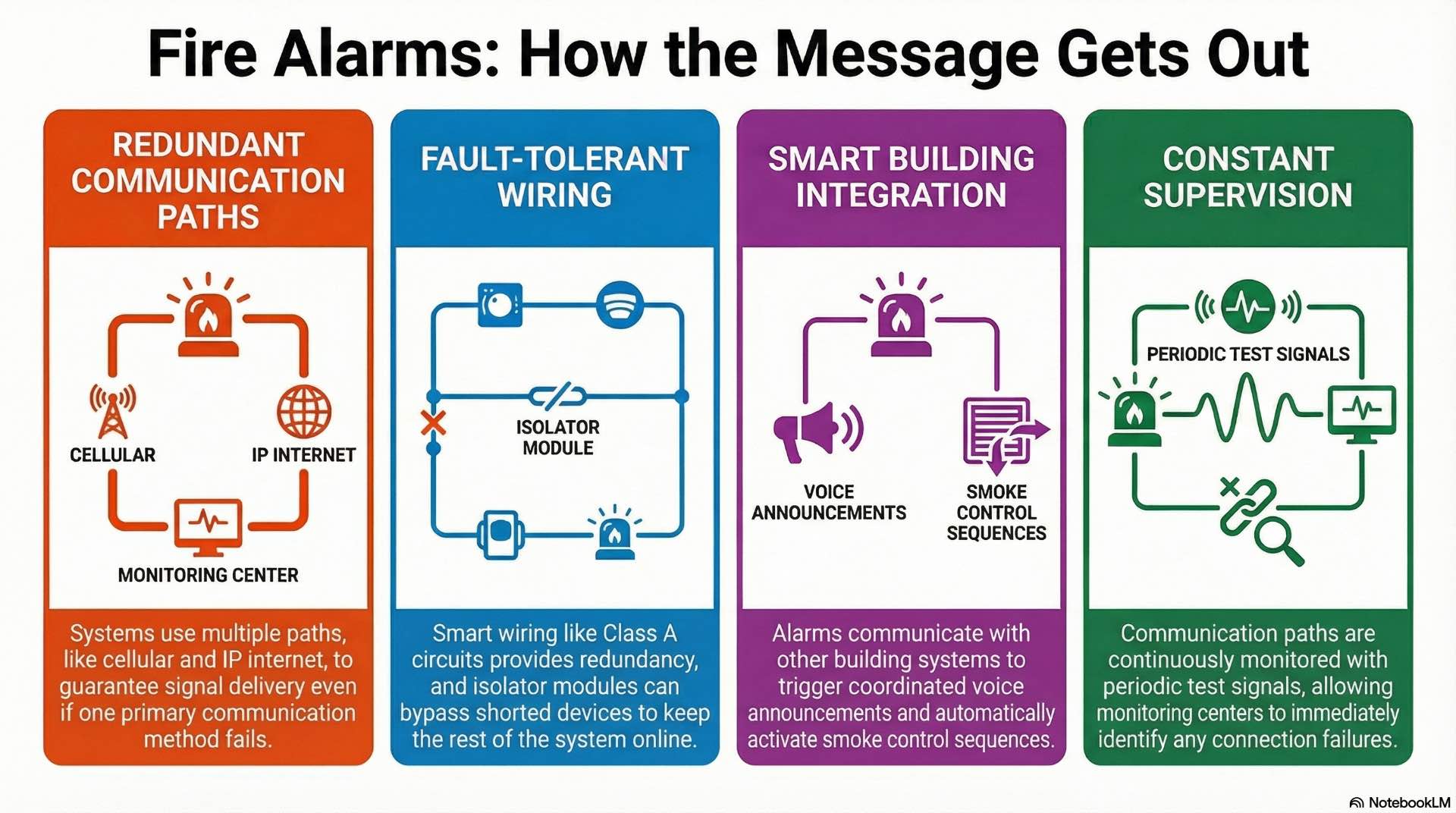
Communication systems ensure reliable signal transmission to monitoring centers and emergency responders continuously. Multiple paths protect against transmission failures that could delay emergency response. Redundant communication ensures signal delivery reliably.
Wired communication paths and circuit isolation
DACTs transmit signals over telephone circuits to monitoring centers for evaluation and dispatch. Circuit isolation prevents faults from spreading to unaffected system portions during troubleshooting.
Isolator modules bypass shorted devices automatically maintaining loop communication with remaining equipment.
Wireless signaling and supervised transmission
Cellular communicators provide wireless transmission paths independently from landline telephone service. Dual-path configurations enhance reliability through redundant cellular and IP transmission methods.
Supervised paths verify integrity through periodic test signals to monitoring centers. Centers identify communication failures when expected signals stop arriving.
Fire detection protocols (Modbus, BACnet, proprietary)
BACnet enables fire alarm integration with building automation across different manufacturers and equipment types. Open protocols provide interoperability for unified building management dashboards.
Proprietary protocols offer optimized performance within single-manufacturer ecosystems for tighter integration.
Event reporting to monitoring centers
Monitoring centers receive fire alarm signals and dispatch responders following verification protocols established for each account. Operators evaluate events professionally before dispatching emergency services. Contact ID and SIA formats enable signal interpretation.
Secure alarm transmission and redundancy
Encryption protects IP transmissions from interception on public networks during transmission. Redundant paths ensure signal delivery when primary communication fails unexpectedly.
Critical facilities implement multiple independent paths for reliable transmission to monitoring centers.
PA/VA and building system interfacing
Voice alarm systems deliver evacuation instructions during emergencies throughout protected buildings. Integration enables coordinated announcements based on alarm location and zone configuration.
Smoke control requires cross-zone confirmation and firefighter station interaction per code requirements. Firefighter’s Smoke Control Stations provide manual override capability for smoke management systems. FSCS panels display zone status and allow firefighters to manually activate fans, dampers, and pressurization systems. Fire alarm detection signals automatically activate smoke control sequences that firefighters can override from FSCS locations per IBC requirements.
Fire Alarm Monitoring Software and System Management
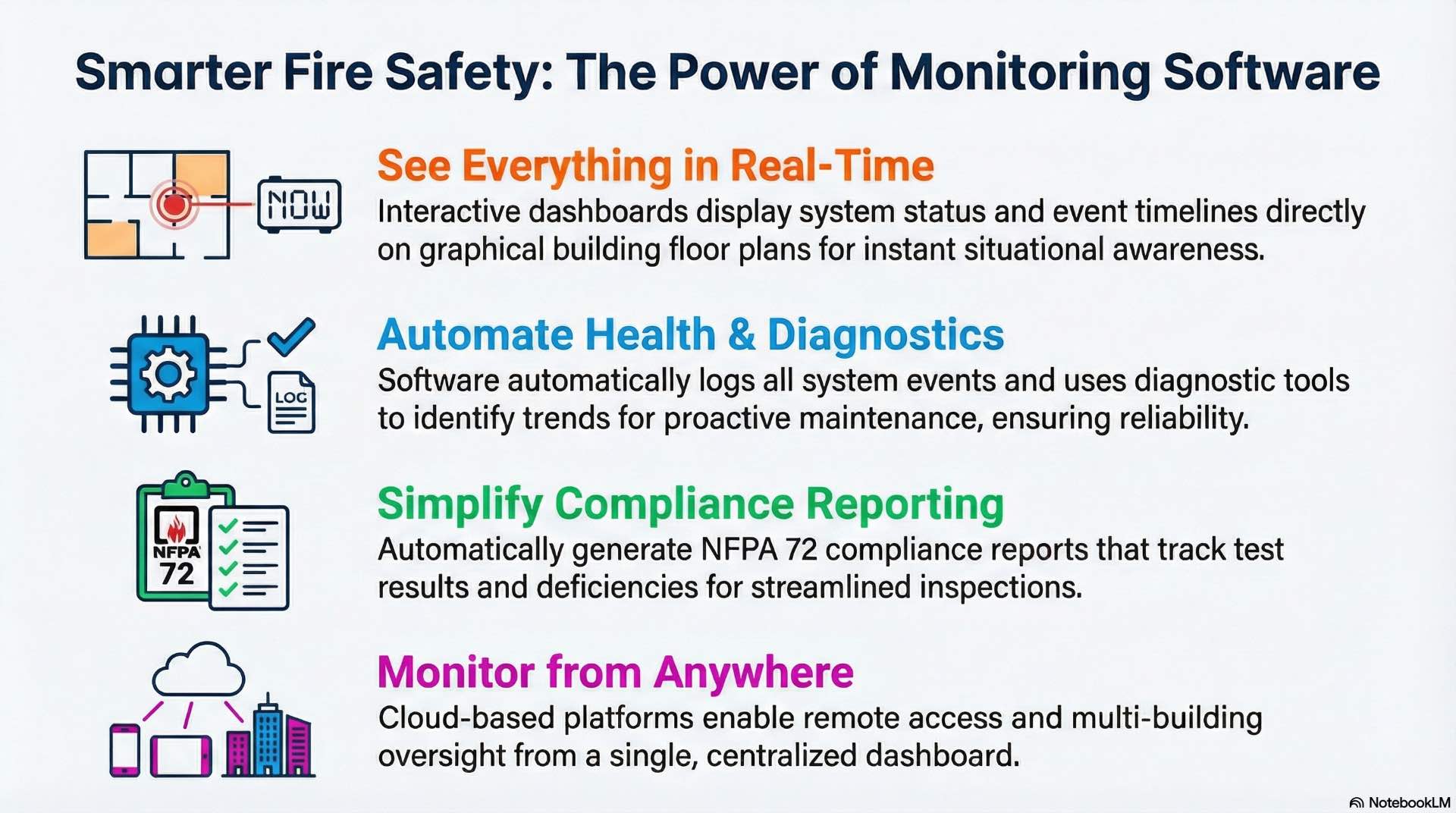
Software platforms enhance system management capabilities for building operators and facility managers significantly. Monitoring dashboards display status graphically on building floor plans for situational awareness. Software tools improve efficiency through automation.
Real-time dashboards and event monitoring
Dashboards display system status graphically for operator awareness on interactive floor plans with zoom capabilities. Event timelines show activity chronologically for investigation. Mobile applications extend monitoring remotely.
Fault logs, diagnostics, and system health tracking
Event logs record all activity with timestamps for compliance documentation and incident investigation. Diagnostic tools identify trends for proactive maintenance before failures occur. Health monitoring ensures reliability.
Maintenance reporting and compliance documentation
Automated reporting generates NFPA 72 documentation for authority review during inspections. Reports track test results and deficiencies for corrective action planning. Compliance tools ensure records meet requirements.
Evacuation management workflows
Evacuation platforms coordinate emergency response with occupancy information for accountability tracking. Workflow automation triggers appropriate responses based on alarm locations. Different zones activate appropriate sequences automatically.
API and SDK-based integrations
APIs expose system data to external applications for unified facility management operations. Integration platforms enable centralized dashboards through data consumption. Custom applications extend capabilities.
Cloud-based fire alarm monitoring
Cloud platforms enable remote access from any internet connection for monitoring flexibility. Cloud monitoring provides multi-building oversight from centralized dashboards. Remote capabilities improve management efficiency.
Fire Alarm Installation and Commissioning Standards
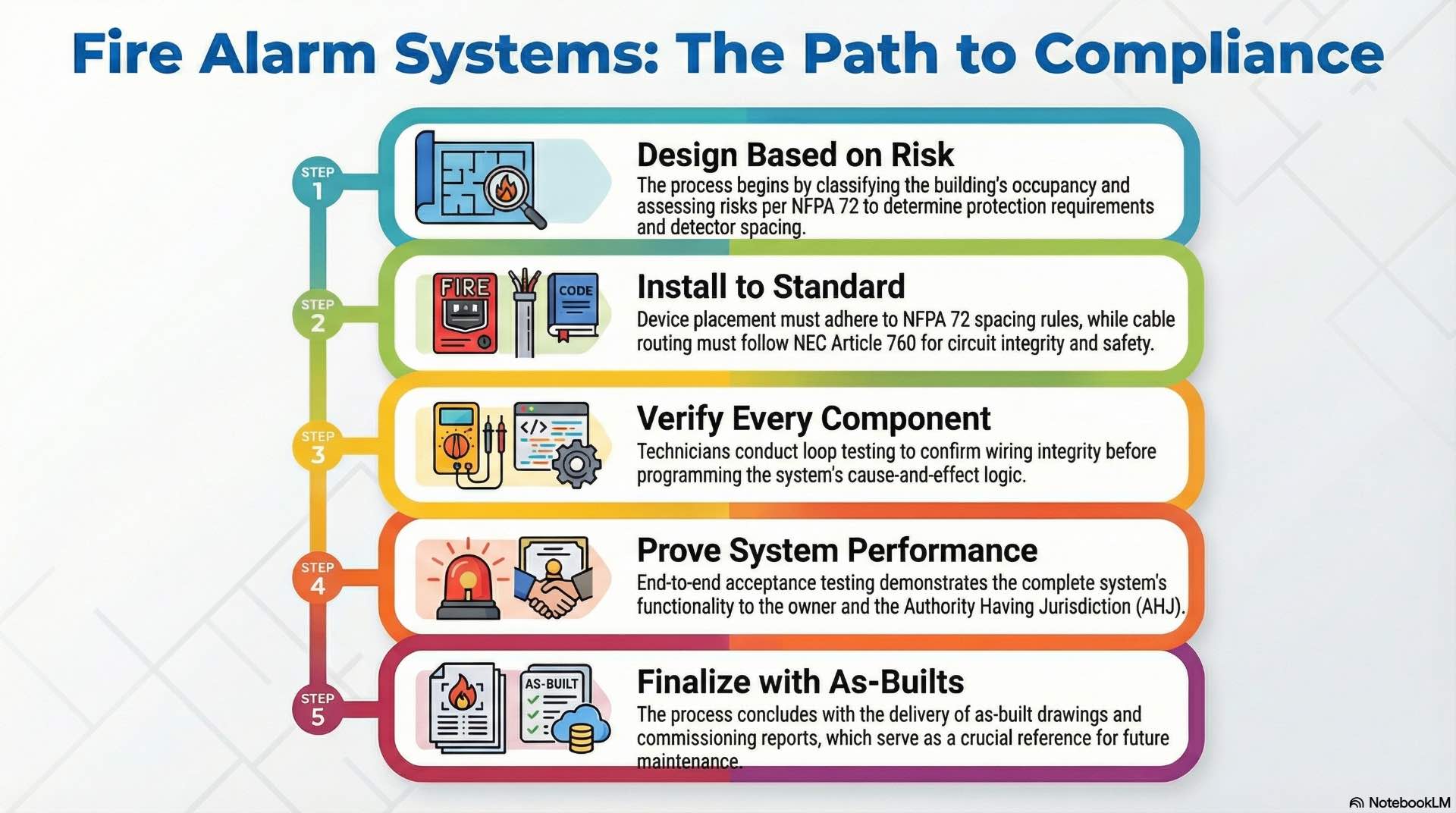
Proper installation ensures designed performance throughout operational life in protected buildings. Installation standards govern device placement and wiring practices comprehensively. Following codes ensures compliance with regulatory requirements.
Design methodology and risk assessment
Fire alarm design begins with occupancy classification and risk assessment per NFPA 72. Risk categories determine detection requirements based on occupancy type and hazard level. Assembly occupancies require different protection than storage facilities. Detector spacing calculations account for ceiling height and configuration using NFPA 72 tables and manufacturer listings for safety coverage.
Detector placement rules and spacing standards
NFPA 72 establishes fire alarm spacing requirements for comprehensive coverage. Standard smoke spacing allows 30 feet maximum with 15-foot wall distances. Placement accounts for obstructions and airflow patterns. Beam pocket and joist configurations require modified spacing per code annexes for proper detection.
Cable routing, circuit segregation, and fire-resistant wiring
NEC Article 760 governs cable installation practices in buildings. Power-limited circuits require separation from line-voltage conductors. Fire-resistant cables maintain circuit integrity during exposure. Pathway survivability Level 2 and Level 3 require protected raceways or listed cables.
Loop testing, addressing, and system programming
Loop testing verifies wiring before device connection during installation. Testing confirms circuit specifications are met for proper operation. Programming configures cause-and-effect sequences. Cause-and-effect matrices document all input-output relationships for safety.
Sensitivity calibration and functional verification
Testing verifies sensor response characteristics match design requirements for each application. Calibration adjusts sensitivity for environmental conditions in protected spaces. Functional tests confirm device operation.
Commissioning workflow and acceptance
Commissioning follows structured workflows from pre-functional through functional testing phases. Pre-functional testing verifies wiring and power before device energization. Functional testing confirms detection and notification operation under simulated alarm conditions. Acceptance testing demonstrates complete system performance to owners and authorities having jurisdiction per NFPA 72 Chapter 14.
End-to-end acceptance testing
Acceptance testing demonstrates complete functionality for owners and authorities having jurisdiction. Testing includes alarm initiation from multiple points throughout protected buildings. Verification ensures compliance before occupancy.
As-built documentation and commissioning reports
As-built drawings document final configurations for future maintenance reference. Documentation provides system reference for maintenance activities and troubleshooting. Commissioning reports record test results including sensitivity measurements.
Fire Detection Operations, Inspection, and Maintenance Lifecycle
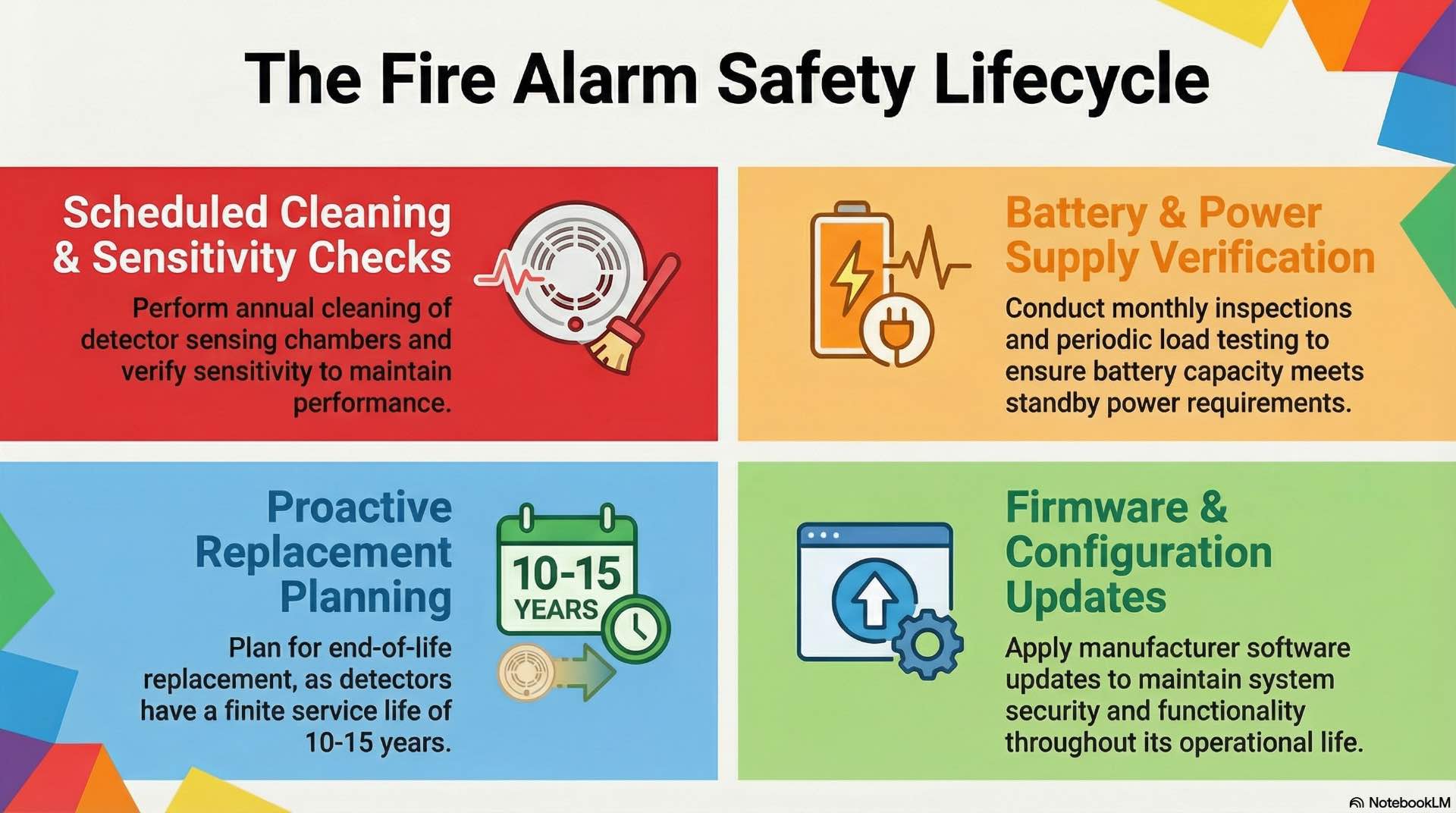
Ongoing maintenance ensures continued functionality throughout service life in protected buildings effectively. Regular testing maintains reliability for occupant protection during emergencies. Neglected systems may fail when protection is needed most.
Scheduled detector cleaning and sensitivity checks
Sensors accumulate contamination over time affecting performance characteristics significantly. Annual cleaning maintains performance by removing debris from sensing chambers. Sensitivity testing verifies response remains within acceptable parameters.
Battery testing and power supply verification
Monthly inspections confirm battery condition and terminal connections for proper operation. Load testing verifies capacity meets standby requirements under discharge conditions. Power verification ensures reliability during outages.
Firmware updates and configuration management
Manufacturers release software updates periodically addressing vulnerabilities and improving functionality. Updates maintain system security and functionality throughout operational life. Configuration management tracks changes with documentation.
Fault diagnosis and troubleshooting techniques
Systematic troubleshooting isolates problems efficiently using diagnostic equipment. Diagnostic tools include ground fault locators and loop analyzers for circuit testing. Event analysis identifies fault patterns for correction.
False alarm reduction practices
False alarms waste resources and create occupant complacency over time negatively affecting response effectiveness. Analysis identifies nuisance activation causes for corrective action implementation. Sensitivity adjustments reduce false alarms through careful calibration.
End-of-life device replacement planning
Components have finite service lives regardless of testing results showing acceptable performance. Sensors require replacement after 10-15 years based on manufacturer recommendations. Proactive planning ensures continuity through scheduled replacements.
Fire Safety Codes and Regulatory Compliance Requirements

Codes establish minimum requirements for building protection in occupied facilities. NFPA 72 governs fire alarm design and installation comprehensively for all occupancies. Code compliance ensures conformance with jurisdictional requirements.
Local codes and international standards (EN 54, NFPA)
NFPA 72 serves as primary North American standard for fire alarm systems comprehensively. This code addresses requirements for all occupancies including commercial, residential, and industrial buildings.
EN 54 provides European fire alarm standards through multiple parts covering specific components. EN 54-2 governs fire alarm control panels while EN 54-5 covers heat detectors. EN 54-7 addresses smoke detectors and EN 54-11 covers manual call points. EN 54-23 specifies visual alarm devices with coverage requirements based on room dimensions and mounting height. Category classifications in EN 54 define protection levels from L1 through L5 for life safety and P1 through P2 for property protection.
Fire detection zoning for evacuation
Zoning strategies support phased evacuation in high-rise buildings per NFPA 72. Alarm zones align with smoke compartments and floor boundaries for coordinated response. Adjacent floor notification allows phased evacuation reducing stairwell congestion. Detection zones enable precise alarm localization while notification zones control speaker and strobe activation patterns for safety.
Impairment procedures and documentation
System impairments require documented procedures per NFPA 72. Impairment coordinators notify authorities and implement fire watch when detection systems go offline. Preplanned impairment procedures minimize safety exposure during maintenance. Documentation tracks impairment duration and compensating measures for authority review.
Evacuation workflow and notification requirements
Notification requirements specify sound levels and coverage patterns throughout protected buildings per code. Visual devices meet requirements for hearing-impaired occupants per ADA.
Testing intervals and maintenance documentation
NFPA 72 specifies testing frequencies for components including monthly and annual requirements. Testing requirements apply to various devices throughout systems. Documentation demonstrates compliance for authority review.
Safety certifications and audit trails
Listed equipment meets testing laboratory standards for performance and reliability. UL listing indicates equipment compliance with applicable requirements. Audit trails document modifications for verification.
Emergency preparedness and building safety policies
Emergency plans integrate fire alarm procedures with building response strategies for coordinated action. Drills verify effectiveness under simulated conditions.
Properly designed fire alarm systems provide critical protection through coordinated sensing, processing, and notification components working together. Early detection technology ensures reliable warning matched to specific building environments and hazard types present. Maintaining fire alarm compliance and safety standards throughout operational life ensures systems perform reliably when emergencies occur.