
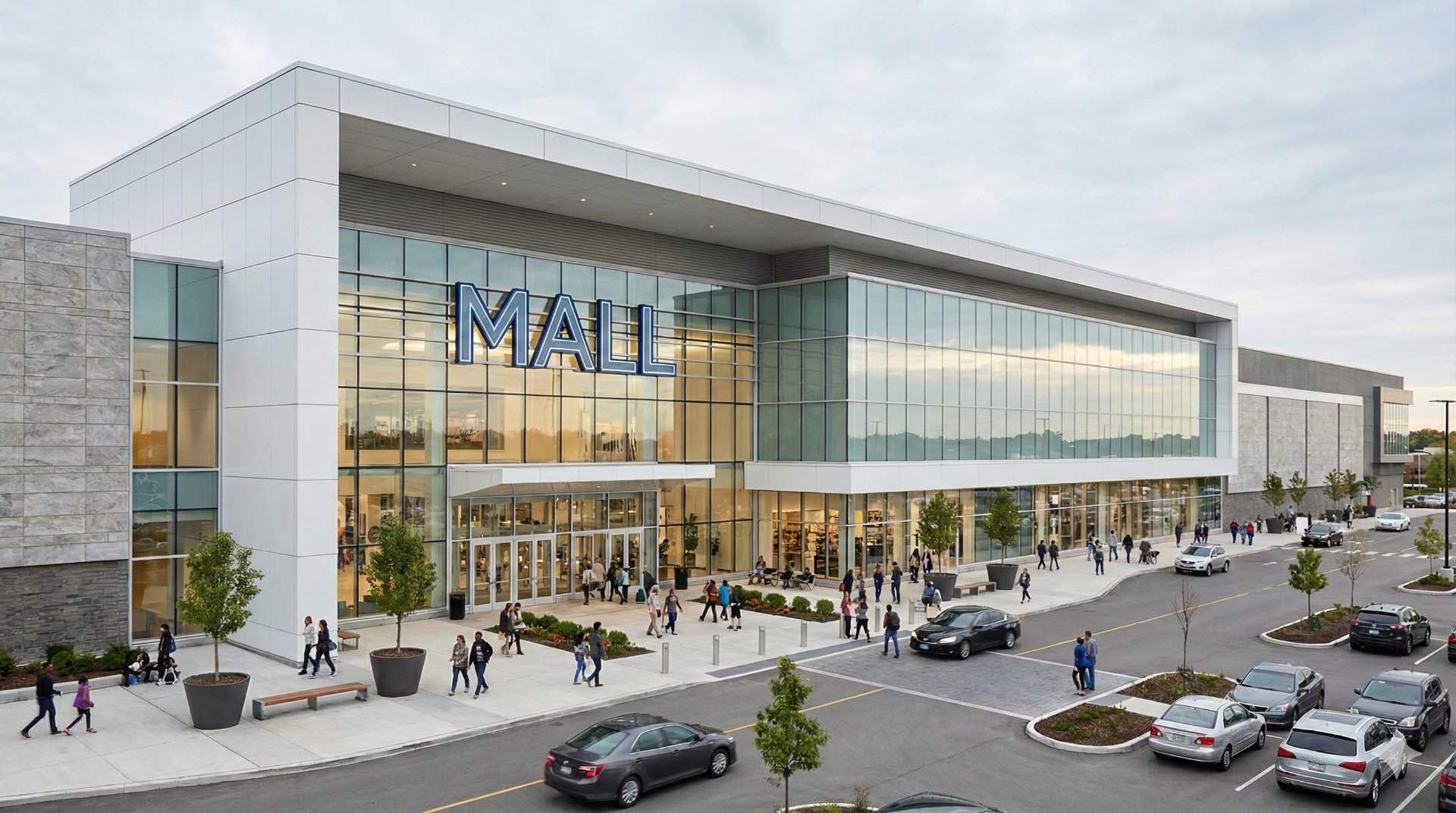
Fire alarm solutions for shopping mall and retail complex sites strengthen life safety with fast fire detection that protects visitors, staff, and assets.
Fire alarm systems in shopping mall and retail complex demand more than simple smoke detectors. These high-occupancy environments see thousands of visitors daily. They combine multiple tenants with varying fire loads. A properly engineered system provides rapid fire detection and clear notification. It integrates automatically with building safety systems and adapts as tenants change. This article explains the core fire risks in these sites, describes essential system components, and outlines best practices for zoning and integration to keep life safety strategies robust, compliant, and effective.
What Fire Risks And Requirements Do Shopping Malls Have?
Typical Fire Hazards In Malls And Retail Complexes
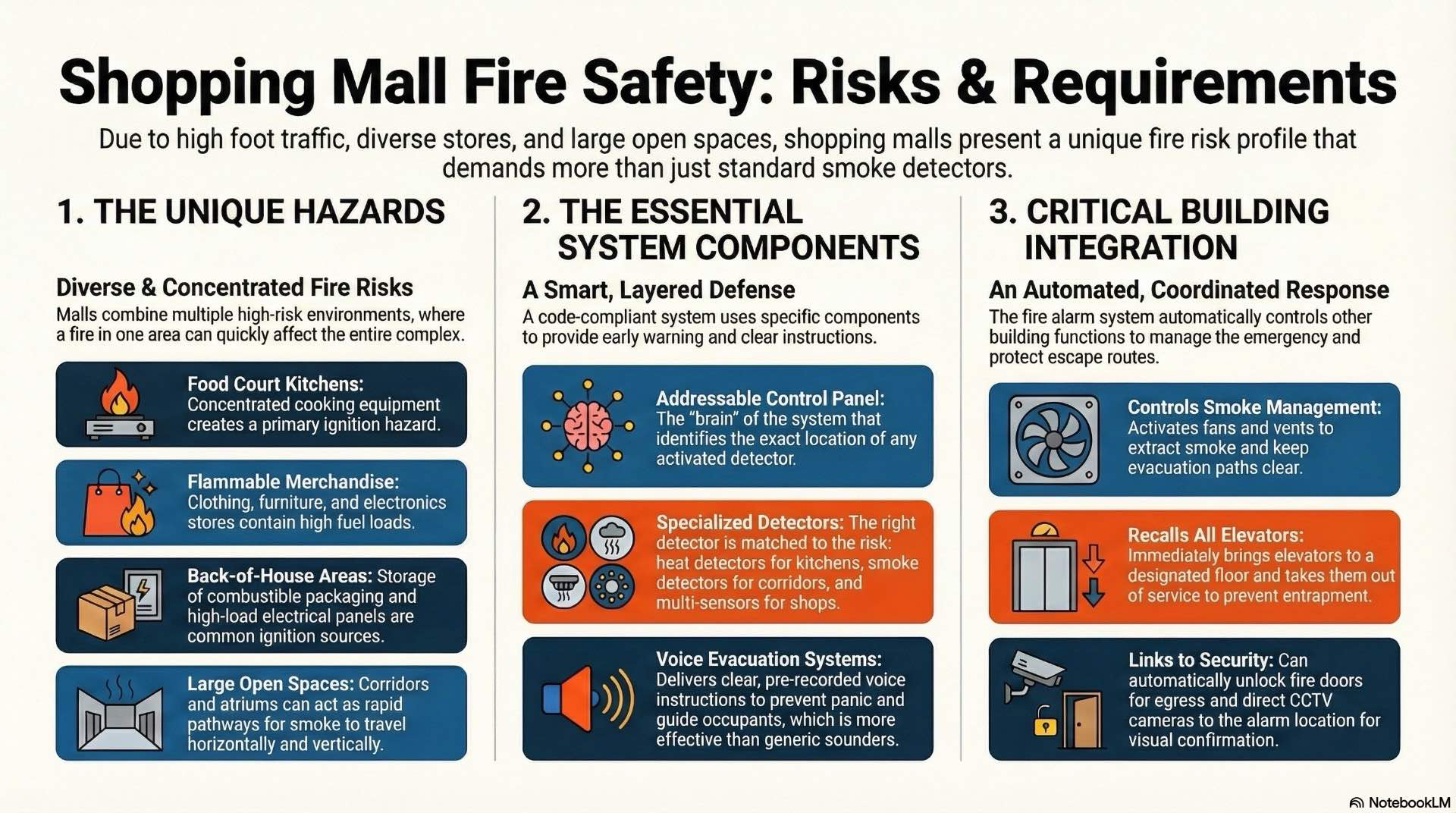
A shopping mall or retail complex has a unique fire risk profile. High occupancy, diverse tenant activities, and large open spaces all drive that risk.
Food courts contain cooking equipment as the most obvious hazard. Clothing and furniture stores hold flammable merchandise. Additionally, lighting and HVAC systems create constant electrical loads.
Back-of-house areas contain cardboard storage and delivery bays with combustible packaging. Electrical panels can be ignition sources. Meanwhile, anchor tenants like department stores may have high-bay racking or refrigeration equipment.
Common corridors and atriums act as vertical or horizontal smoke pathways. As a result, a fire in one shop can quickly affect adjacent zones.
Recognizing these hazards is the first step. Your fire detection system must detect smoke or heat early. Furthermore, it must trigger the correct response before conditions deteriorate. Effective fire detection in a retail complex saves lives.
Basic Fire Alarm And Code Requirements
Most jurisdictions require fire alarm systems in shopping malls to comply with fire codes. In the United States, NFPA 72 provides the standard. Similarly, EN 54 standards apply in Europe. These codes specify detector spacing and notification appliance coverage. They also mandate integration with sprinkler systems and emergency voice communication. Life safety is the primary focus of these regulations.
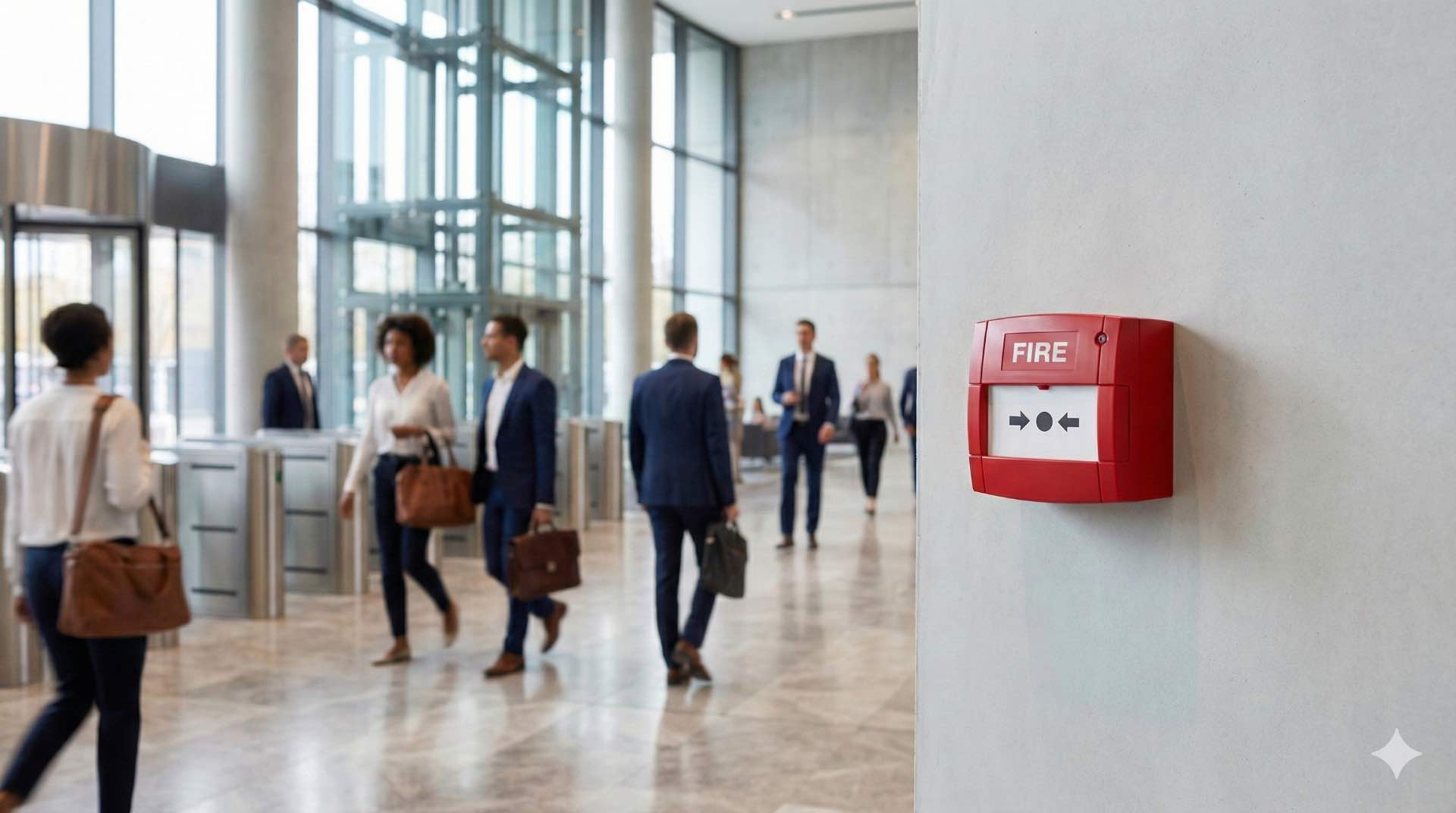
A typical mall must have automatic detection in all public areas. This includes shops, corridors, service spaces, and car parks. Every retail complex requires comprehensive coverage. Designers must place Manual call points near exits. Moreover, the system must provide occupant notification through sounders or voice evacuation speakers.
Integration with the building’s fire suppression, smoke control, and elevator recall functions is essential. In large or multi-level complexes, authorities may mandate phased evacuation. This approach prevents panic and congestion.
Local codes may impose additional requirements. For example, specific detector types in kitchens or enhanced notification for cinema auditoriums. Compliance is not optional. Rather, it forms the legal and operational baseline for any retail complex fire alarm design.
Life Safety Goals For Visitors Staff And Assets
The primary goal of a shopping mall fire alarm system is protecting human life and supporting life safety. Early warning and orderly evacuation are essential for life safety. This means detecting smoke or heat before it reaches untenable levels. Fast fire detection gives occupants time to evacuate safely.
The system delivers clear instructions to occupants. In addition, it coordinates with other building systems to facilitate safe egress. Staff training and regular fire drills reinforce these technical measures.
Beyond life safety, the system also protects property and business continuity. Fast, accurate alarms reduce response time. Consequently, sprinklers activate sooner. Fire services arrive faster. The system limits fire spread and smoke damage.
For retail tenants, this means less downtime and lower repair costs. The system protects stock and fixtures. For mall owners, it safeguards long-term asset value and reputation.
A well-designed system balances these life safety and asset protection goals. Overall, detection, notification, and response work together seamlessly.
Which Components Are Essential In Malls?
Control Panels And System Architecture
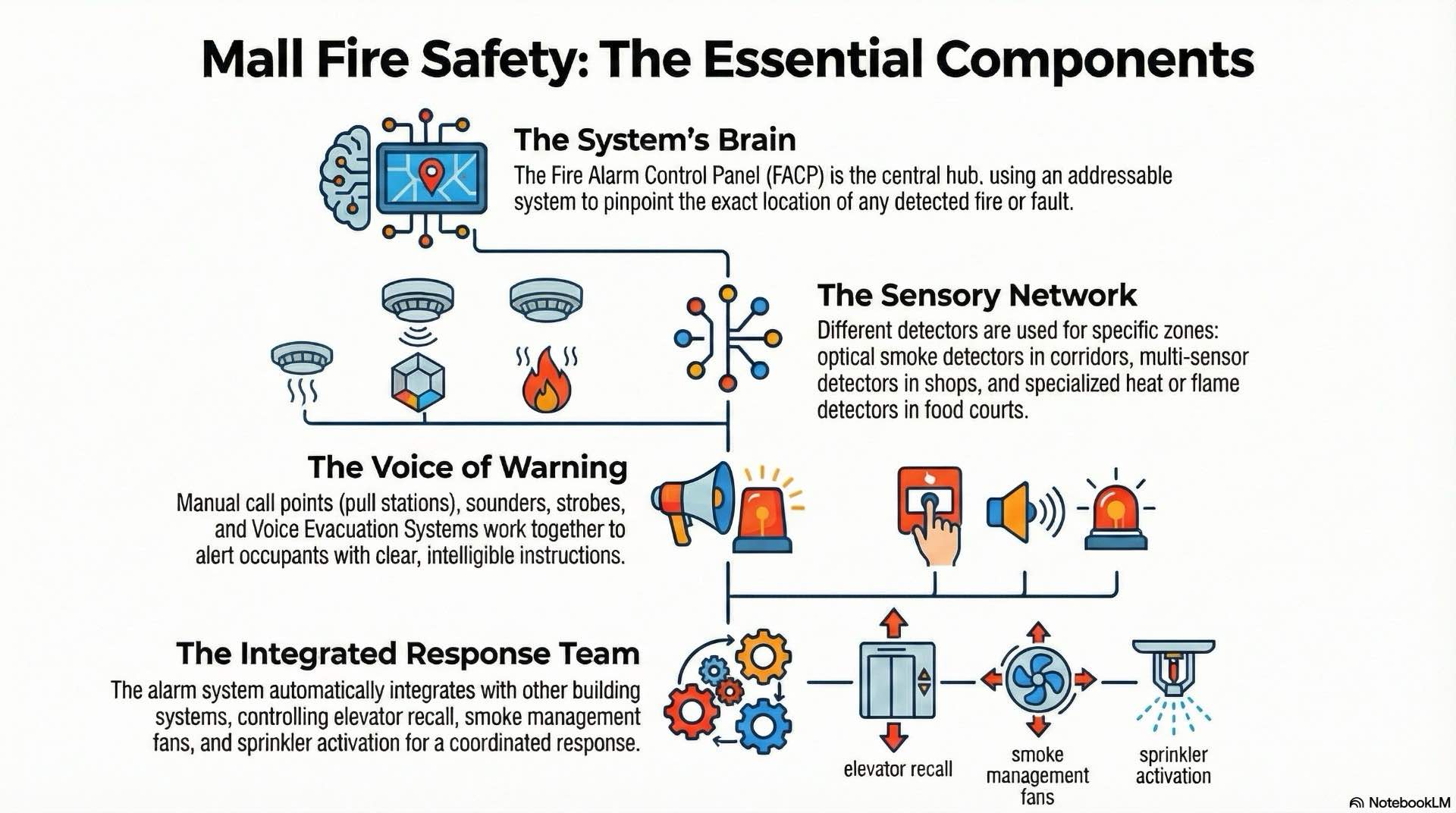
The fire alarm control panel (FACP) is the brain of the entire system. In a shopping mall, this is typically an addressable system. Such systems can identify the exact location of each detector or manual call point.
Addressable architecture is essential in large, multi-tenant sites. Specifically, it speeds up fault diagnosis. Moreover, it allows granular control of notification devices.
The FACP receives inputs from detectors and call points. Then, it processes the alarm logic. Finally, it triggers outputs such as sounders, voice evacuation speakers, sprinkler flow switches, and elevator recall.
In very large or phased projects, designers may use a distributed architecture. Multiple panels link over a network.
Operators must locate the FACP in a secure, accessible area. A fire command center is typical. Additionally, the panel needs a dedicated power supply and battery backup. Its programming must reflect the mall’s zoning strategy, evacuation plan, and integration with other building systems.
Regular functional testing of the panel ensures it remains the reliable hub that coordinates all fire detection and life safety actions.
Detectors In Corridors Shops And Back Of House Areas
Detector selection and placement are critical for reliable fire detection. You need fast, dependable response without excessive false alarms.
In common corridors and public malls, designers typically use optical smoke detectors. These detectors respond well to smoldering fires. Furthermore, they are less prone to false alarms from dust or steam.
Shops themselves require detectors spaced according to code and ceiling height. Engineers often choose multi-sensor detectors combining smoke and heat. This reduces nuisance alarms from cooking or steam in adjacent food outlets.
Back-of-house areas like storage rooms, loading docks, and plant rooms benefit from heat detectors. Alternatively, smoke detectors with higher sensitivity thresholds also work.
Kitchens and food preparation areas in food courts need specialized heat detectors or flame detectors. Smoke detectors would trigger constantly. In cinemas, high-sensitivity smoke detection provides early warning. However, it doesn’t disrupt screenings. Proper fire detection in these zones prevents both missed alarms and false alerts.
The key is matching the detector type to the expected fire signature. It must suit the ambient conditions in each zone. As a result, the system detects real threats early. It minimizes false alarms that disrupt business.
Manual Call Points Sounders And Voice Evacuation
Codes require manual call points (also known as pull stations) at strategic locations. Designers should locate them at all exits. Place them along escape routes. Include them at key decision points such as stair landings and fire doors.
In a multi-level mall, occupants may encounter a call point every 30 to 50 meters. Therefore, they can quickly raise an alarm if they discover a fire.
Notification devices are equally important. Sounders, strobes, and voice evacuation speakers alert occupants. In large, acoustically complex malls, codes often mandate voice evacuation systems.
These systems provide clear, intelligible instructions. They reduce confusion. Additionally, they facilitate phased evacuation. Designers use sounders as backup or for smaller retail units.
All notification devices must meet minimum sound pressure levels and visibility requirements. Specifically, strobes ensure accessibility for people with hearing impairments.
The system’s ability to deliver clear, authoritative instructions during a fire is critical. It transforms raw fire detection into an effective life safety response. These notification systems are the final link in the life safety chain.
How Should Fire Alarm Coverage And Zones Be Designed In A Mall?
Separating Common Areas Shops And Anchor Tenants
Effective fire alarm design requires careful zoning. This is especially true in a shopping mall or retail complex. Zoning must reflect the building’s layout, tenant boundaries, and evacuation strategy.
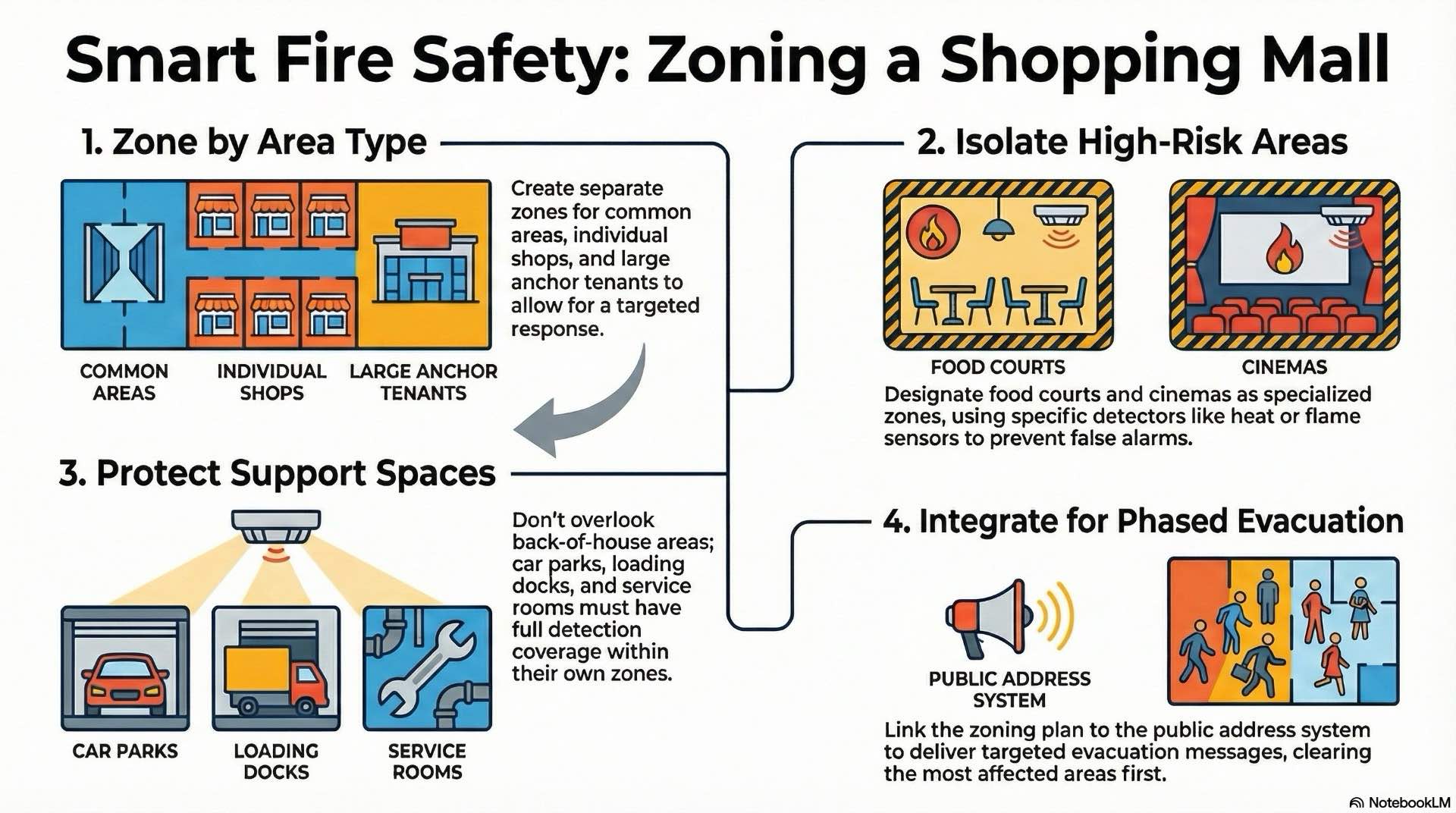
Designers typically designate common areas such as public malls, corridors, and atriums as separate zones. Consequently, the system can alert all occupants simultaneously if a fire is detected in these shared spaces.
Engineers often treat individual shops as sub-zones. Each has its own set of detectors and notification devices. This zoning strategy allows for targeted response.
If a fire starts in a single shop, operators can confine the alarm to that unit and adjacent corridors. Therefore, staff get time to investigate before triggering a building-wide evacuation.
Anchor tenants like department stores or supermarkets may operate as independent zones. They may have their own FACP or sub-panel. Such arrangements interface with the main mall system.
This separation simplifies tenant fit-out and commissioning. Overall system integration is maintained. The goal is creating a logical, manageable zoning structure for the retail complex. As a result, it supports fast, accurate alarm identification. It enables a controlled evacuation response.
Covering Food Courts Cinemas And Other High Risk Zones
Food courts and cinemas present unique fire detection challenges. Consequently, they require specialized zoning and detector selection.
In food courts, cooking equipment is concentrated. Grease fires are a potential risk. Engineers prefer heat detectors or flame detectors over smoke detectors. Designers should isolate the food court from adjacent retail areas through proper zoning.
This allows for a localized alarm and response. Moreover, it avoids triggering unnecessary evacuation of the entire mall.
Cinemas are another high-risk zone. High occupancy, limited exits, and dark environments create challenges. Detection here must be highly sensitive. However, it must resist false alarms from popcorn machines or fog effects.
Engineers often use high-sensitivity smoke detection combined with multi-sensor technology. The cinema zone should integrate with the mall’s voice evacuation system. It provides clear instructions to patrons. Guidance includes using alternative exits if the main entrance is compromised. Reliable fire detection is essential in these challenging environments.
Other high-risk zones include plant rooms, electrical switch rooms, and loading docks. Each requires specific detector types and zoning. Therefore, this ensures early detection and targeted response in every retail complex area.
Protecting Car Parks Loading Docks And Service Areas
Car parks, loading docks, and service areas are often overlooked in mall fire alarm design. Nevertheless, they present significant fire risks. They support critical business operations.
Multi-level car parks require smoke or heat detectors. Spacing follows ceiling height and ventilation patterns. Car parks are open to the weather. Vehicle exhaust is present. Engineers typically use heat detectors or specialized car park smoke detectors. Consequently, this avoids false alarms.
Loading docks are high-activity zones. Cardboard, pallets, and packaging materials accumulate. This creates a fire load. Detectors in these areas should be robust. Position them to avoid damage from delivery vehicles.
Service corridors, plant rooms, and electrical switch rooms require full detection coverage. A fire in these hidden areas can compromise the entire building. Comprehensive fire detection in service areas prevents catastrophic failures.
Designers should make each of these zones separately addressable on the FACP. As a result, security or facilities staff can quickly identify the alarm location. They can assess the situation.
Protecting these back-of-house areas is essential in any shopping mall or retail complex. It supports asset protection and business continuity. Furthermore, it also protects staff who work in less-visible parts of the retail complex.
How Do Fire Alarm Systems Integrate With Other Building Systems?
System Links To Evacuation And Public Address
In a shopping mall, the fire alarm system triggers a coordinated emergency response. Integration with the evacuation and public address (PA/VA) system is essential.
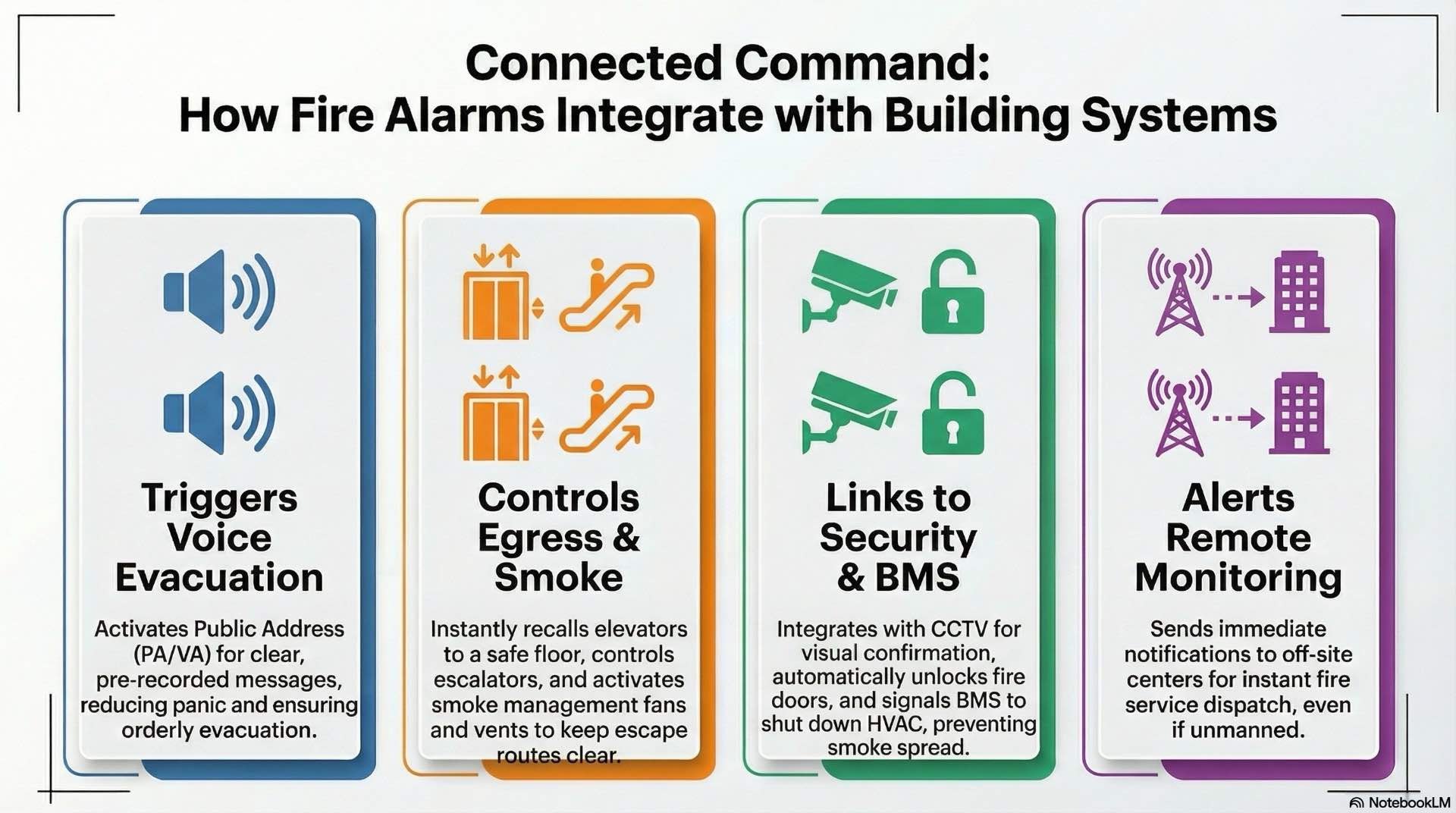
When the fire alarm activates, it automatically triggers pre-recorded or live voice evacuation messages. These messages play through the mall’s PA/VA speakers. They provide clear instructions. For example: “A fire has been detected on the first floor. Please proceed calmly to the nearest exit.”
This integration ensures occupants receive authoritative, consistent information. Panic is reduced. Orderly evacuation is supported. Clear communication is a cornerstone of life safety strategy.
In phased evacuation scenarios, the fire alarm system controls which zones receive which messages. The first and second floors evacuate. Meanwhile, upper floors are placed on standby.
Codes require the PA/VA system to be voice-alarm-compliant. EN 54-16 is one example standard. Speaker coverage must be sufficient to ensure intelligibility in all areas. This includes noisy food courts and high-ceiling atriums.
This integration transforms the fire alarm from a simple alert into a command-and-control tool. Overall, it actively manages the evacuation process. It prioritizes life safety messaging throughout the emergency.
Control Of Elevators Escalators And Smoke Management
When a fire alarm activates in a shopping mall, the system must automatically control elevators, escalators, and smoke management systems.
The system immediately recalls elevators to a designated recall floor. Then it takes them out of service. This prevents occupants from becoming trapped in a smoke-filled shaft. Most codes mandate elevator recall.
Operators may stop escalators to prevent use during evacuation. Alternatively, they may allow them to continue running to assist egress. This depends on the mall’s evacuation strategy.
Smoke management systems include smoke extract fans, pressurization fans, and automatic smoke vents. The fire alarm triggers these to control smoke spread. As a result, tenable conditions are maintained in escape routes.
For example, if a fire is detected in a shop, the fire alarm might activate smoke extraction in that zone. Adjacent corridors receive pressurization to prevent smoke migration.
These integrations typically connect through hardwired or networked links to the FACP. Operators individually monitor each output point for fault conditions.
The result is a coordinated, automatic response. Security staff remove occupants from danger zones. The system controls smoke movement. Additionally, fire service operations are supported. These systems work together to protect the retail complex during emergencies.
Integration With Security BMS And Remote Monitoring
Modern shopping malls increasingly integrate fire alarm systems with security, building management systems (BMS), and remote monitoring platforms. This improves operational efficiency. Response coordination is enhanced.
Integration with the security system allows CCTV cameras to automatically pan to the fire alarm location. Consequently, security staff get immediate visual confirmation. Access control systems can unlock all fire doors and turnstiles. This facilitates evacuation. Moreover, cash rooms and high-value storage areas receive simultaneous security.
Integration with the BMS enables automatic shutdown of HVAC systems. This prevents smoke spread. Facilities staff can remotely monitor the fire alarm system’s health and status. Real-time monitoring enhances life safety oversight.
Remote monitoring platforms send alarm notifications to off-site centers. Fire services and designated stakeholders receive immediate alerts. Therefore, help is dispatched immediately, even if the mall is unmanned.
Open protocols typically achieve these integrations. BACnet or Modbus are common examples. Alternatively, designers may use dedicated API connections.
The benefit is a holistic, coordinated response. All available building systems work together. As a result, occupants, assets, and business continuity are protected in the shopping mall or retail complex.
How Should Mall Fire Alarm Systems Be Operated And Improved?
Routine Testing Inspection And Maintenance
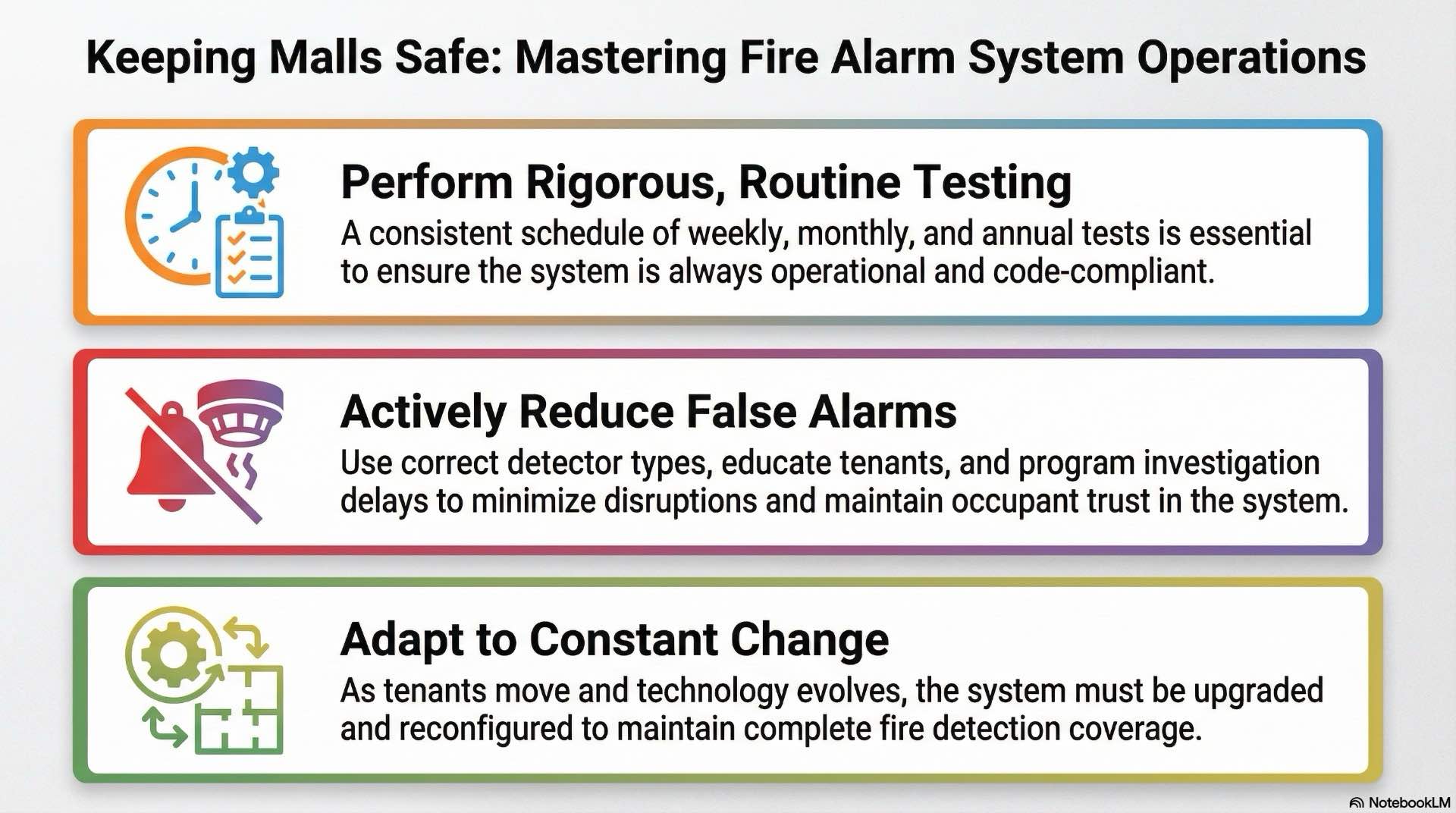
A fire alarm system in a shopping mall is only as reliable as the maintenance program behind it. Regular testing, inspection, and maintenance are essential to maintain life safety performance. The system must remain fully operational and code-compliant.
Technicians should perform weekly functional tests on a rotating basis. Check different zones, detectors, and notification devices each week. Monthly tests should include battery voltage checks and FACP indicator lamp tests. Additionally, verify backup power supply functionality.
Quarterly inspections should cover detector sensitivity testing and manual call point operation. Furthermore, check integration links to sprinklers, elevators, and smoke control systems.
Annual commissioning tests should be comprehensive. Involve a full system test under simulated alarm conditions. Include PA/VA intelligibility testing and evacuation drill coordination. These tests validate the entire life safety system.
Technicians must document all test results in a logbook. Fire authorities require access to these records for audits.
A proactive maintenance program ensures compliance and consistent life safety performance. It maximizes system uptime. Moreover, it reduces false alarms. It extends the lifespan of expensive components.
Reducing False Alarms In Busy Retail Environments
False alarms are a persistent challenge in shopping malls. The variety of activities, high occupancy, and environmental conditions all contribute. Common causes include cooking smoke from food courts and steam from bathrooms and cleaning. Dust during fit-out works is another trigger. Additionally, malicious activation of manual call points also occurs.
Reducing false alarms starts with correct detector selection and placement. Use multi-sensor or heat detectors in kitchens. Install smoke detectors away from steam sources. Regular detector cleaning and sensitivity testing ensure devices remain within tolerance.
Tenant education is critical. Shop staff should recognize the difference between a real fire and nuisance smoke. Moreover, they should know how to properly silence or investigate an alarm before evacuating the building.
Programmers should configure the FACP with investigation delays or confirmation logic. Security staff get a short window to verify an alarm. Full evacuation is delayed briefly. However, designers must carefully balance these delays against life safety requirements.
Remote monitoring and analytics can identify patterns in false alarms. Technicians can target a specific detector or zone that repeatedly activates. Maintenance or reconfiguration follows. Data-driven fire detection management improves reliability.
Reducing false alarms improves occupant confidence. Business disruption decreases. When a real alarm occurs, occupants take it seriously. Engineers balance sensitive fire detection with resistance to nuisance alarms. This balance keeps fire detection systems both reliable and trusted.
Upgrading Systems And Managing Tenant Changes
Shopping malls are dynamic environments. Tenants change. Fit-outs occur. Building uses evolve. Managing these changes in a retail complex while maintaining fire alarm system integrity requires careful planning. Configuration control is essential. When a new tenant moves in, technicians must extend the fire alarm system to cover their unit. This may involve adding detectors, notification devices, and manual call points. Engineers must reprogram the FACP to include the new zone. They must verify integration with the tenant’s fit-out. This includes sprinklers or kitchen suppression systems. Technicians should document all changes in the system’s as-built drawings and logbook.
Over time, aging components or obsolete technology may require system upgrades. This could involve replacing conventional detectors with addressable units. Engineers may upgrade the FACP to a newer model. Modern fire detection technology offers better accuracy and fewer false alarms. Migration to a networked architecture supports remote monitoring and BMS integration. Project managers should phase upgrades to minimize disruption. Additionally, they should time them to coincide with major tenant turnovers or building refurbishments.
A well-managed fire alarm system evolves with each shopping mall or retail complex. It ensures that life safety and fire detection measures remain effective and compliant as the building changes over years and decades.