


Choosing the wrong fire alarm system for a hotel can risk guest safety, cause false alarms, fail inspections, and result in legal and operational issues.
Hotels present unique challenges for fire alarm system design and installation that differ significantly from office buildings or industrial facilities. The combination of transient occupants, around-the-clock operations, and mixed-use spaces makes detection planning a critical priority for owners and design teams. Selecting the wrong system leads to nuisance alarms, inspection failures, and potentially dangerous evacuation delays. Poor hotel fire protection creates operational disruptions and regulatory problems. These failures create safety risks that expose operators to liabilityduring actual emergencies.
Detection strategies, zoning approaches, and integration requirements each affect regulatory compliance and daily operations differently. Understanding these variables helps project teams specify systems that perform reliably.
How fire risks differ in hotel and hospitality environments
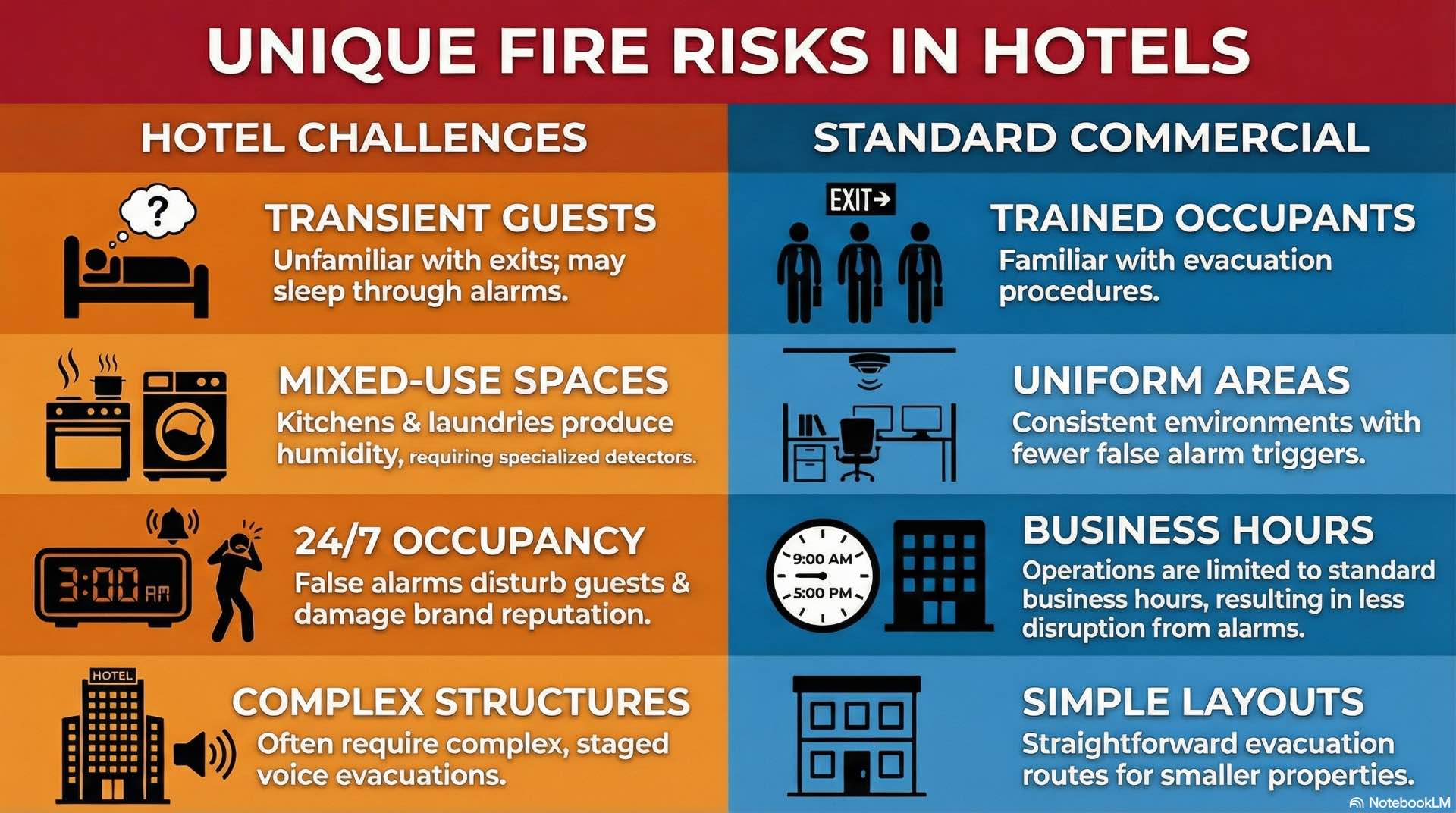
Hotels combine characteristics that make fire alarm design particularly complex. High-rise structures require staged evacuation and firefighter access controls that coordinate multiple building systems. Extended-stay properties may have kitchenettes in guest rooms. These units introduce cooking-related sources that complicate detection. Standard smoke detectors struggle to distinguish normal cooking from actual emergencies in these spaces.
Guest behavior adds unpredictability. Travelers may sleep through initial fire alarm activations. They may struggle to locate exits in unfamiliar corridors. Language barriers affect response to voice instructions. These factors mean notification systems must provide clear safety guidance without relying on prior building familiarity.
Building construction varies widely. Historic properties often lack fire-rated compartmentalization. They present retrofit challenges for modern fire alarm equipment installation. New construction follows current codes. It requires coordination between alarm and sprinkler systems along with building automation interfaces.
Back-of-house areas generate most false alarm sources. Commercial kitchens produce smoke and steam during normal operations. Laundry facilities create humidity and particulates. These environmental factors affect detector performance throughout adjacent spaces and require careful equipment selection.
Why choosing the wrong fire alarm system creates safety and legal risks
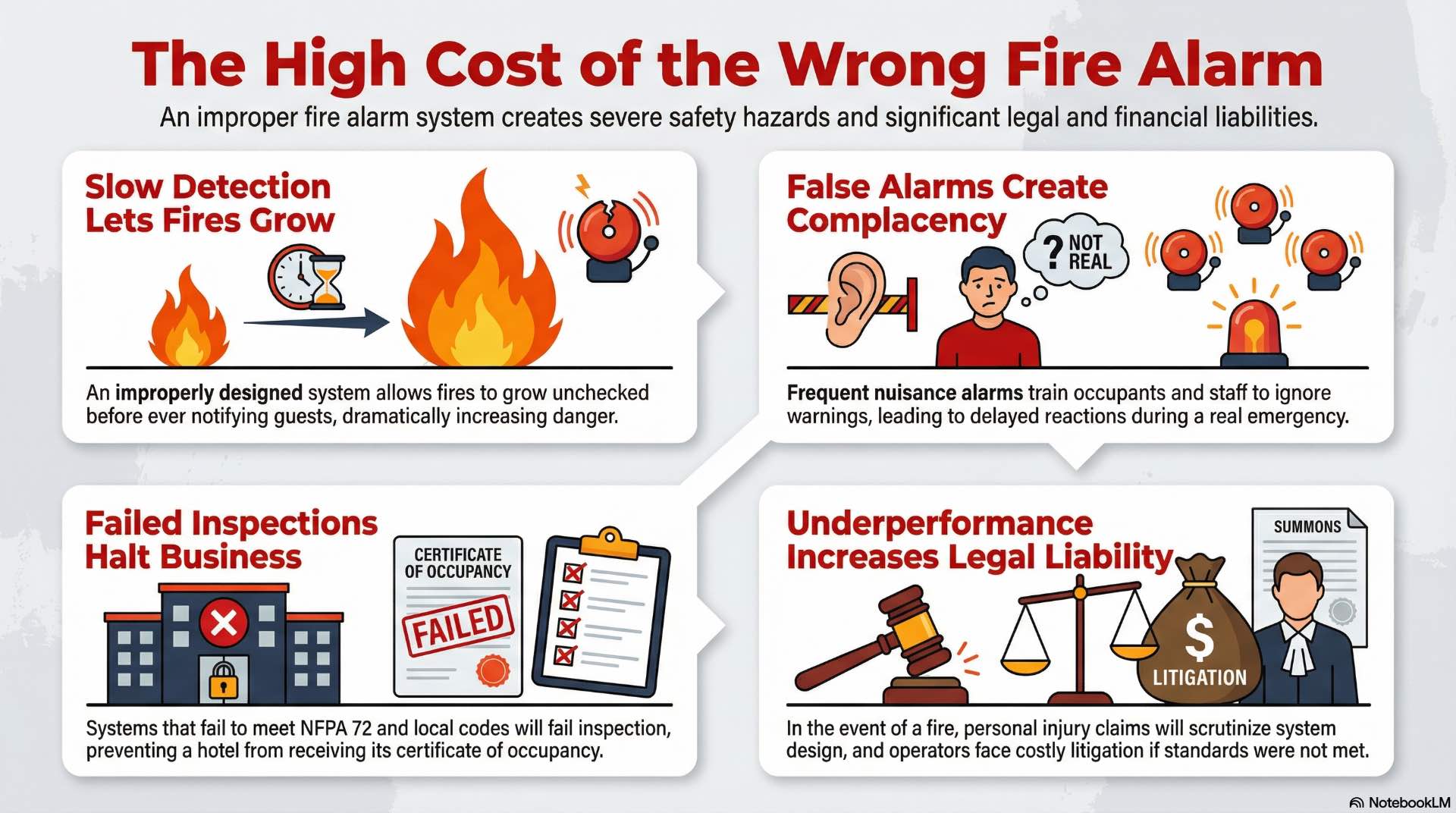
An undersized or improperly designed fire alarm system creates immediate safety hazards. Slow detection allows fires to grow unchecked before notification reaches occupants. Inadequate notification coverage leaves guests unaware of emergencies. Incompatible integration prevents automatic elevator recall or smoke control activation when needed most.
Nuisance alarms carry their own safety risks. Frequent false activations train occupants to ignore warnings. They delay response during actual emergencies. Fire departments may impose fines for repeat false calls. Insurance carriers may increase premiums or require corrective action.
Code compliance failures result in inspection holds. The authority having jurisdiction requires systems to meet NFPA 72 and local amendments before granting certificates of occupancy. Deficiencies found during inspection require costly corrections.
Liability exposure increases when systems underperform. Personal injury claims scrutinize whether the installation met applicable codes and industry standards during design. Documentation of fire alarm testing and maintenance becomes critical evidence in litigation.
Key factors to consider when choosing a fire alarm system for hotels
Building size, layout, and number of guest rooms
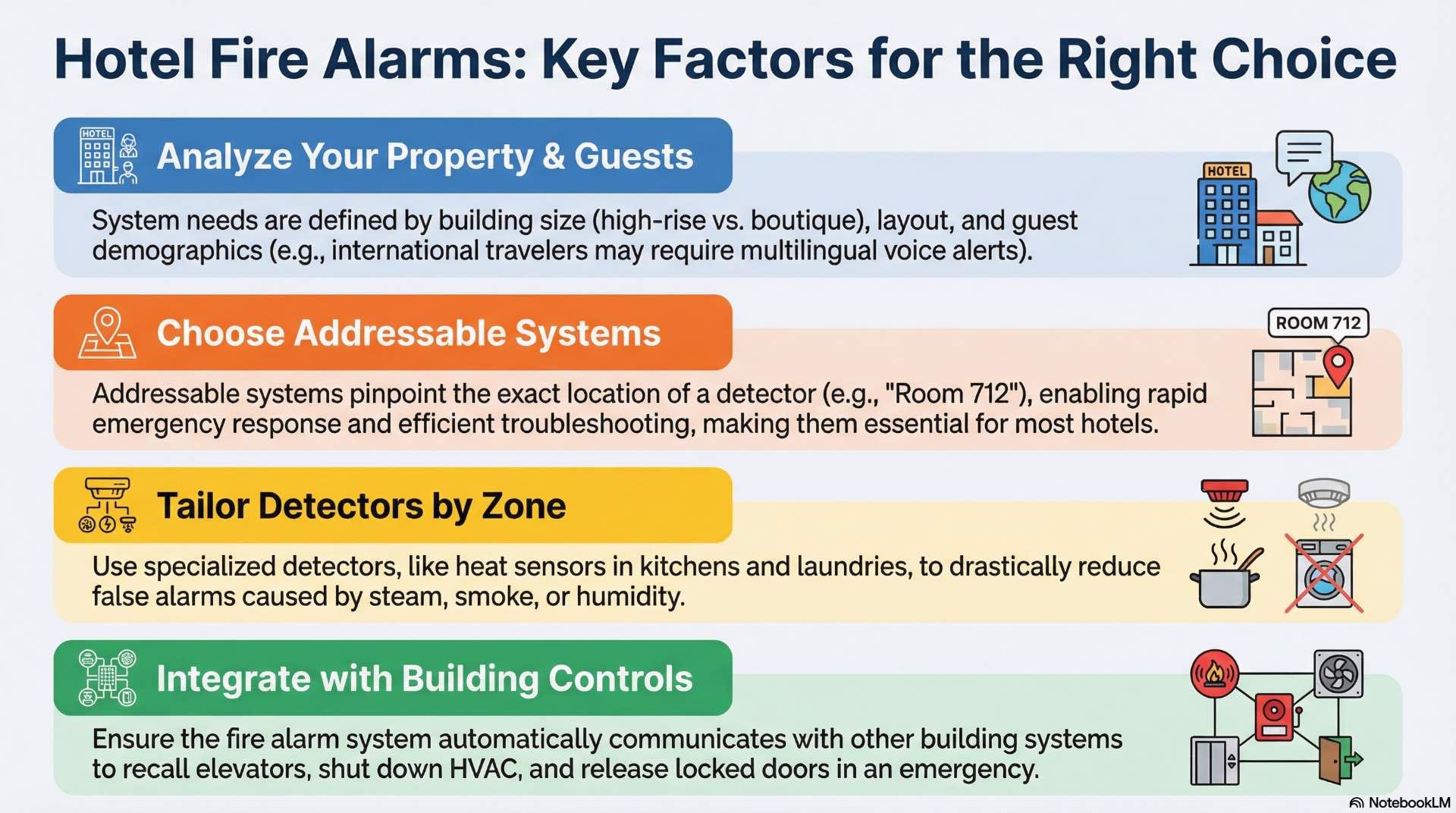
Building configuration directly influences system architecture. High-rise hotels exceeding 75 feet typically require voice evacuation per NFPA 72 requirements for occupant notification. Large footprint properties may need multiple control units with networked communication to coordinate response across buildings.
Guest room count determines initiating device quantities. A 200-room property requires smoke detectors in each room plus corridors and common areas. Duct detectors, pull stations, and waterflow switches push device counts to 500 or more.
Layout complexity affects zoning strategies. Properties with multiple wings require careful zone definition for effective emergency response. Guests must receive clear information about affected areas.
Occupancy levels and guest behavior
Peak occupancy varies by property type and season. Convention hotels experience dramatic swings between events. System design must account for maximum occupancy scenarios during emergency evacuation planning and egress calculations.
Guest demographics influence notification requirements. Properties serving international travelers may need multilingual voice messages for clear communication during emergencies. Hotels catering to hearing-impaired guests require visual notification appliances meeting ADA requirements.
Transient occupancy creates unique challenges. Guests rarely know exit locations. The system must provide clear actionable information that guides unfamiliar occupants to safety without prior training.
Operational continuity and false alarm tolerance
Hotels operate 24 hours daily. False alarms during overnight hours wake every guest. Repeated activations damage brand reputation significantly and generate negative reviews affecting future bookings.
Operational tolerance for nuisance alarms is essentially zero. Industrial facilities accept occasional false activations. Hotels face immediate guest impact requiring compensation and recovery efforts after each unnecessary evacuation.
Maintenance windows are limited. Most testing must occur during low-occupancy periods. Reliable equipment with extended maintenance intervals reduces operational burden.
Choosing the right fire alarm system type for hotels
When addressable fire alarm systems are required
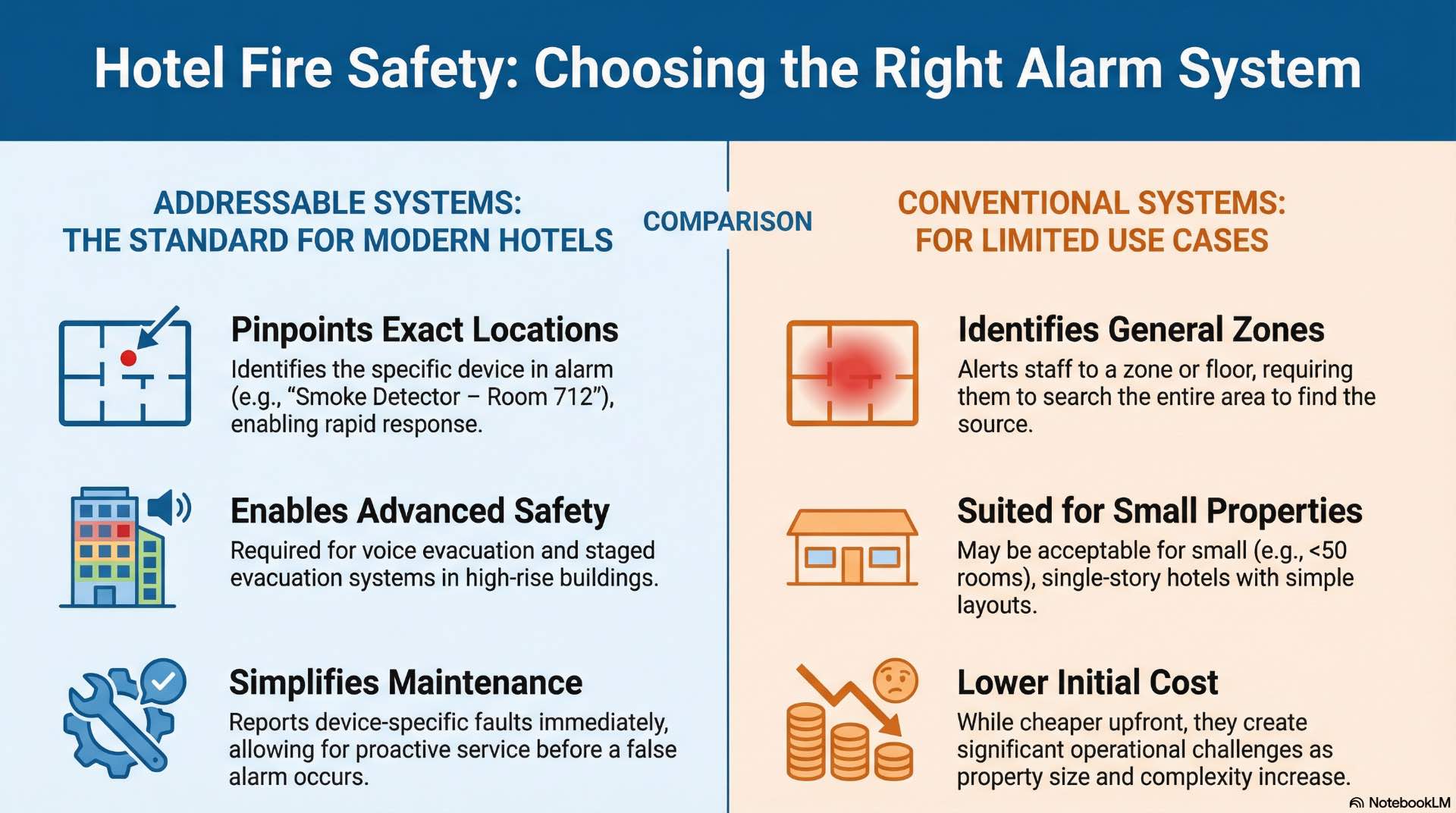
Addressable systems provide device-level identification essential for hotel applications and large properties. Each detector reports its unique address. Staff can identify exact locations immediately. A report of “smoke detector – room 712” allows direct response.
NFPA 72 requires voice notification in most high-rise hotels. Voice systems require addressable control architecturethat supports pre-signal investigation modes. The same infrastructure enables staged notification sequences.
Code requirements vary by jurisdiction. Many authorities require addressable systems in assembly occupancies. Properties exceeding size thresholds face similar mandates. Operational advantages make addressable systems practical for most applications regardless of code minimums.
Troubleshooting benefits justify the investment. Addressable systems report device-specific faults immediatelywithout floor-by-floor testing. Sensitivity readings allow proactive cleaning before contamination triggers false alarms.
When conventional systems may be acceptable
Small properties with simple layouts may function with conventional systems. Boutique hotels under 50 rooms with single-story construction and straightforward floor plans present limited locating challenges. Front desk staff provides immediate response capability.
Budget constraints sometimes drive conventional selection. Initial costs run 20-40% lower than addressable systems. Properties with planned short-term ownership may prioritize first costs.
Conventional systems suit limited applications. They create operational challenges at scale. Zone-level identification requires staff to search entire areas to locate activated devices.
Fire alarm zoning strategies that support safe evacuation in hotels
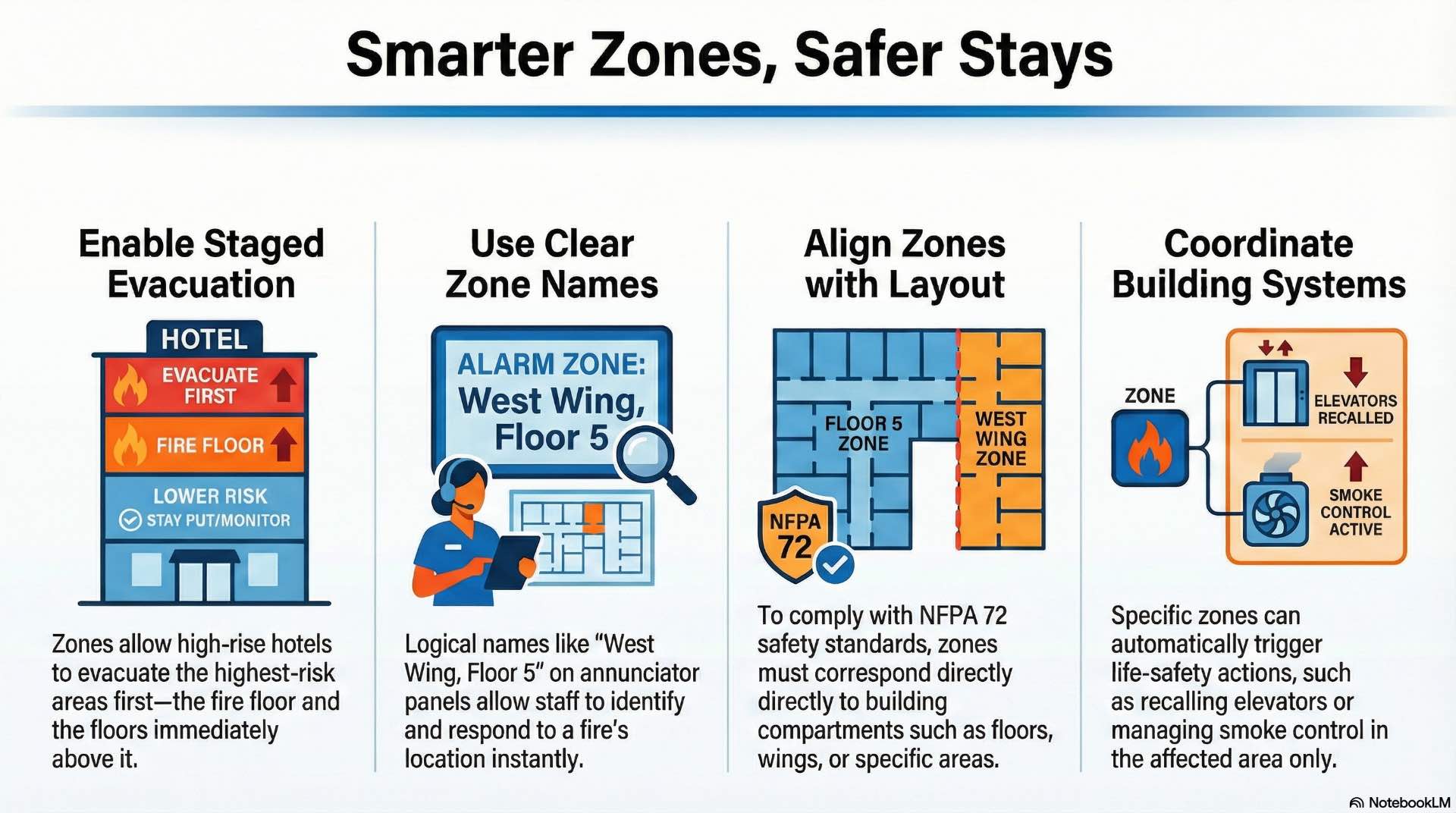
Proper zoning enables targeted safety response. NFPA 72 limits zone sizes and requires correspondence to building compartments. Hotels typically organize zones by floor. Large floors subdivide by wing or area.
High-rise properties need zones compatible with staged evacuation. The fire floor receives notification first. Floors immediately above evacuate before lower levels based on smoke travel. Voice fire alarm systems allow differentiated messaging by zone.
Annunciator displays depend on zone definition. Staff must quickly interpret locations from names. Logical naming conventions speed emergency response time significantly. Complex numbering schemes delay interpretation and slow reaction.
Elevator controls require coordination with fire alarm panels. Smoke detection in elevator lobbies triggers Phase Irecall to the designated floor. Different zones determine which elevators respond to specific detector activations.
Selecting fire alarm solutions for different hotel areas
Guest rooms and accommodation floors
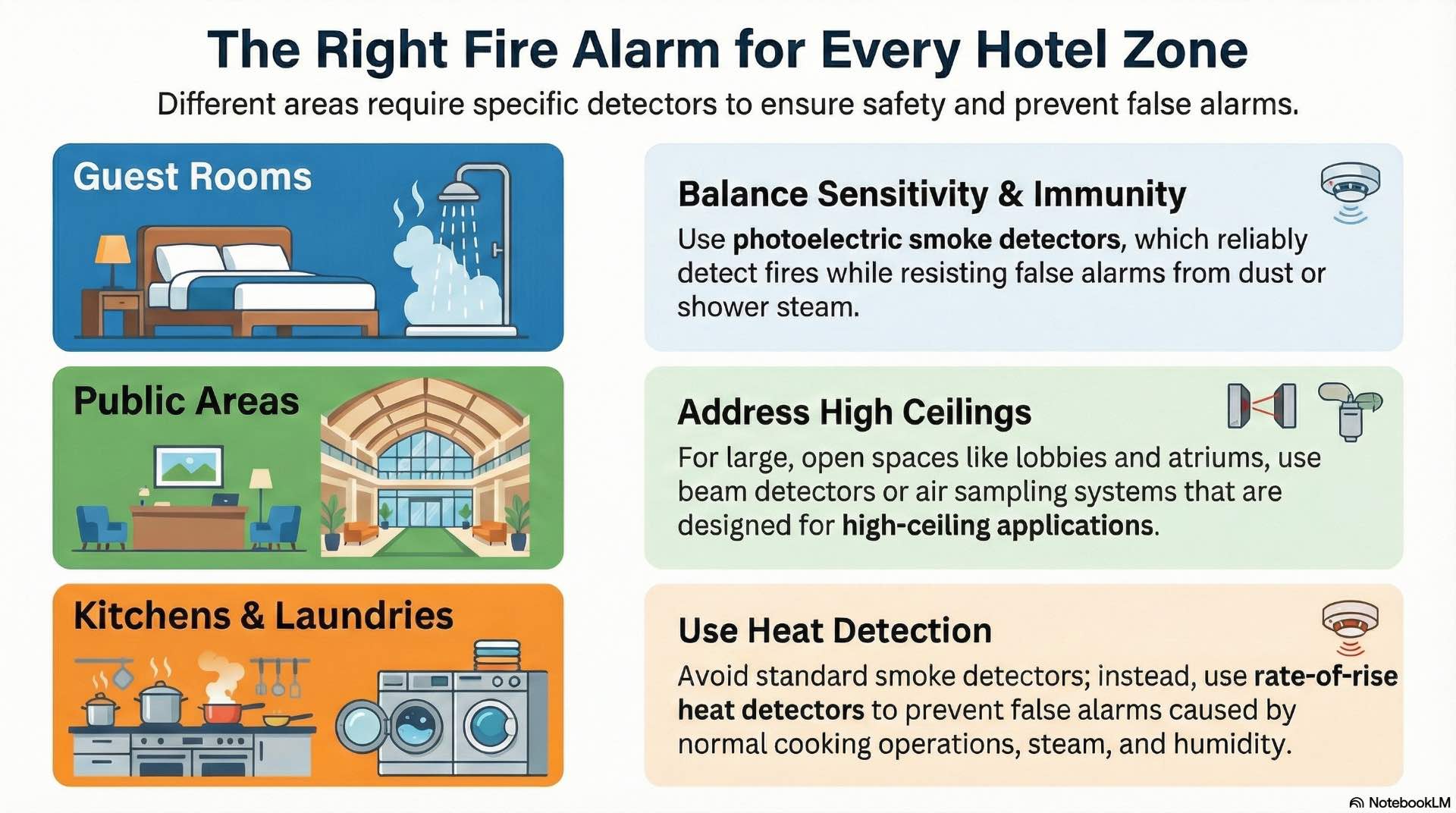
Hotel guest room detectors must balance sensitivity with nuisance immunity. Photoelectric smoke detectors provide reliable detection while resisting false alarms from dust. Placement must account for ceiling configurations and HVAC diffuser locations that affect smoke travel patterns.
Fire alarm notification appliances require ADA-compliant visual signals for hearing-impaired guests per accessibility codes. Properties must maintain inventories of auxiliary alerting devices.
Corridor detection follows NFPA 72 spacing requirements. Detectors locate at 30-foot intervals on smooth ceilingswith adjustments for beam construction.
Door holder devices keep corridor doors open during normal operations. Magnetic holders release upon fire alarm activation to maintain smoke compartmentalization during emergencies.
Lobbies, corridors, and public areas
Lobby spaces combine high ceilings with open floor plans. Ceiling heights above standard detector listings requirevalidated detection approaches. Beam detectors or air sampling systems suit high-ceiling applications in atriums and grand lobbies.
High occupant loads require enhanced notification. Speaker/strobe units with high candela ratings ensure visibility in crowded spaces. Audio intelligibility matters in reverberant environments.
Transition areas need detection without nuisance sources. Entrance vestibules experience temperature and humidity swings throughout the day. Environmental compensation prevents weather-related false activations.
Kitchens, back-of-house, and service zones
Commercial kitchen detection presents the greatest false alarm challenge. Standard smoke detectors activate from normal cooking operations generating steam and particles. NFPA 72 permits flame detectors or rate-of-rise heat detectors in cooking areas instead.
Laundry areas generate humidity and lint affecting detector performance. Heat detectors suit high-humidity environments better than smoke detection. Regular maintenance prevents lint accumulation.
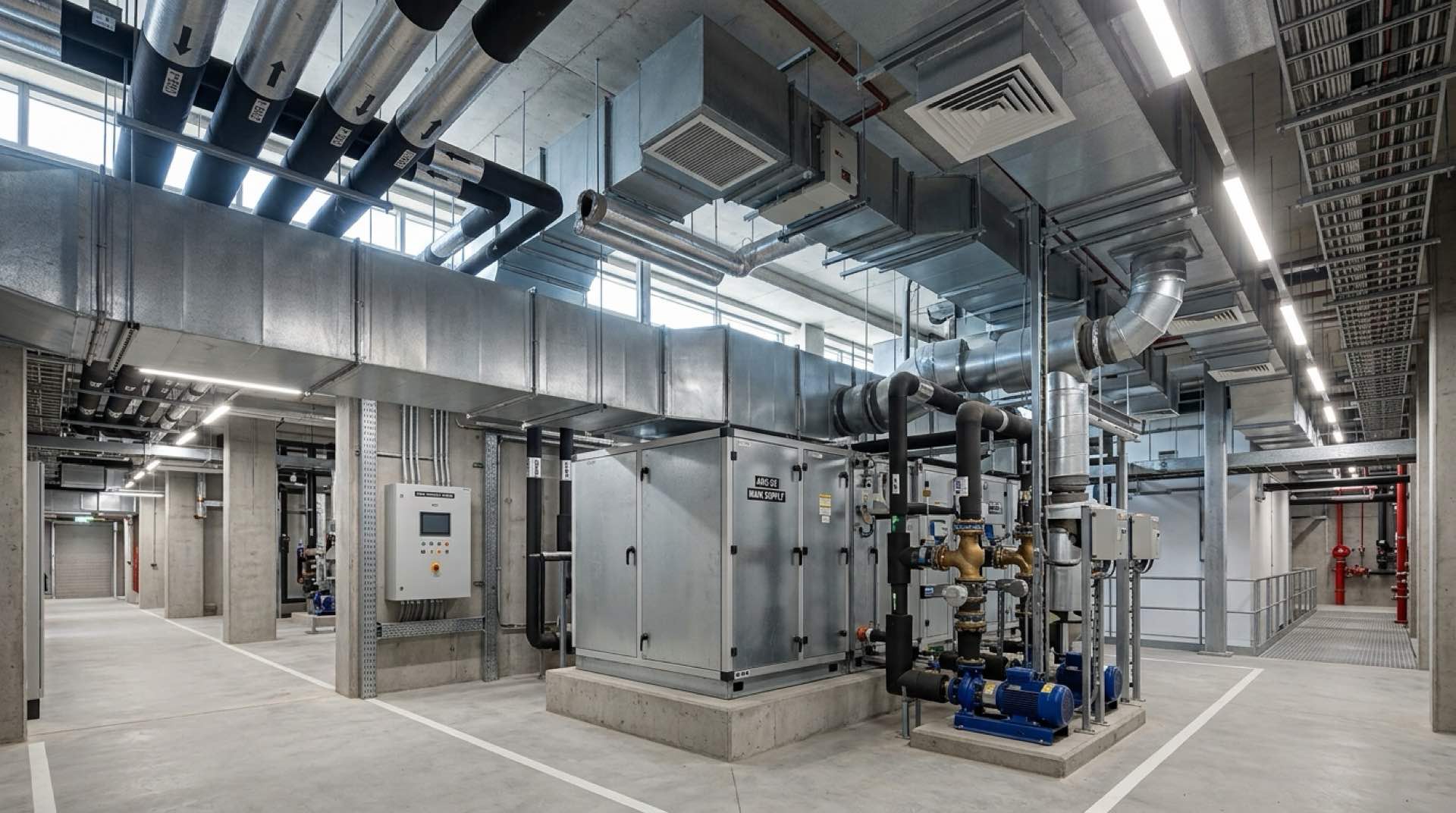
Mechanical rooms require detection appropriate to the hazard. Elevator machine rooms require smoke detection forrecall functions per code. Electrical rooms may need specialized detection equipment.
Integration requirements to consider when selecting hotel fire systems
Voice evacuation and emergency communication
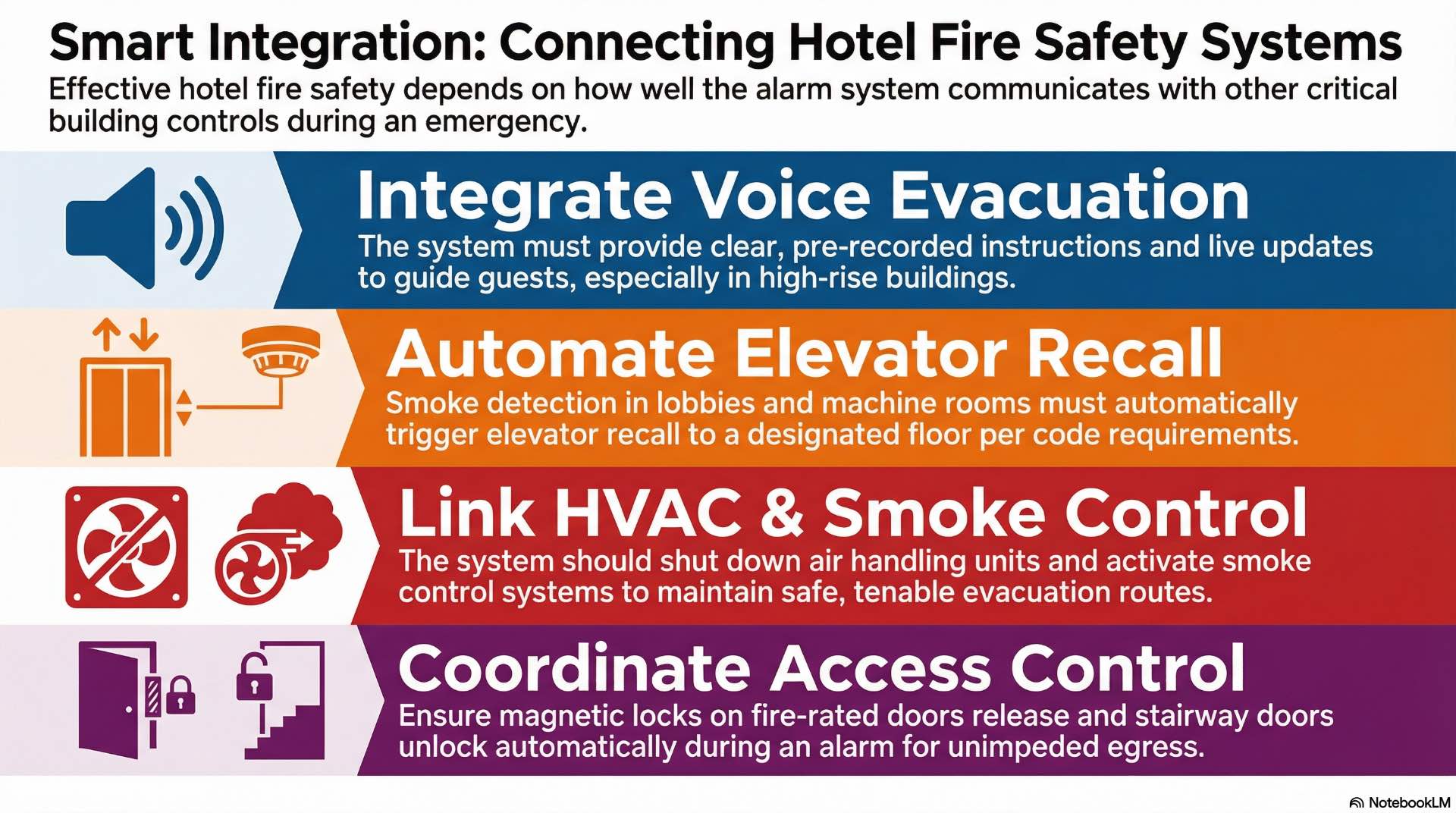
Voice notification transforms fire alarm systems into emergency platforms. Pre-recorded messages provide clear evacuation instructions to occupants. Live paging allows real-time updates when conditions change.
NFPA 72 requires voice intelligibility meeting speech transmission index values. Acoustic design must account for ambient noise. Reverberation affects message clarity in large spaces.
Mass notification extends communication beyond fire emergencies. Severe weather alerts and security threats benefit from the same distribution infrastructure.
Elevators, HVAC, and access control interaction
Elevator recall represents a primary fire alarm integration requirement. Smoke detection in lobbies triggers Phase I recall to the designated floor per code requirements. Verification testing must confirm proper operation of all elevator groups responding to alarm signals.
HVAC shutdown coordination affects life safety directly. Control panels provide shutdown signals to air handling units in affected areas. Smoke control sequences pressurize stairways. They exhaust smoke from fire floors to maintain tenable safety conditions.
Access control enables emergency unlocking from fire alarm signals. Magnetic locks on fire-rated doors require release inputs during alarms. Stairway doors unlock to permit re-entry during evacuation.
Compliance and inspection criteria that affect system selection
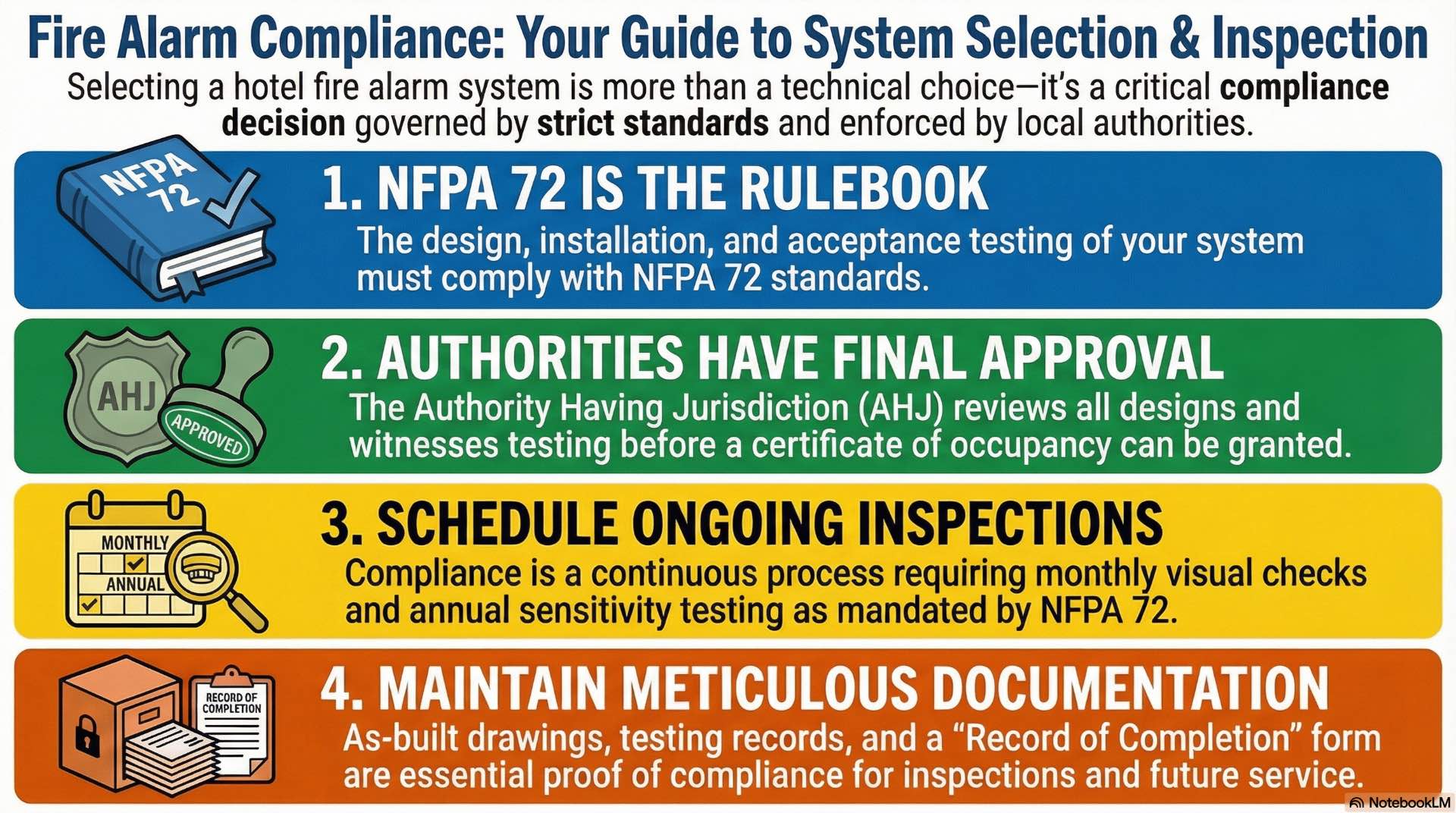
Fire alarm systems require design per NFPA 72. Installation and acceptance follow the same standard. Authorities having jurisdiction review designs carefully and witness acceptance testing before approvals. Proper documentation supports ongoing safety compliance verification.
Ongoing compliance requires inspection per NFPA 72 Chapter 14. Monthly visual inspections document system performance and identify issues early. Annual sensitivity testing verifies detector operation. These requirements affect maintenance scheduling and operational budget planning throughout the system lifecycle.
Documentation requirements include as-built drawings. Testing records must be maintained for fire alarm systems. Record of completion forms capture initial configuration data. This information proves essential for future modifications and troubleshooting by service technicians.
Final checklist for choosing the right fire alarm solution for hotels
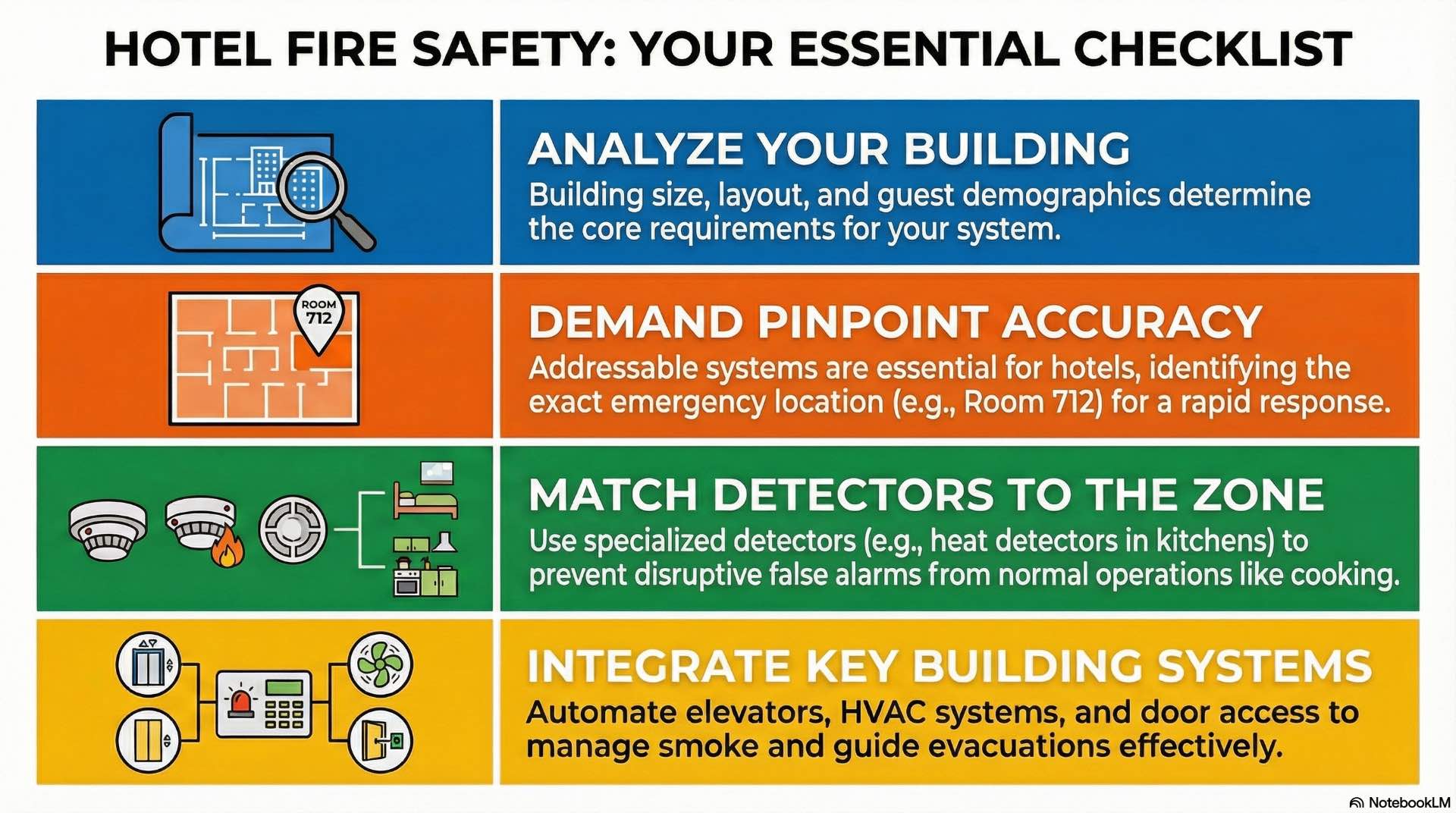
System selection starts with property-specific requirements. Building size determines capacity. Layout complexity drives zoning strategy. Occupancy characteristics influence notification approach.
Addressable voice systems suit most applications. Device-level identification speeds emergency response time while voice communication guides unfamiliar occupants safely.
Environmental considerations prevent nuisance alarms. Kitchen detection strategies avoid cooking-related activations. Proper detector selection minimizes false alarm sources.
Coordination with building systems requires planning. Elevator recall, HVAC shutdown, and access control release need defined interfaces between equipment.
Selecting the right fire alarm system requires balancing detection reliability with notification effectiveness and operational practicality. Properties need systems that detect fires promptly and guide guests safely. The goal is hotel fire alarm performance that satisfies codes without disrupting daily operations. Proper planning ensures safety for guests while minimizing false alarm impact on business continuity.