
Physical intrusion detection works as a chain of functions rather than as a collection of sensors. A protected condition changes, a detector produces an input, control or processing equipment interprets that input in context, and the system may create an alarm or other event. Depending on the implementation, that event can produce local indication, remote transmission, or both.
Perimeter detection applies the same model at or near an external boundary, while opening and interior detection cover other protected conditions. These layers can participate in one wider alarm architecture, but not every system uses all of them.
What intrusion detection and perimeter security protect
In physical security, an intrusion detection system is intended to detect and signal conditions associated with an intruder or intrusion attempt in a protected area. The most useful model is functional: detection inputs, control or processing, system state, alarm or event handling, indication, communications, and any downstream receiving or monitoring function.
Perimeter intrusion detection applies that purpose to an external boundary or the area around it. Depending on the site and system, detection may be associated with a fence or other barrier, a freestanding sensing layer, an approach area, or another external protected condition. Detection is not the same as physical delay: a detector can indicate activity, while a barrier or other physical measure provides resistance or delay.
Opening detection is another layer. A contact on a door or window can report a change at an opening, while interior or volumetric detectors observe conditions within a protected space. Perimeter, opening, and interior detection are useful conceptual layers, not a required site-design sequence.
The core parts of an intrusion detection system
Sensors and detectors
Sensors and detectors are physical inputs to the system. They respond to a condition or change and provide information for the rest of the system to evaluate.
Representative detector families include opening contacts, passive infrared motion detectors, microwave motion detectors, combined PIR/microwave detectors, acoustic glass-break detectors, vibration or fence-sensing devices, and beam-based detection. These examples illustrate different sensing roles; they do not imply that one technology is universally preferable or that every installation requires several detector families.
A detector input is not necessarily an alarm decision by itself. Its significance can depend on control logic, current system state, configuration, and the status of other system elements.
Control panel or processing layer
Many alarm systems use a control panel or control unit, while standards terminology may refer to control and indicating equipment. Processing can also be distributed rather than concentrated in one physical device.
This layer receives or coordinates detector inputs, tracks system state, applies configured logic, and creates alarm, status, fault, or other event conditions as appropriate to the implementation. The key distinction is between sensing and interpretation: a detector provides an input, while control or processing determines how that input is handled within the system.
User and system state
Intrusion systems commonly use terms such as armed and disarmed, or set and unset. The terminology varies, but the underlying principle is important: system state affects how intrusion-related inputs are interpreted.
When a relevant part of the system is armed or set, configured intrusion conditions may produce alarm behavior. Exact state names, entry or exit behavior, bypass rules, always-active conditions, and exceptions depend on the platform and configuration.
Local indication and communications
An alarm event can produce local warning or indication, such as audible or visual signaling, but local indication is a separate function from remote transmission. A system may use one, both, or neither for a particular event path depending on its design and configuration.
Where remote reporting is used, communications carry alarm, status, or fault information from the protected premises toward receiving equipment or services. The communications path is part of the wider system architecture, not part of the detector itself.
How a detected condition becomes an alarm event
A useful conceptual flow is:
protected condition changes → detector input → control or processing evaluates the input and system state → alarm or event condition → local indication and/or remote transmission → downstream monitoring or response handoff
This flow is intentionally generic. It is not a universal wiring diagram, and it does not mean every system uses one central panel, one alarm output, one communications technology, or professional monitoring.
A door contact can report a change at an opening. A motion detector can report activity within a monitored area. A perimeter sensing element can report activity associated with an external protected boundary. In each case, the system interprets the input in the context of its configuration and state.
The resulting event can then be presented locally, transmitted remotely, or passed to another security function. Which outputs occur is implementation-specific.
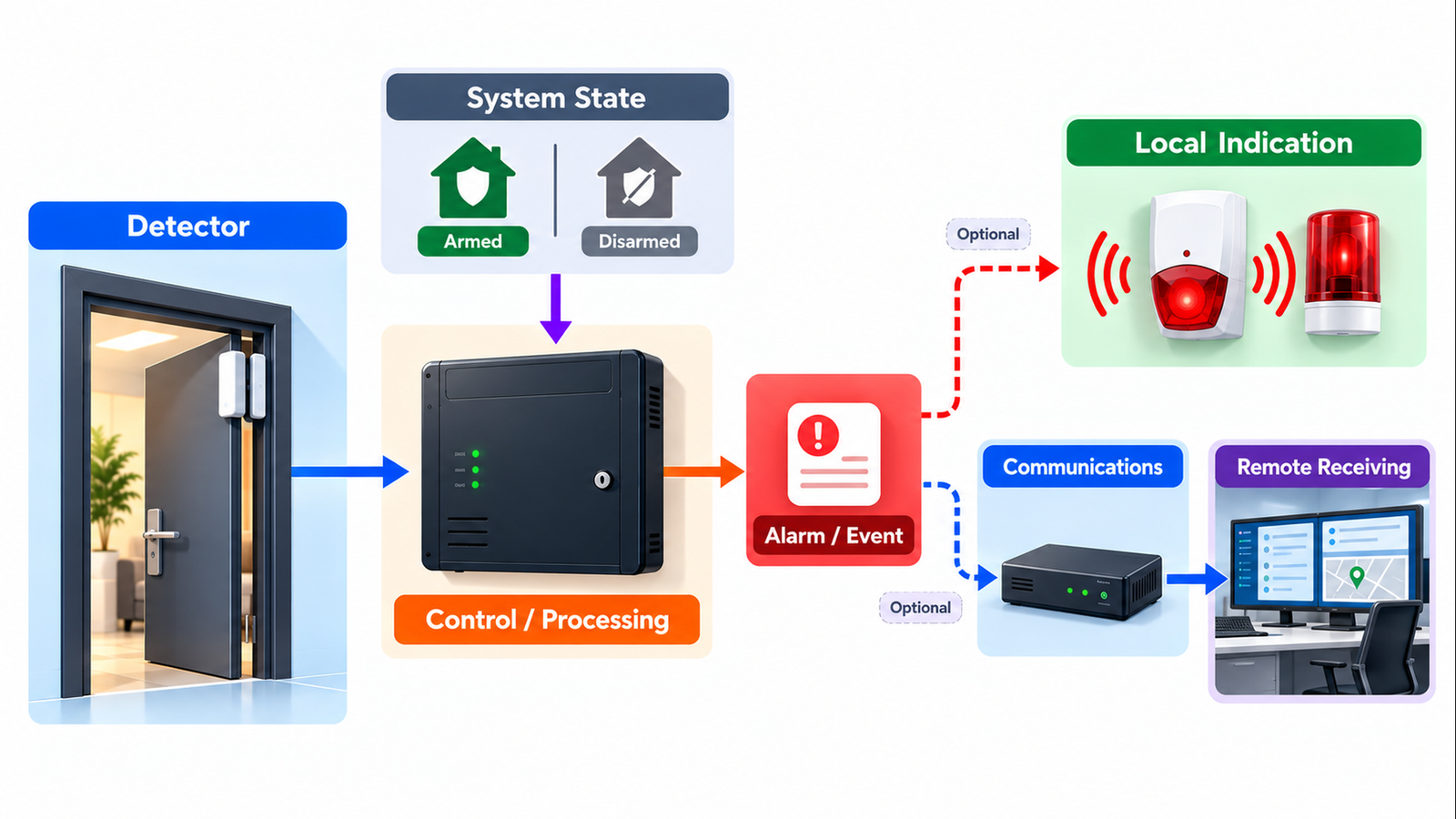
Conceptual intrusion alarm event flow showing detector input and armed or disarmed system state feeding control and processing, with an alarm event branching to optional local indication and remote communications.
Perimeter detection and interior intrusion detection are different layers
Perimeter detection is concerned with activity at or around an external boundary or approach to a protected site or area. It can provide earlier indication before activity reaches an interior protected space. Detection itself does not provide the physical resistance or delay of a barrier.
Opening detection focuses on changes at doors, windows, or comparable entry points. Interior detection focuses on protected spaces, often using volumetric sensing technologies. These functions can overlap in a real system, and not every installation uses all of them.
The layers are best understood as different positions in the protection model rather than as a shopping list of technologies. A perimeter sensing system can feed the same wider alarm architecture as opening contacts and interior detectors while operating under different environmental and operational conditions.
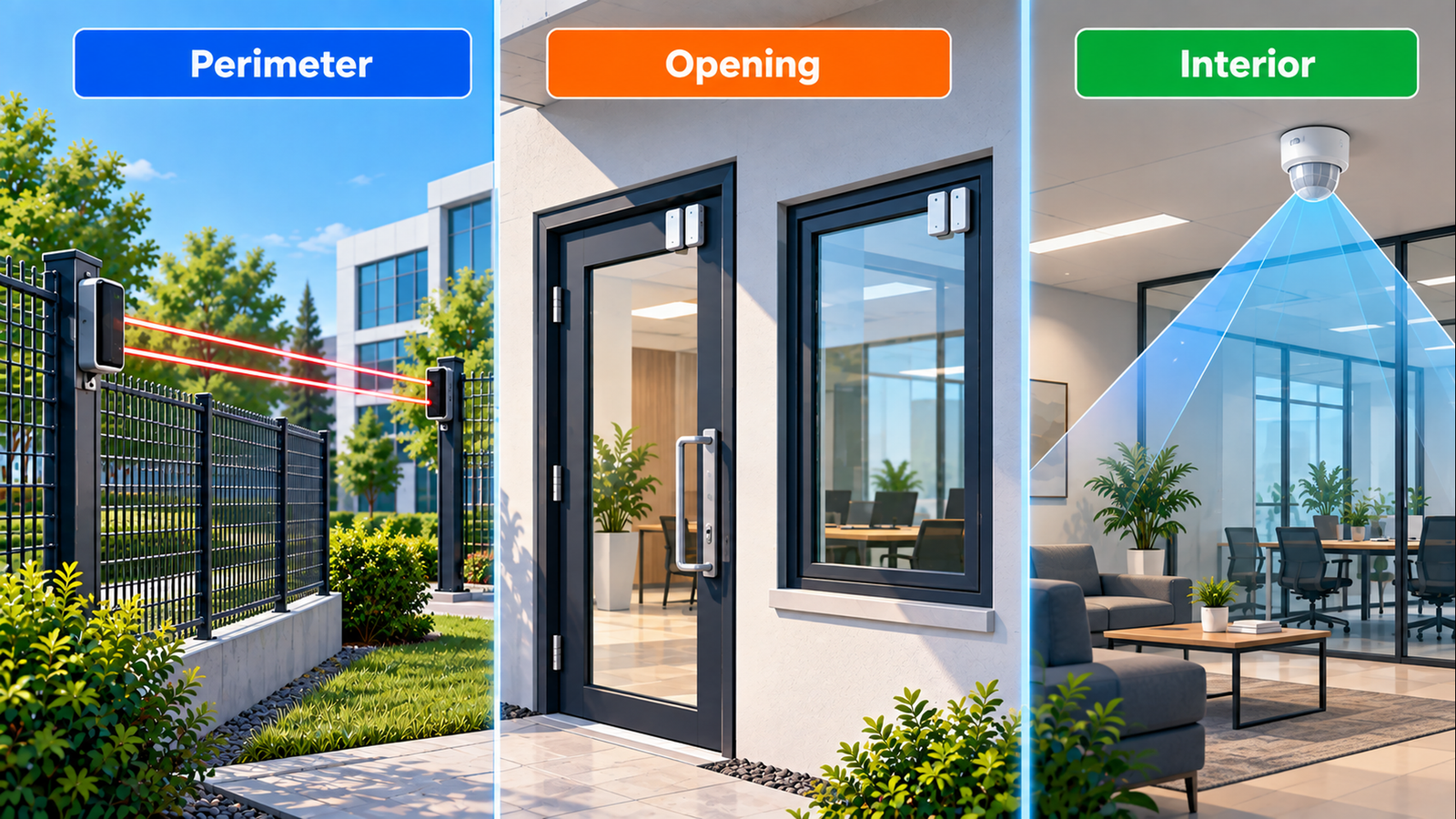
Three conceptual intrusion detection layers: perimeter detection along a fence, opening sensors at an entrance and window, and interior motion detection inside a building.
Zones, points, system state, supervision, tamper, and faults
Alarm platforms need a way to identify and organize detector inputs, but the terminology is not universal. Some systems use zone for a configured input or logical detection entity. Others use point, while larger groupings may be called partitions, areas, or something else.
These terms should therefore be read as platform-specific organizational concepts rather than one standardized data model. A zone is not necessarily one physical detector, and a point and a zone are not safe universal synonyms.
System integrity also involves conditions that are distinct from an intrusion alarm. Depending on the implementation, supervision can be used to check the availability or integrity of circuits, devices, modules, wireless links, or communications paths. Tamper conditions can indicate interference with equipment or protected circuitry. Fault or trouble conditions can identify abnormal equipment, power, device, or communications states.
The exact definitions and responses vary by system and standards context. An intrusion alarm, a tamper condition, a supervision issue, and a fault should therefore be treated as distinct concepts unless a specific implementation defines their relationship.
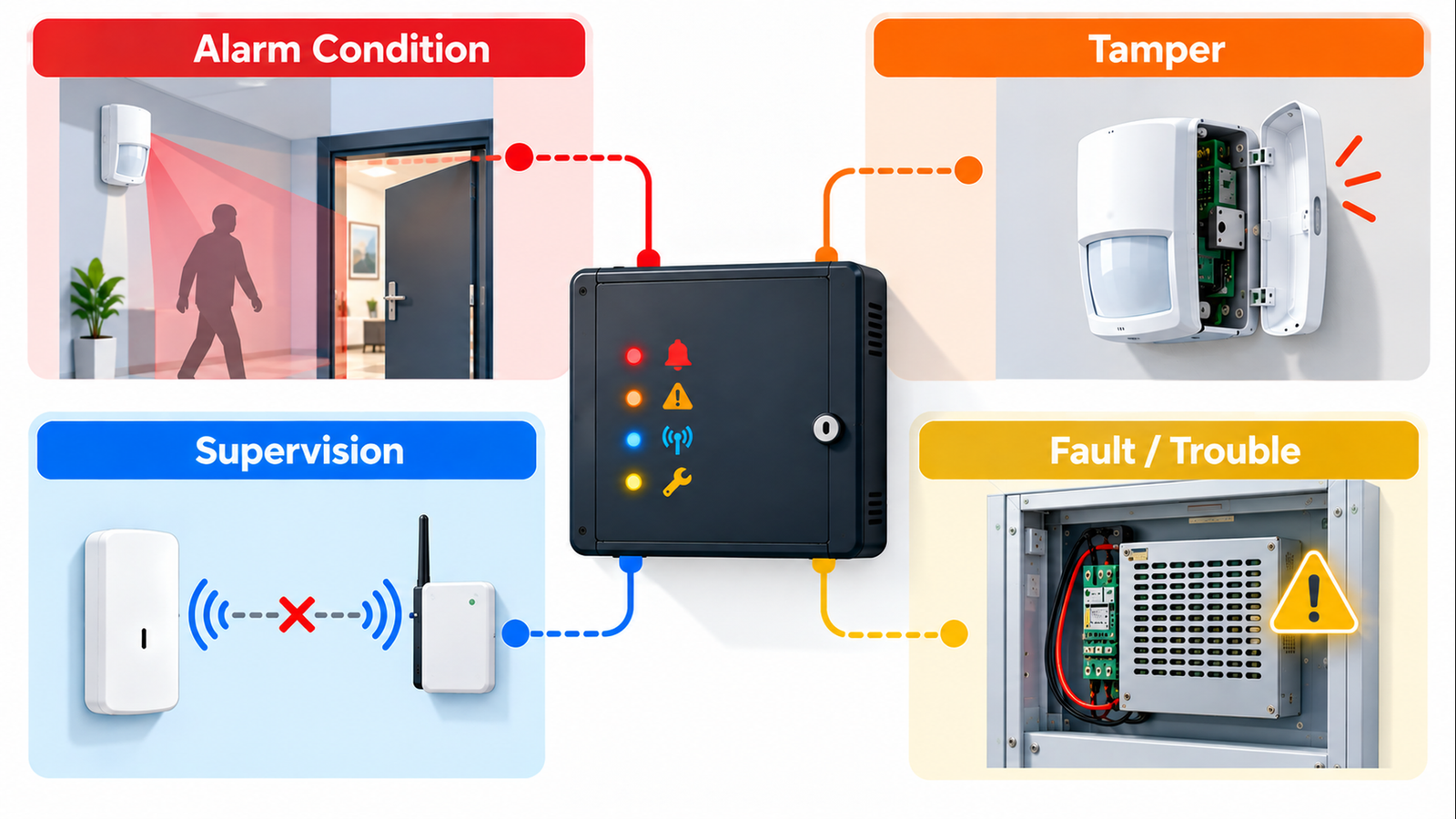
Conceptual alarm panel connected to four separately labeled conditions: intrusion alarm, equipment tamper, supervision loss, and system fault or trouble.
Wired, wireless, and hybrid architectures
Intrusion alarm systems can use wired or wire-free interconnections. IEC 62642-1 covers intrusion and hold-up alarm systems using wired or wire-free interconnections, while IEC 62642-5-3 addresses equipment using radio-frequency techniques within that standards family.
In a wired architecture, detector or module information travels over supported physical conductors, loops, buses, or other connections. The exact topology and supervision method depend on the system.
In a wireless architecture, supported devices use radio links to communicate with compatible system equipment. Frequency, range, battery behavior, supervision timing, and device capacity are product- and implementation-specific and should not be generalized across the category.
A hybrid implementation combines supported wired and wireless elements. The term is useful descriptively, but it is not one universal topology and does not mean that any controller can mix any wired and wireless device.
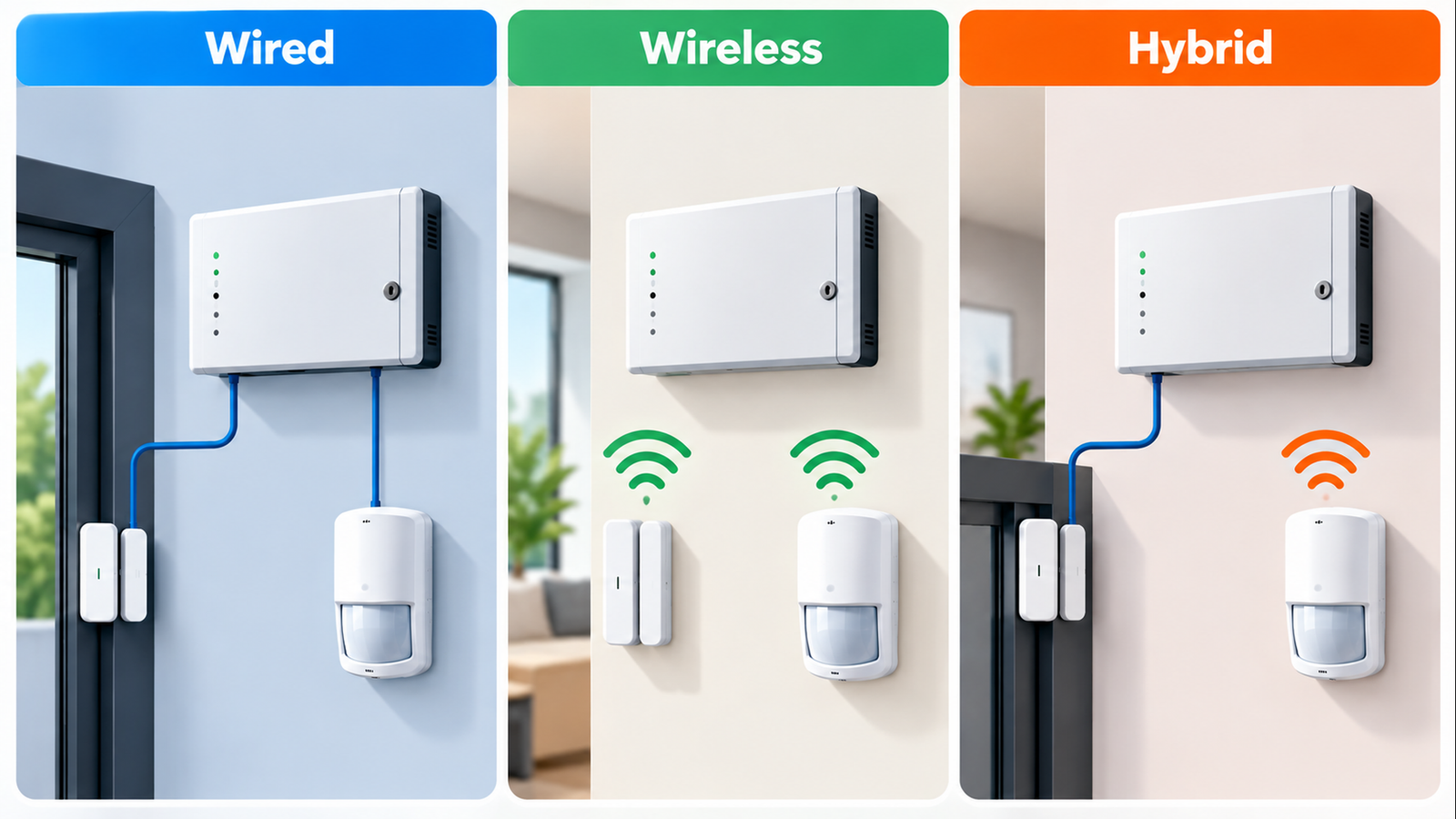
Side-by-side alarm system illustrations labeled Wired, Wireless and Hybrid, showing cabled connections, radio connections and a combination of both.
Alarm transmission and remote monitoring
Local detection and processing can exist without professional remote monitoring. When remote reporting is part of the system, an alarm transmission path carries events or messages from protected-premises equipment toward receiving equipment or a monitoring service.
BS EN 50136-1 addresses alarm transmission between supervised premises and receiving-center equipment. BS EN 50518 addresses monitoring and alarm receiving centers as a separate downstream domain. These standards do not establish that every intrusion system uses professional monitoring or one specific communications path.
It is useful to keep three functions separate:
- Detection: a sensor or detector responds to a protected condition.
- Local control and event handling: the system interprets the input and creates an alarm, status, or other event according to its state and configuration.
- Remote receiving or monitoring: when used, communications pass that event to downstream receiving equipment or personnel.
What happens after that handoff depends on the service, organization, contract, jurisdiction, and operating procedures. Dispatch rules, alarm permits, response contracts, and central-station workflows are outside this system-level explanation.
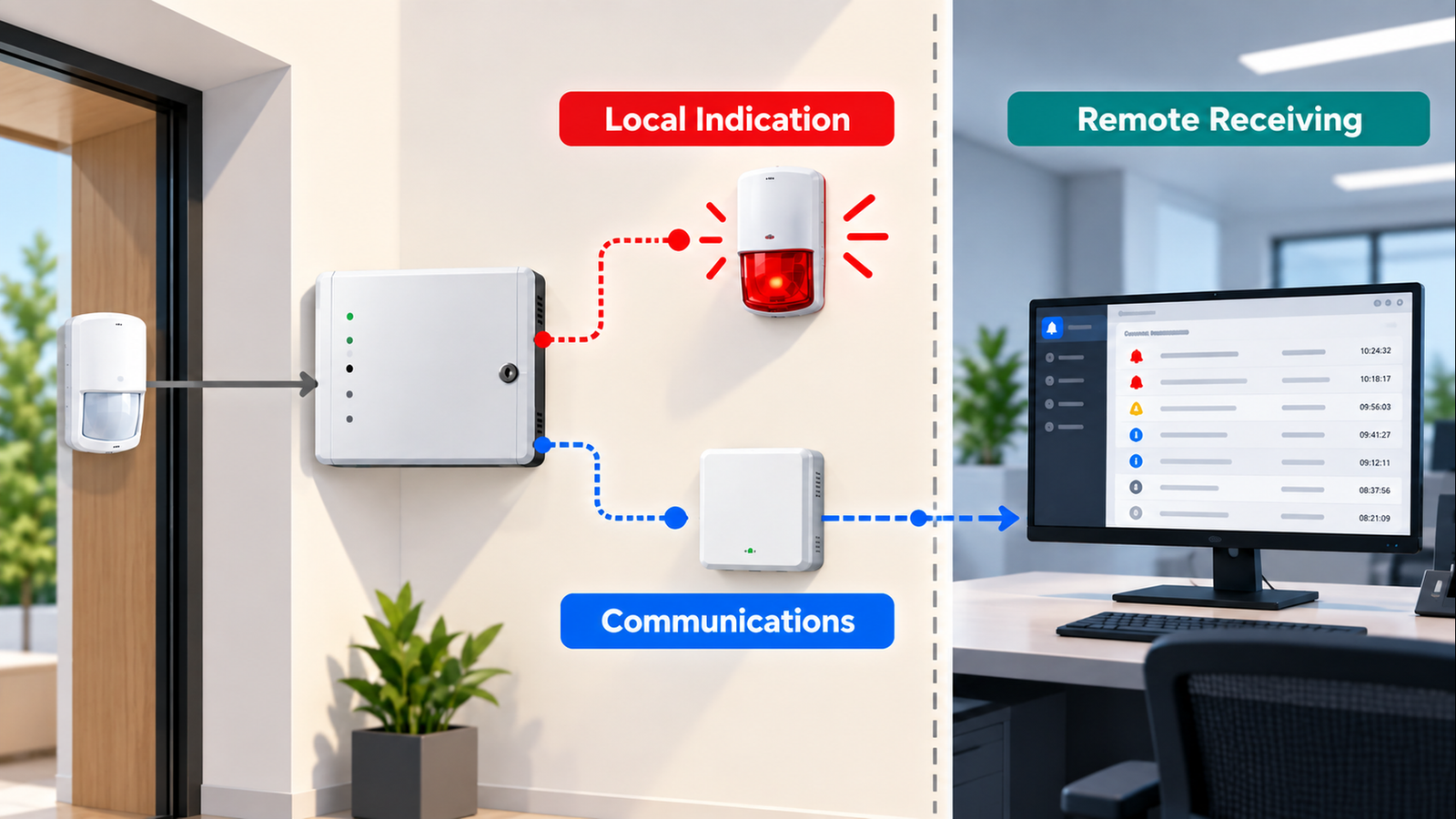
Intrusion alarm controller showing separate paths to a local sounder and to communications equipment serving a remote receiving workstation.
Detection reliability depends on the environment and system design
A detector does not operate in isolation from its surroundings. Environmental conditions, installation context, configuration, equipment condition, maintenance state, and the way a system is armed and operated can influence detection reliability and false or unwanted alarm behavior. Communications availability can separately affect whether events are delivered to downstream receiving or monitoring functions.
Perimeter systems can be exposed to changing outdoor conditions, while interior and opening detectors have their own application constraints. The effect of those conditions is implementation-dependent.
False-alarm reduction is not only a detector issue. Control-panel behavior, system state, communications status, supervision, and user interaction can also affect how events are generated and interpreted. ANSI/SIA CP-01, for example, addresses control-panel and arming/disarming features for false-alarm reduction in a specific U.S. standards context.
False-alarm rates should not be generalized across systems without a defined scope. For perimeter intrusion detection, zero false alarms should not be assumed as a general expectation. Detection reliability is better understood as a system property shaped by environment, implementation, configuration, operation, and maintenance.
Integration with other building security systems
Intrusion detection often operates alongside other security systems, but integration does not erase the boundaries between them.
Access control decides or enforces who or what is allowed to pass through a controlled access point. Intrusion detection observes protected conditions and creates alarm or event information when configured conditions are met. The systems can exchange context, but neither is simply a subset of the other.
Video surveillance provides imagery, recording, analytics, and visual context. It can support alarm verification or situational understanding, but an intrusion detector is not the same thing as a video surveillance system, even when video analytics can generate intrusion-related events.
Security operations and management systems can receive, correlate, present, and manage events from multiple subsystems. That downstream operational layer is broader than the intrusion-detection system itself.
Life-safety systems such as fire detection, gas detection, evacuation, and emergency communications are separate technical domains from intrusion detection. Some platforms or receiving centers may handle multiple alarm types, but that does not make life-safety detection part of intrusion detection.
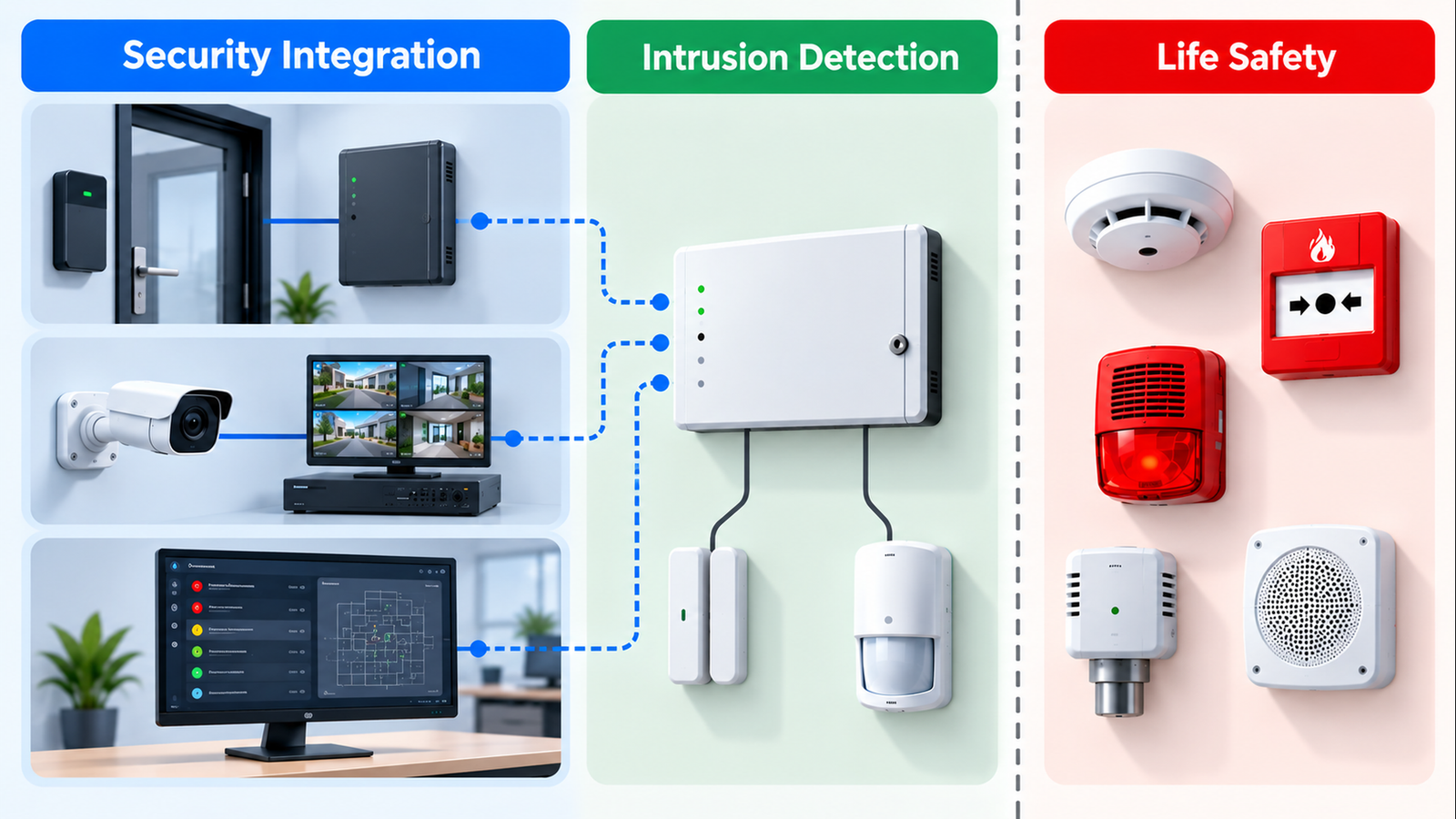
Three-part conceptual illustration separating integrated building security systems, intrusion detection equipment and life-safety systems.
Connected intrusion systems also need cybersecurity consideration
Once intrusion components use IP networks, remote services, mobile applications, cloud platforms, or other connected computing functions, physical security is no longer the only risk domain. Network-connected security technology also has cybersecurity and data-protection considerations.
At a high level, relevant concerns can include controlling access to devices and interfaces, protecting stored and transmitted data, supporting secure software updates, maintaining awareness of device or security state, and managing support across the product lifecycle. NPSA/NCSC guidance for network-connected security technologies and NIST IoT guidance support these as broad connected-device concerns.
The exact cybersecurity requirements depend on the architecture, products, environment, organization, and applicable obligations. There is no single alarm-system hardening recipe that fits every deployment, and this article does not prescribe network segmentation, firewall rules, cryptographic profiles, or patching procedures.
The durable model is a chain of sensing, processing, system state, event handling, communications, and optional downstream monitoring. Separating those functions makes it easier to understand a real implementation without assuming one terminology set, topology, or operating model.
Sources
- NPSA — Intrusion Detection (opens in a new tab)
- NPSA — Perimeter Intrusion Detection PIDS (opens in a new tab)
- NPSA — Building Protection (opens in a new tab)
- IEC 62642-1:2010 — Alarm systems - Intrusion and hold-up systems - Part 1: System requirements (opens in a new tab)
- IEC 62642-3:2010 — Alarm systems - Intrusion and hold-up systems - Part 3: Control and indicating equipment (opens in a new tab)
- IEC 62642-5-3:2010 — Alarm systems - Intrusion and hold-up systems - Part 5-3: Interconnections - Requirements for equipment using radio frequency techniques (opens in a new tab)
- BS EN 50136-1:2012+A1:2018 — Alarm transmission systems and equipment (opens in a new tab)
- BS EN 50518:2019+A1:2023 — Monitoring and Alarm Receiving Centre (opens in a new tab)
- ANSI/SIA CP-01-2019 — Control Panel Standard – Features for False Alarm Reduction (opens in a new tab)
- NPSA / NCSC — Network Connected Security Technologies Guidance (opens in a new tab)
- NIST IR 8259 Rev. 1 — Foundational Cybersecurity Activities for IoT Product Manufacturers (opens in a new tab)
- NIST IR 8259A — IoT Device Cybersecurity Capability Core Baseline (opens in a new tab)