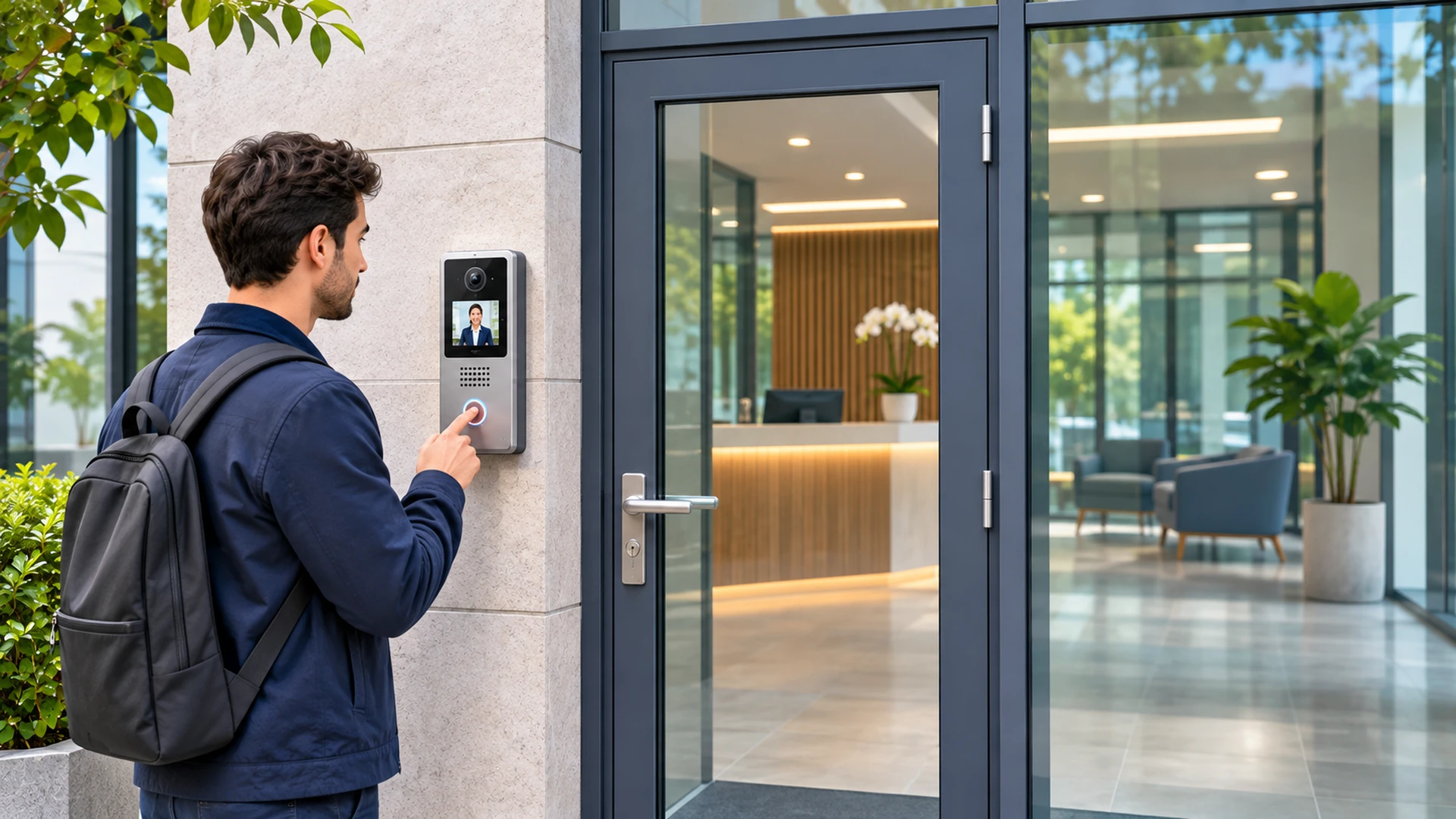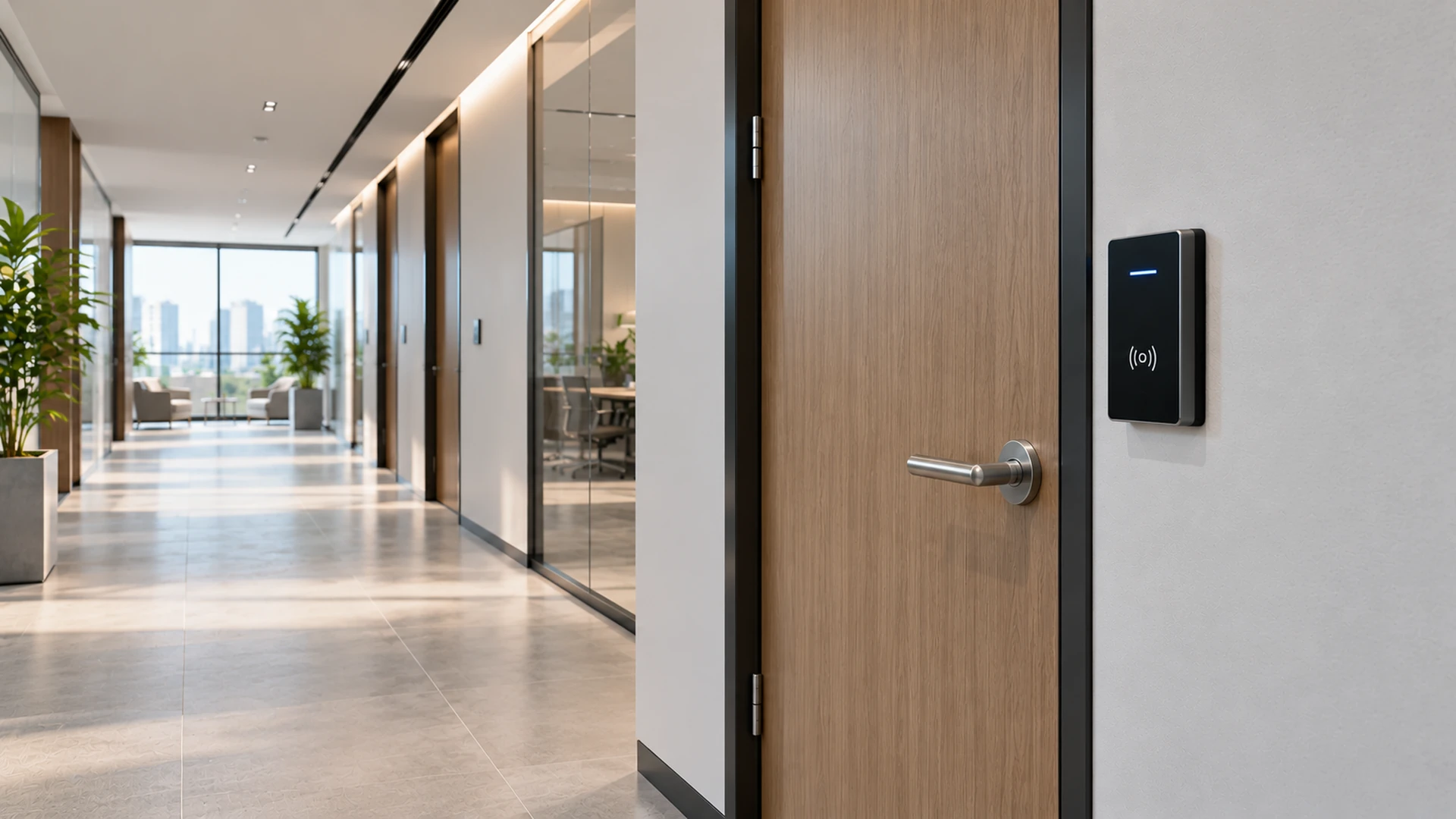



Intrusion detection and perimeter security is the coordinated use of physical safeguards, sensors, alarm processing, assessment and an organized response to recognize and act on possible unauthorized activity at a protected site. Detection reports a condition that needs interpretation; it does not establish hostile intent or provide the whole protective response. RCMP guidance separates electronic detection from the wider protection, detection, response and recovery model.[1][2]
A useful system specification follows an event from its physical location to the person responsible for acting on it. That approach exposes gaps between a detector activating, an operator understanding the situation and an authorized response becoming available.
What intrusion detection and perimeter security do
A physical intrusion detection system reports changes associated with possible unauthorized activity in protected spaces. It differs from network intrusion detection, which addresses another technical domain. RCMP’s detection guide discusses physical sensors, alarm systems and visual monitoring; its protection framework explains how detection contributes to a coordinated security arrangement.[1][2]
Perimeter security starts at a defined boundary, but the protected objective may sit farther inside. A barrier provides a different function from an alarm. The relationship between available physical delay, detection and response matters more than the presence of an isolated device.[2]
For an illustrative warehouse, define the protected objectives before listing sensors. The owner might need awareness of activity near an external boundary, unauthorized opening of a building entrance and movement within a restricted storage area. These are different detection tasks. The example is a planning model rather than a recommended layout: the actual threat assessment determines which tasks are justified.
Describe each task as an observable condition, its location and its operational consequence. “Protect the perimeter” leaves too much unresolved. A clearer requirement identifies the boundary being monitored, the information needed to assess an event and the organization responsible for responding. RCMP’s response guidance makes available support and practiced plans part of the protective arrangement; it does not promise attendance by a particular outside responder.[2]
Protection from the boundary to the asset
Protection can be organized through successive physical layers. RCMP describes layered safeguards, and the government perimeter-sensor handbook distinguishes envelope, interior and individual-asset detection tasks.[2][3] These are useful categories for a survey; they do not require every site to install a detector at every layer.
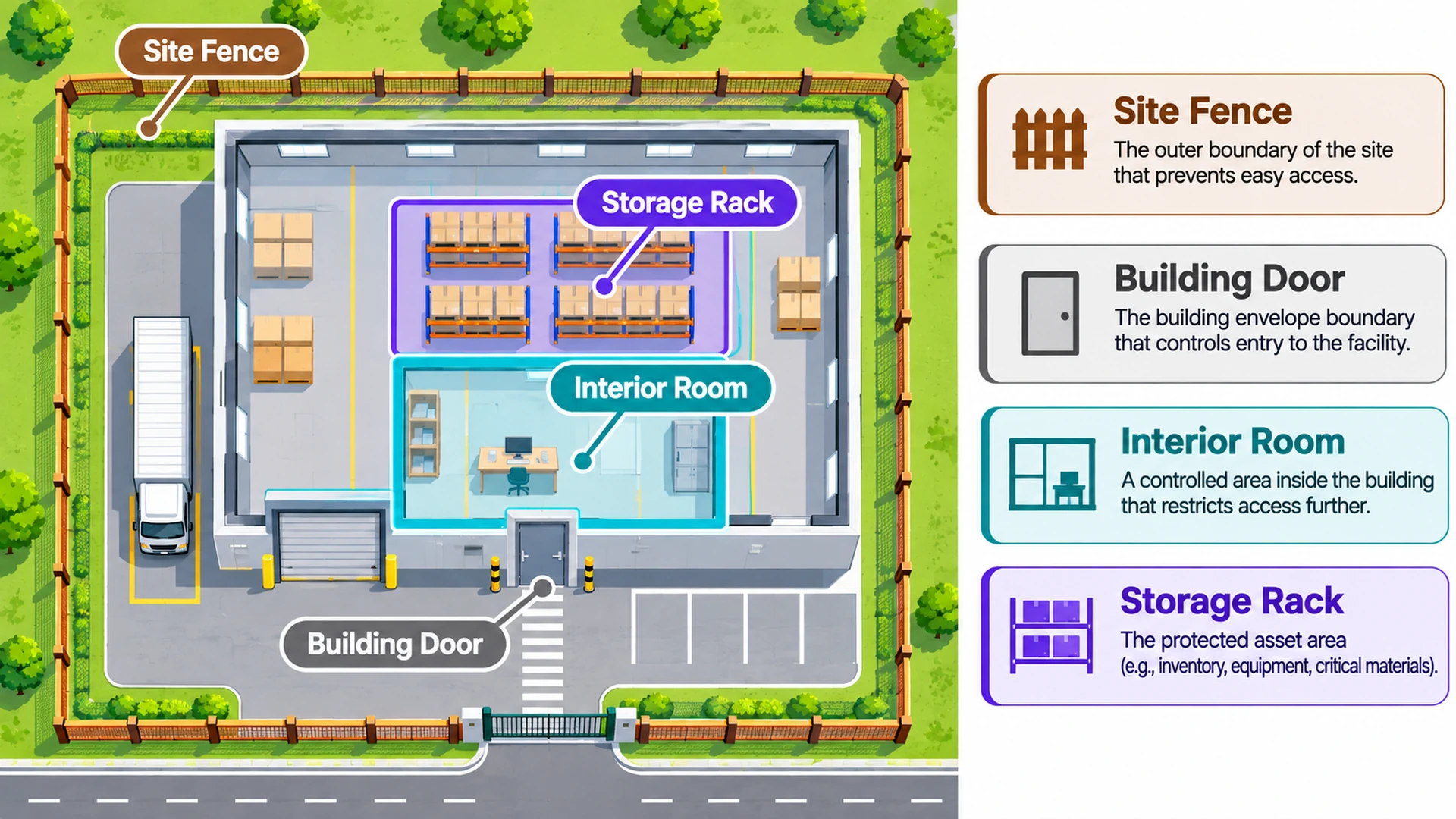
Use a layer schedule to establish the purpose of proposed coverage.
| Layer | Example planning question |
|---|---|
| Site boundary | Which approach or boundary condition matters to the risk assessment? |
| Building envelope | Which openings or surfaces separate public exposure from protected space? |
| Interior area | Which rooms or circulation areas need a separately understood detection task? |
| Individual asset | Does a particular asset need a condition monitored independently? |
At each layer, ask whether the proposed measure detects, delays, supports assessment or enables response. A controlled entrance may support authorized circulation, while an intrusion function assesses activity inconsistent with the protected operating state. Keep those purposes visible when coordinating related systems.[1][2]
In an illustrative survey meeting, walk a proposed protection boundary with the owner and integrator. Record the boundary identifier, the asset it serves and the activity that is expected there. If a loading operation crosses that boundary routinely, define how normal use will be recognized and managed. The proposed survey method turns “coverage” into a documented operational task rather than a line on a plan.
Also record what lies outside the task. If a detector reports an opening condition, do not describe it as identifying the person responsible. RCMP’s contact-sensor explanation supports this distinction.[1] Explicit boundaries help the team avoid relying on evidence that the selected sensing method does not provide.
The detection-to-response chain
A detector is one of several intruder alarm components in a larger chain. The perimeter-sensor handbook connects sensors, processing, communications, annunciation, people and procedures. It is a historical source used here for these enduring architectural distinctions, not for current product performance.[3]
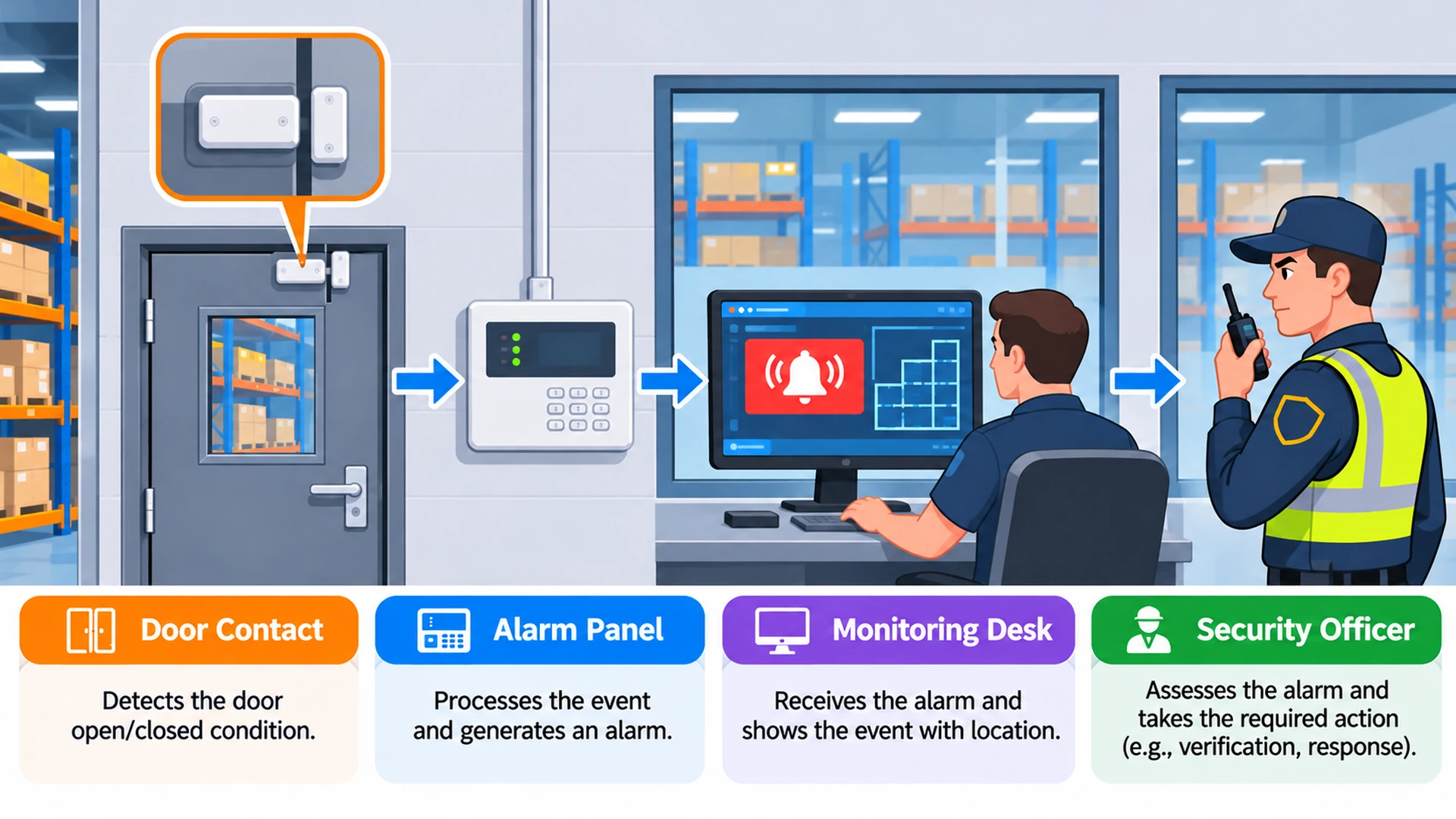
The following sequence provides a framework for writing requirements.
- Define the physical condition to be detected and its protected location.
- Describe how processing associates the input with a meaningful event.
- Identify how the event reaches the monitoring function.
- Specify the information needed for assessment.
- Assign the authorized response and escalation responsibility.
- Define how protection is restored and the event reviewed.
The sequence is a proposed requirements method based on the detection chain and RCMP’s recovery framework.[2][3] It is not a site response playbook. The owner must establish the actual roles, authority and safe actions appropriate to the site. Record them as part of the site’s physical security operating model.
IEC 62642-3:2010 addresses control and indicating equipment and recognizes that processing functions may be incorporated or distributed. IEC 60839-5-1:2014 addresses alarm transmission between supervised premises and receiving-center annunciation. Their catalog scopes reinforce the distinction between processing and transmission; they do not establish the details of a selected installation.[4][5]
For an illustrative requirement, follow a named detection point to its displayed location and responsible monitoring role. Ask what happens if processing remains available but the reporting path is unavailable. Then ask the reverse question: what would the operator see if reporting were available but the field input were impaired? Obtain the answers from the actual system design and test them safely during commissioning.
Indoor and outdoor technology families
Different sensors observe different physical effects. RCMP’s guide describes vibration sensing, acoustic glass-break detection, contact sensors and active beams. A contact detects a change at an opening; a beam detects interruption of its monitored path; acoustic and vibration methods interpret disturbances through their respective sensing methods.[1]
The family name is only a starting point. The government handbook discusses environmental effects, including weather, animals and other disturbances, as constraints on useful detection.[3] A technology described as “outdoor” still needs an assessment of the particular place where it will operate.
A survey should connect the detection task with the environment rather than begin with a preferred family.
| Survey topic | Information to collect before detailed selection |
|---|---|
| Expected legitimate activity | Who or what normally uses the monitored area? |
| Physical condition to observe | Opening, disturbance, interruption or another defined condition |
| Environmental exposure | Relevant weather, vegetation, animals and site changes |
| Assessment opportunity | What information could help explain an activation? |
| Maintenance access | Who can inspect the area and sustain its intended condition? |
This table is a proposed information-gathering tool. It does not rank technologies or establish detection distances. The detailed design needs evidence for the chosen equipment, mounting arrangement and operating environment.
An illustrative comparison can begin with a door-opening task and a boundary-crossing task. The first needs the team to define the opening state of interest. The second needs the monitored boundary and relevant crossing condition defined. Those task descriptions help evaluate candidate methods without assuming that one device can provide every kind of evidence.
Avoid solving nuisance activity solely by making the logic harder to trigger. The historical handbook explains that requiring multiple detections can reduce nuisance alarms while also reducing detection probability.[3] Treat confirmation logic as a design tradeoff to justify and test, with its effect on the original detection objective documented.
Zones, arming and supervision
A zone or area needs a documented meaning in the selected system. Location information supports assessment, while operating state determines how an input is interpreted. Separate that meaning from a convenient grouping on a user interface. The handbook discusses independently reported segments and meaningful annunciation; Bosch’s MAP API provides a product example in which area state and incident state are separately represented.[3][6]
An arming request also differs from confirmation of the resulting state. The MAP API explicitly requires clients to check the outcome of an accepted arming request. This is an implementation example, not a universal API behavior, but it illustrates a useful acceptance question: what evidence confirms that the requested operating state was reached?[6]
Keep several concepts separate in operating requirements.
| Concept | Requirement to define |
|---|---|
| Area operating state | How the selected system reports the actual protection state |
| Intrusion-related activation | Which condition requires assessment under that state |
| Tamper indication | How possible interference is presented and assigned |
| Trouble or supervision event | How an impaired function is identified and handled |
| Acknowledgment or silence | Which interface action was taken and what remains unresolved |
Tamper and line supervision address different conditions from intrusion detection. The handbook distinguishes these functions, and the Bosch documentation demonstrates that handling or silencing an incident does not remove its underlying condition.[3][6]
For a proposed operating exercise, give the team a simulated unresolved trouble event. Ask it to explain the displayed condition, the impaired function, the assigned owner and the evidence needed for closure. This exercise tests understanding of the system’s actual event model without giving bypass instructions or treating acknowledgment as physical restoration.
Alarm assessment and integration
Assessment connects an activation to a defensible understanding of what may be happening. RCMP describes visual monitoring as support for interpreting a detection event and recognizes the relationship between access activity and opening events.[1] Define what information is available before specifying automatic presentation or correlation.
Video surveillance architecture provides the imaging, transmission and recording context for this interface. The intrusion design still needs its own event-to-location mapping and operating responsibility. A camera view is useful only to the extent that it addresses the operator’s assessment question.
For an illustrative loading entrance, the owner might ask for an event to present the associated entrance view and relevant system state. Write down the required association and the operator question: is the observed activity consistent with the expected operating condition? This is a proposed use case, not a claim that any particular integration makes that judgment automatically.
Ask how the interface distinguishes unavailable information from a normal condition. Record what an operator sees when a requested view cannot be obtained or when related access information is missing. The design team should demonstrate these cases using supported product behavior. A blank field must not be allowed to carry an undocumented operational meaning.
Also distinguish the event record from the incident record. In the Bosch example, the history function has a bounded ring buffer that can overwrite older entries.[6] Specify the records needed for investigation and handover, then verify the selected system’s actual retention and retrieval behavior. Do not assume that an alarm screen, an event buffer and the organization’s retained incident file are interchangeable.
Environmental and continuity constraints
Continuity belongs to the whole alarm chain. The historical handbook explicitly extends power assessment beyond the detector.[3] Apply the same functional approach to the selected processing, reporting and monitoring arrangement: identify the functions the owner needs to retain and the dependencies that support them.
Build a project failure matrix that asks for observed behavior rather than generic resilience labels.
| Condition to examine | Evidence the design team should provide |
|---|---|
| A field function becomes unavailable | Affected detection task and operator indication |
| A communication path is interrupted | What reporting remains and how impairment is shown |
| Monitoring equipment is unavailable | Who owns the affected assessment function |
| Power is lost at a named subsystem | Remaining supported functions and documented limitations |
| A service returns | Evidence of restored operation and unresolved conditions |
This is a proposed matrix, not a set of predicted outcomes or backup durations. The project determines continuity objectives from risk, governing requirements and the available operating arrangement.[2][3]
Environmental change also needs an owner. Ask who reviews the detection task when site use changes, a boundary is altered or surrounding conditions differ from those assumed during commissioning. Keep these changes connected to the original survey record so the maintenance team knows what operating assumptions it is preserving.
IEC 62642-5-3:2010 addresses equipment using radio-frequency interconnections. Its catalog scope identifies a dedicated part for that communication method; it does not establish a universal ranking of wired and wireless systems.[7] Evaluate the chosen communication arrangement against the task, environment, supervision and continuity requirements instead of using the medium as a substitute for a system assessment.
Requirements and lifecycle checks
Begin the requirements package with the risk and protected objective. Add the physical layers, detection tasks, location identifiers, assessment information and response ownership. RCMP’s framework and the government handbook support connecting these elements; IEC TS 62642-7:2011 identifies planning, installation, commissioning, operation and maintenance within its application-guideline scope.[2][3][8]
For each proposed function, write an acceptance question that can be answered with evidence. Can the operator identify the intended location? Does the selected system report the required operating state? Are impairment and intrusion-related conditions distinguishable? Can the responsible team retrieve the records it needs? What demonstrates restoration after a tested outage? These are proposed checks to be completed with the project’s approved methods and expected results.
Establish the applicable standards context
IEC 62642-1:2010 addresses intrusion and hold-up systems installed in buildings, including its stated scope for externally mounted components. It should not be used to imply that every outdoor perimeter intrusion detection application has been covered by that standard.[9]
BSI lists BS EN 50131-1:2006+A3:2020 as current and under review on the checked catalog page. That status identifies the publication; it does not establish the clauses adopted for an individual project. Ireland’s Private Security Authority licensing table illustrates how required standards depend on the jurisdiction and regulated activity.[10][11]
Record the applicable editions, national adoption, contractual requirements and responsible decision maker. Obtain the actual governing texts when compliance is part of the project. Catalog summaries support scope and designation, not claims about detector grades, mandatory transmission performance or inspection intervals.
Plan commissioning, operation and maintenance together
BS 9263:2016 covers commissioning, maintenance and remote support for intruder and hold-up alarm systems. Its catalog describes activities including on-site maintenance and remote checks, but the summary does not establish a universal maintenance interval.[12] The project must define its applicable lifecycle requirements from the governing sources and selected system.
A proposed handover package should give the operating team the location schedule, event definitions, responsible contacts, accepted limitations and evidence of completed tests. Give the maintenance team the same functional identifiers. That shared record makes it possible to ask whether a repair restored the intended detection task rather than merely removed an interface message.
Close the planning exercise by tracing an illustrative event through the complete arrangement: physical condition, reported location, assessment information, authorized response and recovery record. Where the trace stops at an unanswered question, assign that question before detailed design proceeds. This preserves the relationship between detection and the protective purpose it serves.[2][3][8]
For an illustrative acceptance workshop, ask the owner to choose a representative boundary condition and a representative impairment condition. Have the integrator explain the expected display and have the operating team explain ownership, assessment and closure evidence. Record differences as requirements to resolve before handover. This proposed workshop tests the connection between technical behavior and operational understanding. It deliberately leaves site tactics, detector settings and response thresholds to the authorized project process. The aim is a shared account of what the system reports and what responsible people do with that information.[2][8]
References
- RCMP. GCPSG-021 (2025) Fundamentals of Detection Systems in Physical Security. 2025; Sections 5–7, 10–11. rcmp.ca (accessed 22 October 2026).
- RCMP. GCPSG-019 (2023) Protection, Detection, Response, and Recovery. 2023 designation; Sections 5–10. rcmp.ca (accessed 22 October 2026).
- US government/JPSG; OJP repository. Perimeter Security Sensor Technologies Handbook, July 1998 printing. July 1998; Sections 1.3, 1.6–1.14; printed pp.1-1–1-7. www.ojp.gov (accessed 22 October 2026).
- IEC. IEC 62642-3:2010 — Control and indicating equipment. 5 October 2010, Ed.1.0; Abstract. webstore.iec.ch (accessed 22 October 2026).
- IEC. IEC 60839-5-1:2014 — Alarm transmission systems, general requirements. 28 July 2014, Ed.2.0; Abstract/product detail. webstore.iec.ch (accessed 22 October 2026).
- Bosch. MAP REST-API / Open Intrusion Interface, firmware 1.4.0295. Live versioned documentation; area_SIID; incidents; history; general client requests. media.boschsecurity.com (accessed 22 October 2026).
- IEC. IEC 62642-5-3:2010 — RF interconnections. 7 October 2010, Ed.1.0; Abstract. webstore.iec.ch (accessed 22 October 2026).
- IEC. IEC TS 62642-7:2011 — Application guidelines. 10 February 2011, Ed.1.0; Abstract. webstore.iec.ch (accessed 22 October 2026).
- IEC. IEC 62642-1:2010 — Intrusion and hold-up systems, system requirements. 16 June 2010, Ed.1.0; Abstract and product detail. webstore.iec.ch (accessed 22 October 2026).
- BSI. BS EN 50131-1:2006+A3:2020 — System requirements. 30 June 2020; Status; Overview; change history. knowledge.bsigroup.com (accessed 22 October 2026).
- Ireland Private Security Authority. Standards Required for Licensing. Live licensing table; Installer (Intruder Alarm) rows. www.psa-gov.ie (accessed 22 October 2026).
- BSI. BS 9263:2016 — Commissioning, maintenance and remote support. 31 August 2016; Current status; scope summary. knowledge.bsigroup.com (accessed 22 October 2026).