


Cloud solutions deliver software and virtualization through shared infrastructure, including service models, deployment types, security, and management.
Modern enterprises rely on cloud solutions to deliver computing resources across distributed networks instead of maintaining on-premises hardware. Organizations access software applications through web-based delivery platforms while shifting infrastructure management to specialized providers. The underlying virtualization technology abstracts physical server resources into isolated environments, allowing multiple workloads to run simultaneously without interference.
Cloud architecture builds on centralized data centers that provide processing, storage, and networking capacity on demand. Organizations pay for resources as they consume them rather than investing in expensive hardware. Capital expenses transform into operational costs while providing flexibility to scale resources within minutes.
Hypervisors, container platforms, software-defined networking, and distributed storage systems make up the technology stack. Each component abstracts physical hardware into programmable resources that IT teams provision through APIs and web consoles. Understanding how these elements interact helps technical decision-makers select appropriate deployment models and service tiers for their workloads.
What Are Cloud Solutions and How Do They Work
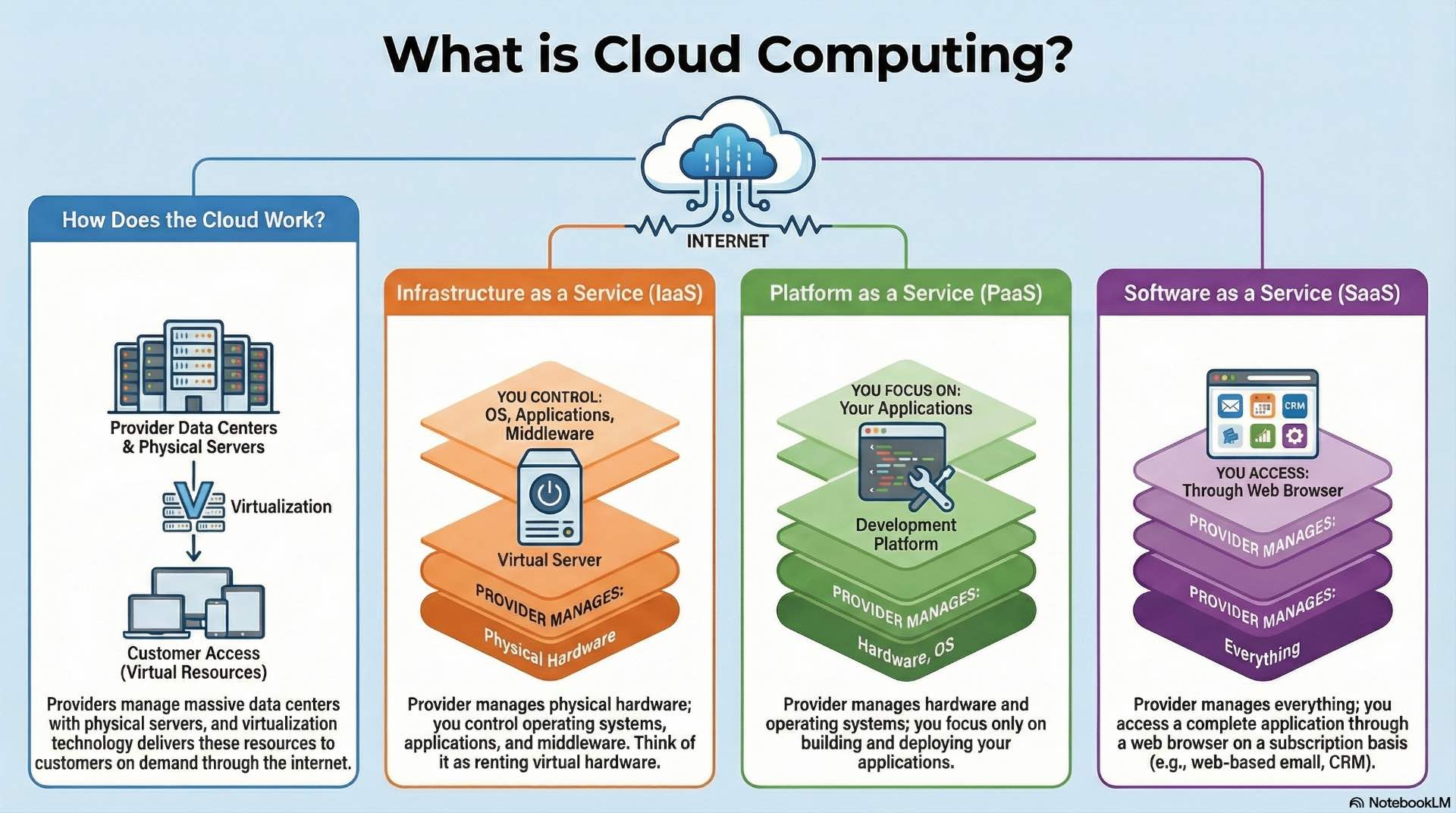
Cloud solutions operate through a layered architecture where physical infrastructure sits at the base. Virtualization layers, management platforms, and applications stack above it. Data centers house thousands of servers connected through high-speed networks. Redundant power systems maintain continuous operation during equipment failures. Hypervisor software creates virtual machines that behave like independent computers with dedicated operating systems.
Administrators define resource requirements through cloud management portals. Orchestration layers translate requests into hardware allocations, spinning up virtual machines or containers on available servers. Network controllers configure virtual switches and firewalls. Storage controllers allocate disk capacity from shared pools. Elastic scaling happens transparently through automated systems that monitor utilization. Multi-tenant architecture maximizes hardware efficiency while logical isolation ensures security between customers.
What Are Cloud Solutions Service Models
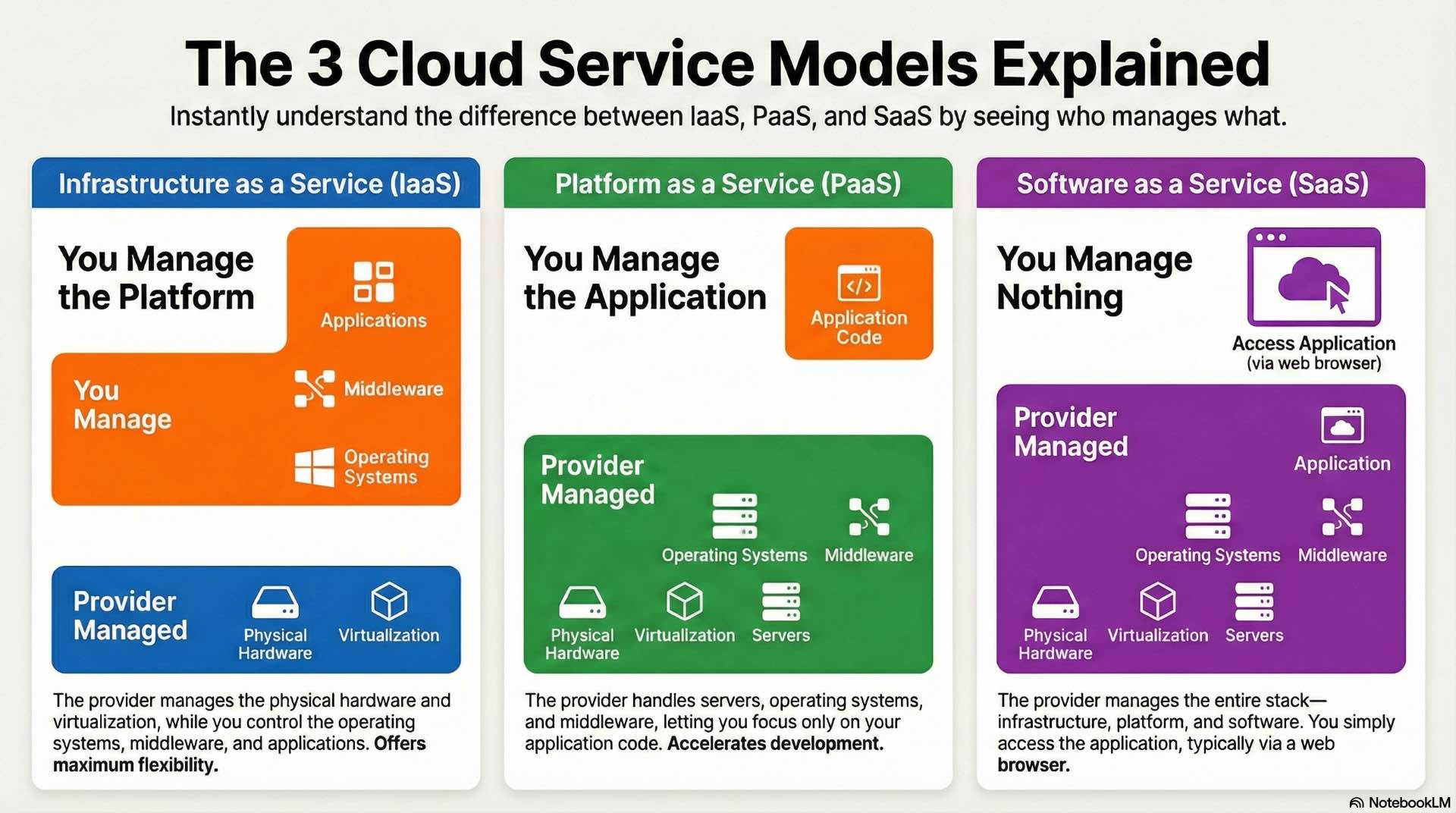
Service models define responsibilities between cloud providers and customers. Each model abstracts different technology layers. IaaS offers maximum control with more management overhead. PaaS balances developer productivity with operational simplicity. SaaS eliminates all infrastructure concerns.
Infrastructure as a service (IaaS)
IaaS provides computing infrastructure—servers, storage, and networking—as on-demand services. Virtualization underlies all IaaS offerings. Providers manage physical hardware and hypervisor layers while customers control operating systems, middleware, and software applications. Organizations choose IaaS for maximum flexibility or legacy software requiring specific OS configurations.
VM provisioning takes minutes rather than weeks for physical servers. Pay-as-you-go pricing charges only for consumed resources, making IaaS cost-effective for variable workloads. Development environments, high-performance computing clusters, and disaster recovery sites commonly use IaaS. Lift-and-shift migration moves applications directly to cloud VMs with minimal modification.
Platform as a service (PaaS)
PaaS abstracts away infrastructure management and provides a complete development platform for software applications. Providers handle servers, operating systems, and middleware while developers focus on application code. Development cycles accelerate without infrastructure concerns.
Developers deploy applications through simple commands or automated pipelines. Automatic scaling and load balancing require no manual configuration. Built-in services for databases, caching, and messaging simplify application architecture. Managed runtime environments reduce operational complexity compared to IaaS.
Software as a service (SaaS)
SaaS delivers complete applications over the internet on a subscription basis. Providers manage infrastructure, platform, and application layers entirely. Users access software through web browsers without local installation.
Email systems, CRM platforms, and collaboration tools commonly operate as SaaS. Subscription pricing provides predictable monthly expenses while providers handle updates and patches. Multi-tenant application architecture shares resources across customers while maintaining data isolation.
What Are Cloud Deployment Models
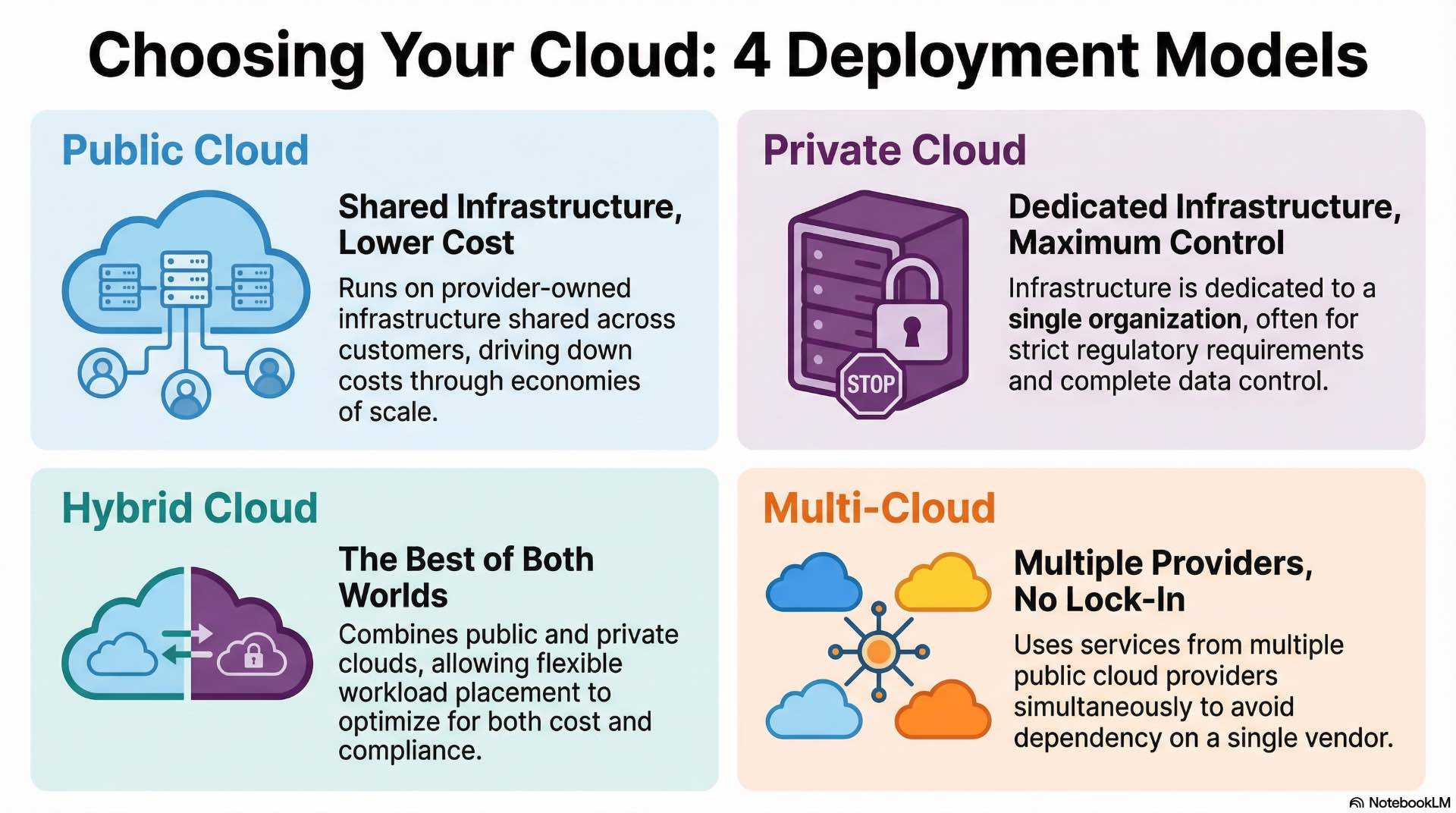
Deployment models determine where infrastructure resides and who manages it. Security, compliance, performance, and cost characteristics vary by model. Most organizations combine multiple models for different workloads.
Public cloud explained
Public cloud services run on provider-owned infrastructure shared across multiple customers. Major providers maintain data centers globally. Shared infrastructure drives economies of scale that reduce costs below independent deployments.
Logical isolation through hypervisors and virtual networks provides security rather than physical separation. Providers invest heavily in compliance frameworks. Global data center presence enables geographic distribution for performance and redundancy.
Private cloud explained
Private cloud dedicates infrastructure to a single organization. On-premises or third-party hosted options exist. Strict regulatory requirements drive private deployment choices for complete data control.
Private clouds use the same virtualization technologies as public providers within a controlled environment. Dedicated hardware eliminates noisy neighbor performance impacts. Predictable performance without resource contention simplifies compliance with data sovereignty regulations.
Hybrid cloud explained
Hybrid cloud combines public and private environments. Workloads move between them based on requirements. Sensitive data stays in private infrastructure. Public cloud handles compute-intensive processing or demand spikes. Workload placement flexibility optimizes cost and compliance together.
Encrypted tunnels or dedicated connections link environments securely. Unified visibility across both deployment types enables consistent policy enforcement. Managing multiple environments increases complexity.
Multi-cloud explained
Multi-cloud strategies use multiple public providers simultaneously. Avoiding vendor lock-in and accessing best-of-breed services motivate adoption. Distributed provider approaches reduce single-vendor dependency and provide negotiating leverage.
Containers and Kubernetes simplify deployments across providers. Standardized interfaces abstract infrastructure differences between platforms. Teams must maintain expertise across multiple platforms with different billing and security models.
Core Components of Cloud Solutions Infrastructure
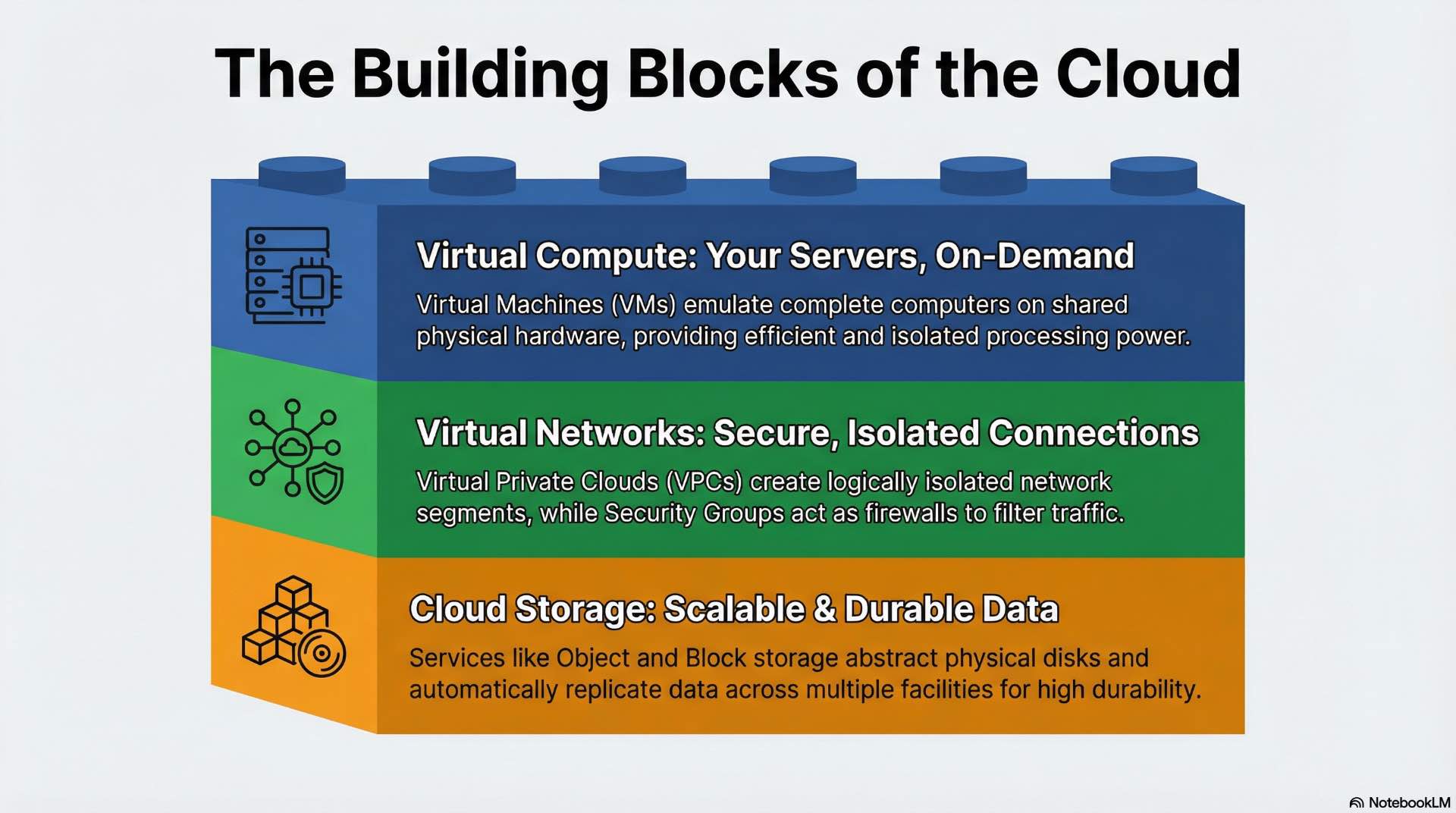
Physical and virtual components determine capability and performance characteristics. Understanding these elements helps architects design effective cloud solutions deployments. Virtualization forms the foundation of modern cloud solutions architectures.
Virtual machines and cloud computing resources
Virtual machines emulate complete computers through software on shared physical servers. Server virtualization enables this resource sharing. Hypervisors like VMware, Hyper-V, and KVM manage resource allocation. VMs remain isolated from each other while sharing hardware efficiently.
Instance types range from single-CPU configurations to massive multi-socket systems. GPU-equipped instances support machine learning workloads. Memory-optimized variants serve in-memory databases requiring fast data access. Live migration moves running VMs between physical hosts without downtime.
Virtual networks and cloud networking
Virtual Private Clouds create logically isolated network segments within provider infrastructure. Organizations define IP address ranges and subnets mirroring traditional designs. Security groups filter traffic at instance level while network ACLs protect subnet boundaries.
Software-defined networking abstracts physical infrastructure into programmable resources. Infrastructure-as-code approaches deploy network configurations alongside compute resources automatically. Transit gateways simplify hub-and-spoke topologies connecting multiple networks.
Cloud storage architecture
Cloud storage services abstract physical disk arrays into accessible APIs. Replication and durability happen automatically. Automatic replication maintains data durability across multiple facilities.
Object storage provides unlimited capacity for unstructured data. HTTP APIs replace traditional file protocols for massive scalability. Block storage delivers persistent volumes for databases requiring low-latency consistent I/O performance.
How Cloud Computing Resources Work
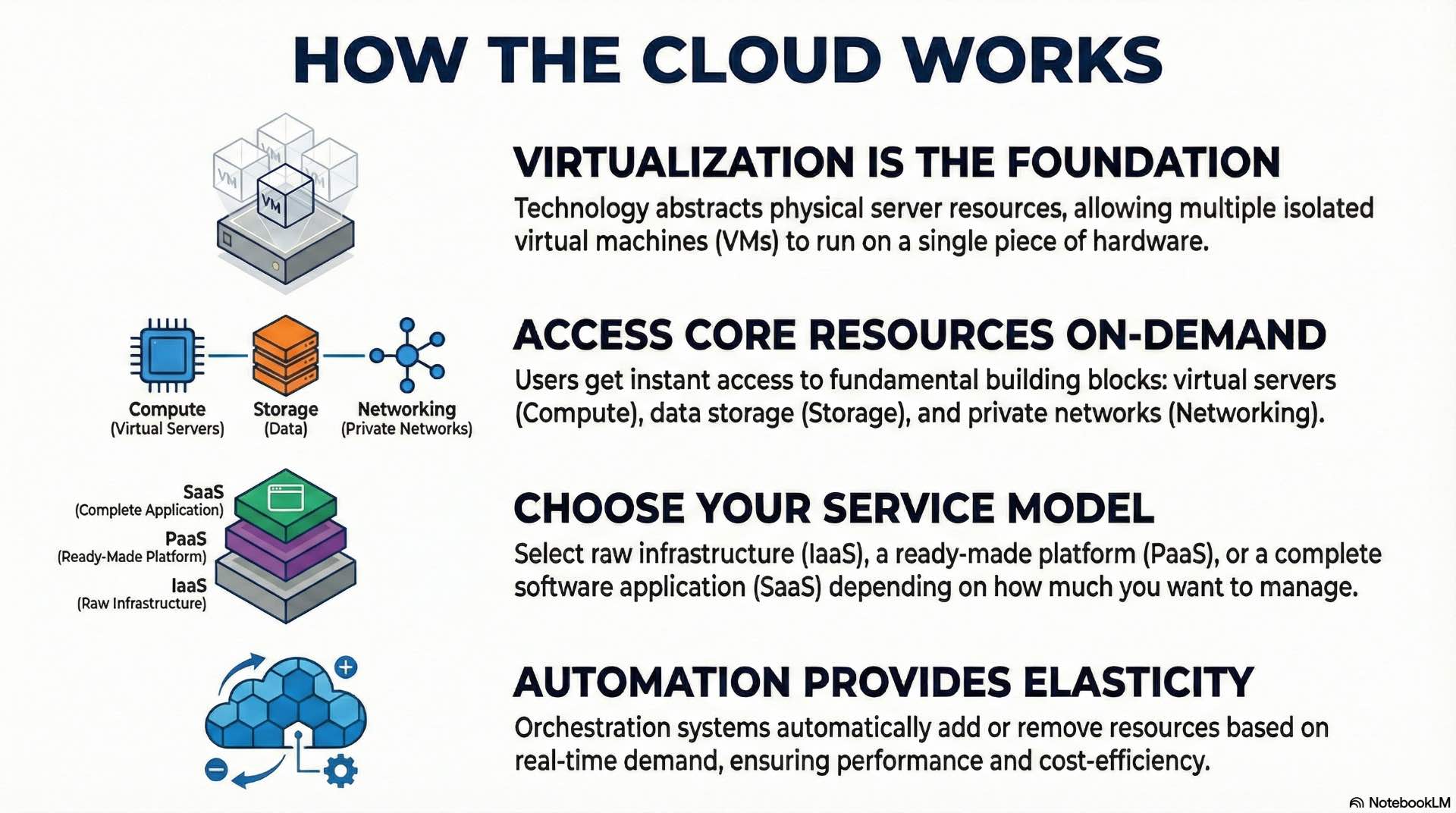
Computing services form the processing foundation of cloud platforms. Virtualization and containerization provide multiple options from traditional VMs to serverless functions. Each approach suits different workload characteristics. Enterprise cloud solutions support all these compute models through unified management interfaces.
Compute instances and resource allocation
Instance provisioning matches configurations to workload requirements. Providers offer dozens of instance types for general purpose, compute-intensive, or memory-intensive applications. Virtual CPU count, memory, and network bandwidth define allocations.
Orchestration places instances on hosts with available capacity. Resource governors enforce limits while allowing burst capacity when available. Auto-scaling adjusts instance counts based on metrics. Scaling policies define thresholds triggering capacity adjustments.
Containers and orchestration platforms
Containers package applications with dependencies into portable units. Unlike VMs, containers share the host operating system kernel for faster startup and better efficiency.
Kubernetes automates container deployment, scaling, and management. Service discovery and automatic load distribution happen across container instances. Container registries store and distribute images. CI/CD pipelines build images automatically from source for deployment.
Serverless computing services
Serverless platforms execute code without server management. Functions spin up on demand, run, then terminate. Platforms handle all scaling automatically from zero to thousands of instances.
HTTP requests, database changes, or scheduled timers trigger function execution. Event-driven architecture decouples system components for improved resilience. Serverless suits sporadic workloads. Sustained high-volume processing may cost more than reserved capacity.
Cloud Solutions Storage and Database Services Explained
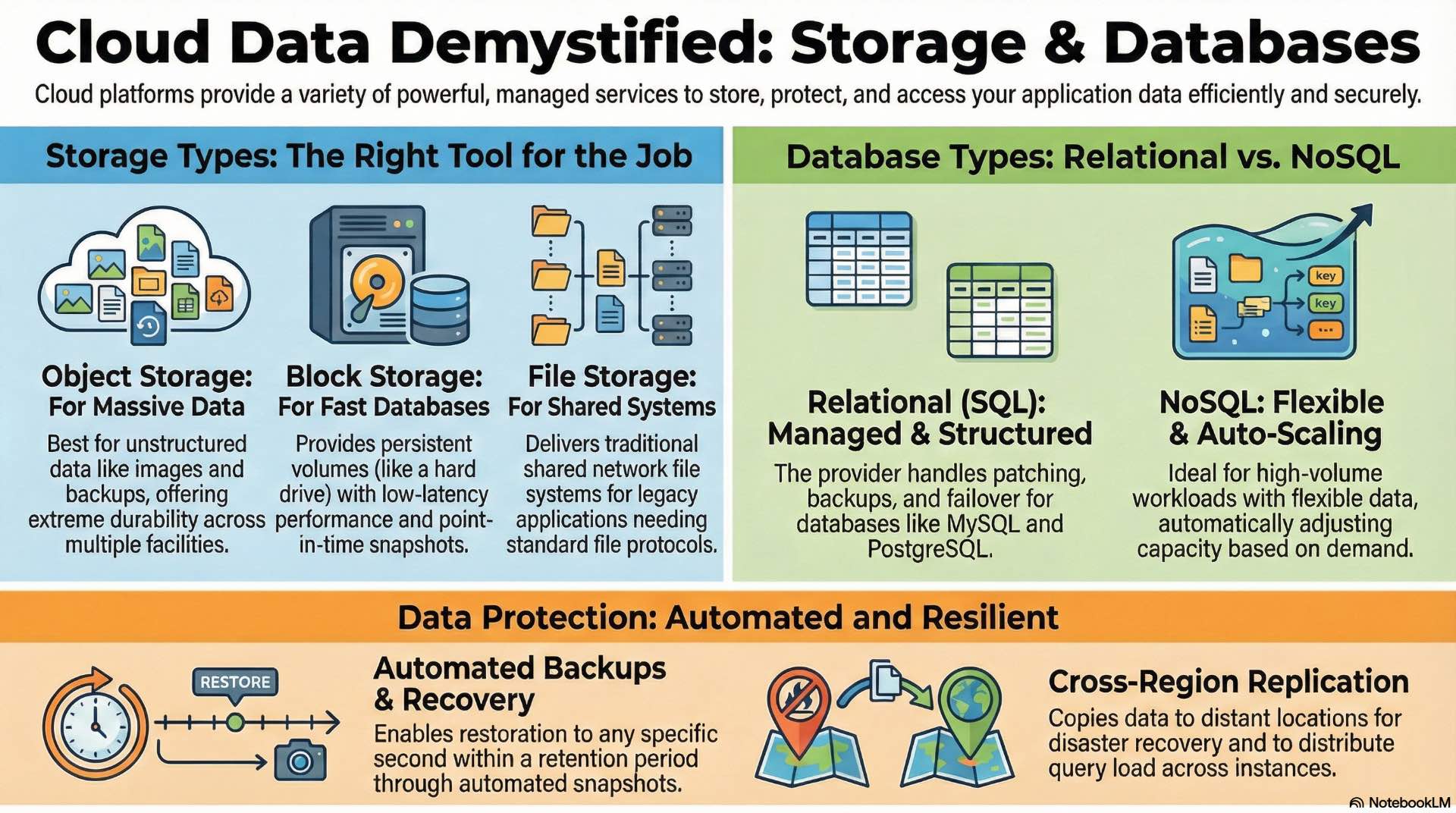
Storage and database services manage persistent application data. Storage virtualization abstracts physical arrays into logical pools. Service selection impacts performance, cost, and operational complexity. Software applications depend on these data services for persistent storage. Virtualization enables efficient resource sharing across database workloads.
Object, block, and file storage
Object storage stores massive quantities of unstructured data. Eleven nines of durability spans multiple facilities through built-in replication. Storage classes optimize costs for access frequency.
Block storage provides persistent volumes with SSD or HDD backing. Point-in-time snapshots enable backup and migration. File storage delivers shared network systems. NFS and SMB protocols support legacy applications expecting traditional file interfaces.
Cloud database types
Relational database services provide managed MySQL, PostgreSQL, and SQL Server engines. Providers handle patching, backups, and failover while customers manage schemas. Multi-AZ deployments maintain standby replicas for automatic failover during primary failures.
NoSQL databases handle high-volume, flexible-schema workloads. Automatic scaling adjusts capacity based on demand without intervention. In-memory caching stores frequently accessed data in RAM for sub-millisecond response times.
Backup and data replication
Automated backup policies capture database snapshots at defined intervals. Point-in-time recovery enables restoration to any second within retention periods.
Cross-region replication copies data to distant locations. Read replicas distribute query load across instances while maintaining consistency. Automated tiering optimizes storage costs over time through lifecycle policies.
Cloud Solutions Networking and Connectivity Basics
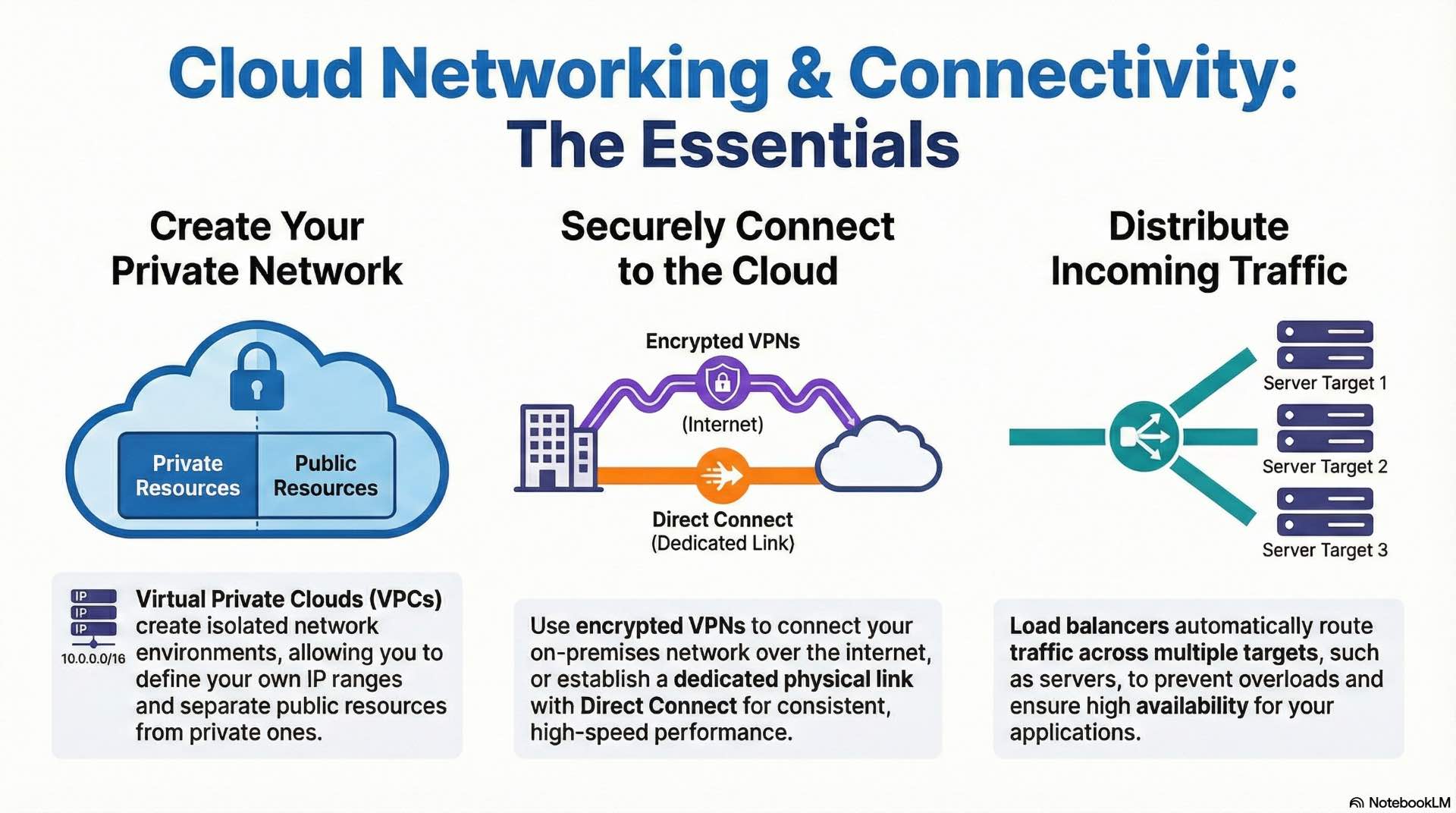
Network services connect cloud resources and provide secure access paths. Network virtualization enables flexible connectivity options. Proper architecture ensures security and performance. All cloud solutions require careful network planning for optimal operation.
Virtual private cloud networking
VPCs define isolated network environments with customizable IP ranges. Subnets segment ranges across availability zones. Multi-tier architectures separate public and private components. Web servers reside in public subnets while databases occupy private subnets.
Route tables control traffic flow. Internet gateways enable outbound access. NAT gateways let private resources reach internet services without inbound exposure. Security groups apply stateful rules tracking connections at instance level.
VPN and direct cloud connectivity
Site-to-site VPNs create encrypted tunnels between on-premises networks and cloud VPCs. IPsec protocols authenticate endpoints and encrypt traffic traversing connections. Multiple tunnels provide redundancy.
Direct connect establishes dedicated physical links. Private connections bypass the public internet entirely for consistent latency up to 100 Gbps. Certificate or directory authentication validates users before granting network access.
Load balancing and traffic control
Application load balancers distribute HTTP and HTTPS traffic across targets. Path-based routing sends different URLs to different backends. Health checks remove unhealthy targets automatically from rotation.
Network load balancers handle TCP and UDP at connection level. Ultra-low latency serves performance-critical applications. Global load balancers route to nearest deployments, minimizing latency for geographically distributed users.
Cloud Security and Compliance Explained
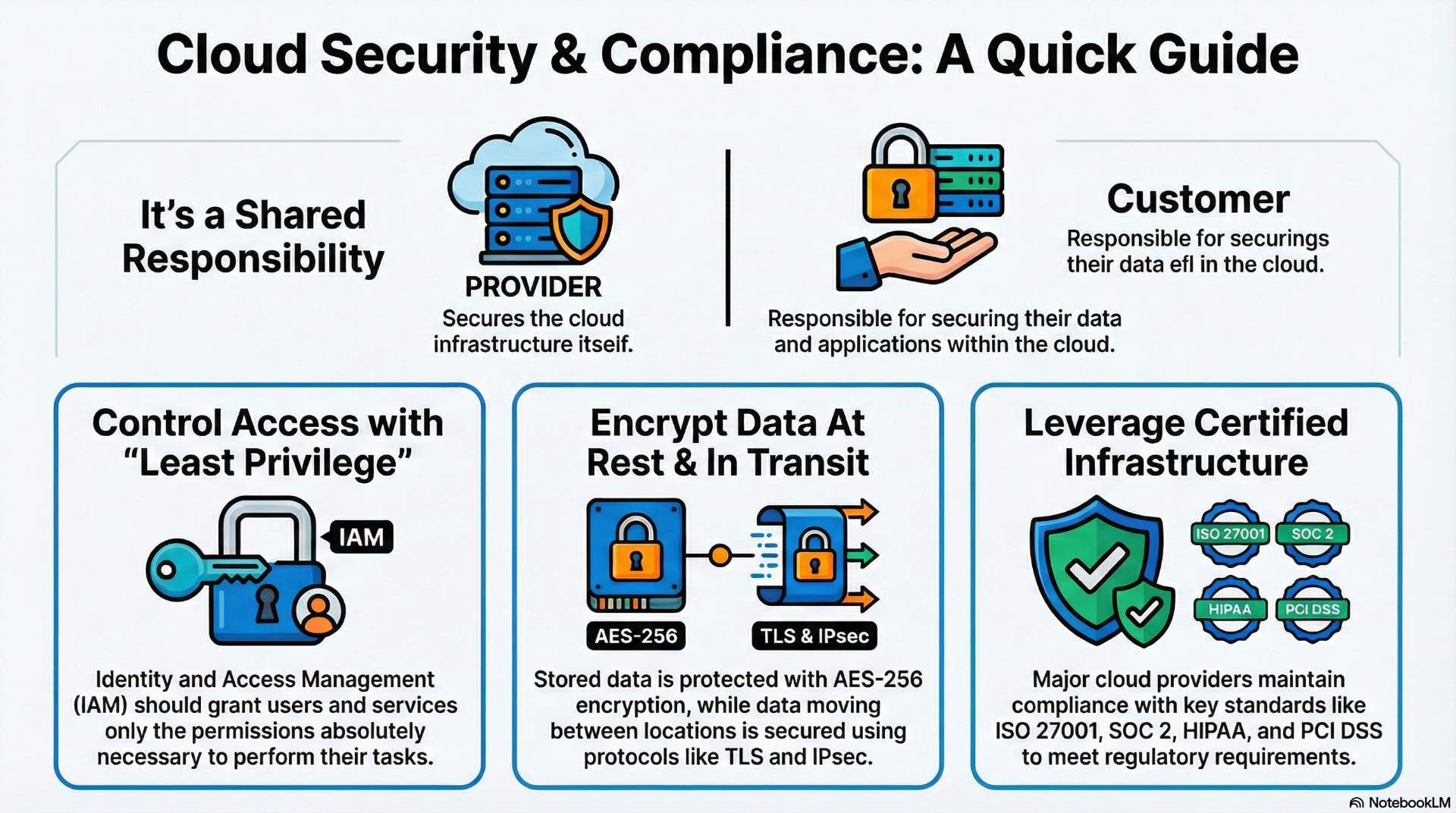
Security frameworks protect cloud resources and ensure regulatory compliance. Layered defense addresses threats at multiple levels. Virtualization security differs from traditional physical security models.
Identity and access management in cloud
IAM services control resource access and permitted actions. Least-privilege principles grant only necessary permissions to minimize damage from compromised credentials.
Multi-factor authentication adds verification beyond passwords. Additional factors confirm user identity before granting access. Service accounts let applications authenticate without user credentials. Role assumption allows temporary elevated permissions.
Data encryption and key management
Encryption at rest protects stored data using AES-256. Provider-managed keys simplify operations. Customer-managed keys provide greater control over encryption lifecycle.
TLS certificates secure HTTP connections. IPsec encrypts VPN tunnel traffic between sites. Hardware security modules provide tamper-resistant storage for sensitive cryptographic material.
Cloud compliance standards
Providers maintain ISO 27001, SOC 2, HIPAA, and PCI DSS certifications. Attestations verify infrastructure meets security requirements defined by regulatory bodies.
Shared responsibility models clarify provider and customer obligations. Compliance tools assess configurations against framework requirements. Audit logs create immutable trails supporting incident investigation.
Cloud Management and Monitoring Tools
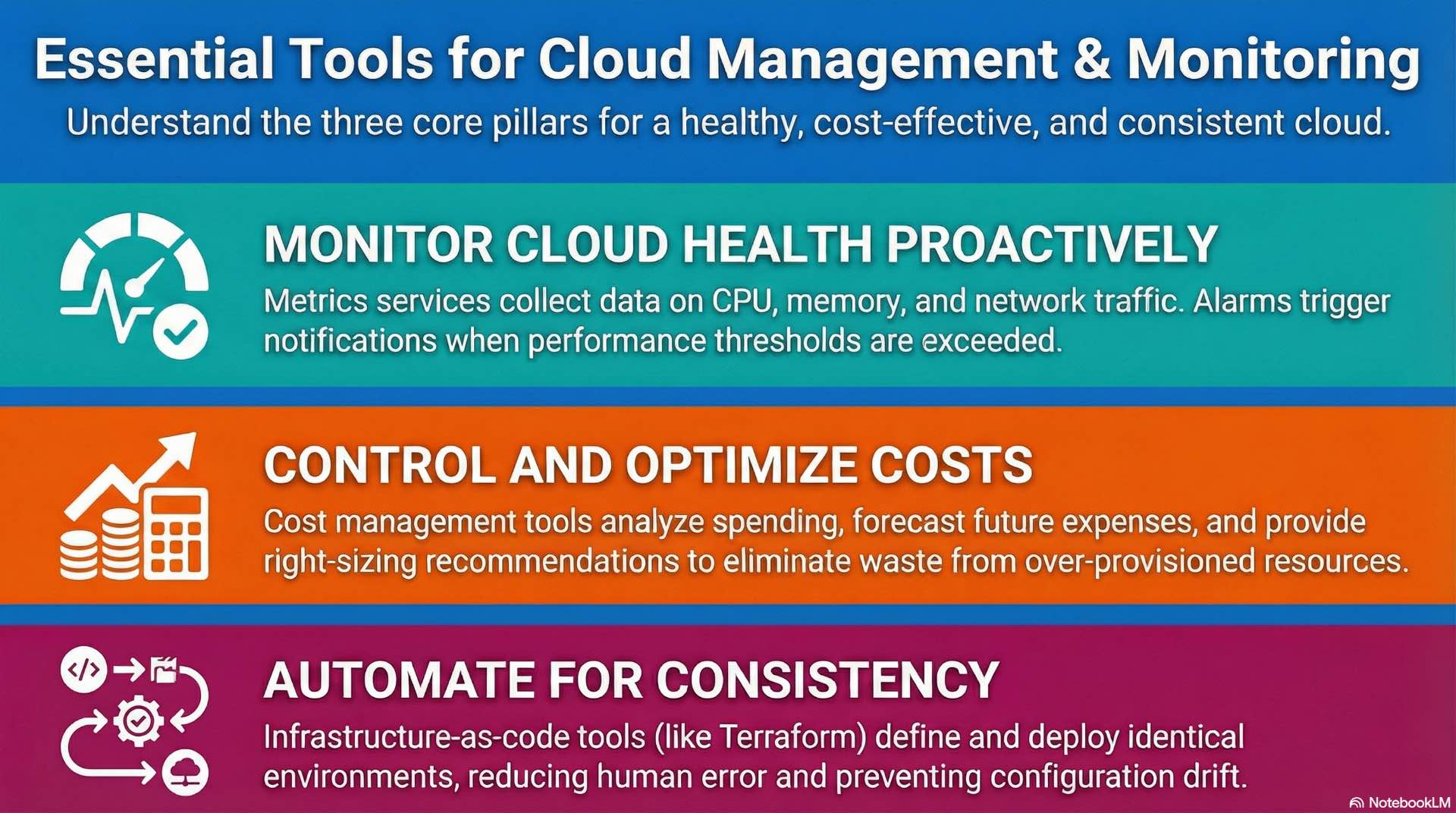
Management platforms provide visibility and control across environments. Effective monitoring enables proactive issue resolution and cost optimization. Software tools automate routine tasks across cloud solutions environments.
Cloud monitoring and logging
Metrics services collect CPU utilization, memory usage, and network traffic. Dashboards visualize trends. Alarms trigger notifications when thresholds exceed limits.
Log aggregation centralizes output from instances and services. Retention policies balance storage costs against investigation needs. Distributed tracing tracks requests across microservices, identifying latency sources and failure points.
Cloud cost management
Cost explorers analyze spending by service, account, or time period. Forecasting tools predict future costs based on trends for budget planning.
Budget alerts notify when spending exceeds limits. Reserved commitments reduce costs for steady-state workloads through term discounts. Right-sizing recommendations identify over-provisioned resources to reduce waste.
Automation and infrastructure as code
Terraform and similar tools define resources in version-controlled files. Identical environments deploy for development and production consistently.
Configuration management ensures instances maintain desired states. Drift detection identifies unauthorized manual changes from baselines. Runbooks automate procedures, reducing human error during incident response.
Cloud Migration and Integration Methods
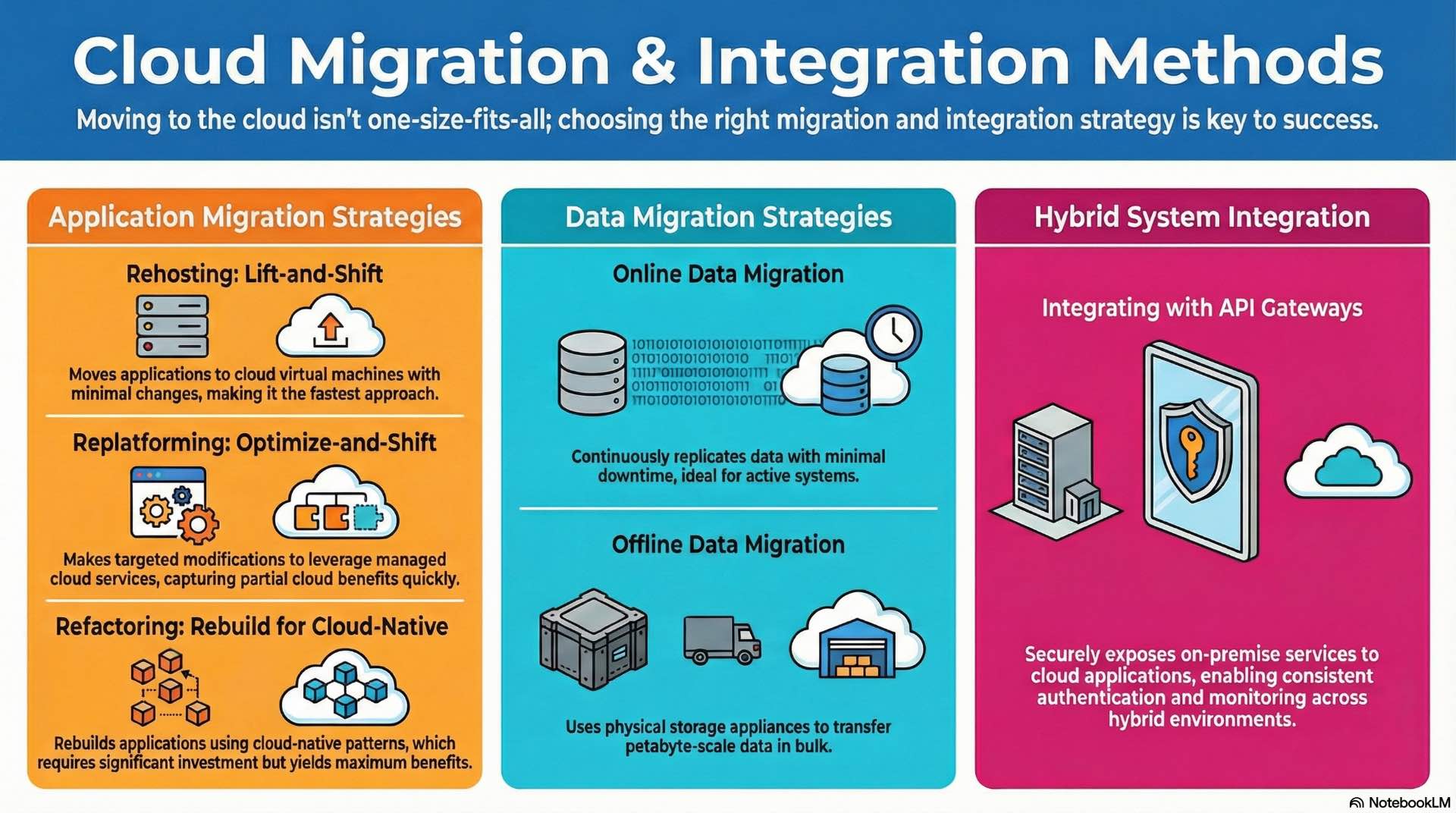
Migration strategies move workloads from existing environments to cloud platforms. Approach selection impacts timeline, cost, and benefits. Modern cloud solutions support multiple migration paths for different application types.
Application migration to cloud
Rehosting lifts applications to cloud VMs with minimal changes. Lift-and-shift minimizes application modifications required to begin operating in cloud environments.
Replatforming makes targeted modifications for managed services. Quick optimization captures partial cloud benefits. Refactoring rebuilds applications using cloud-native patterns but requires significant development investment and expertise.
Data migration strategies
Online migration tools replicate data continuously. Change data capture tracks modifications during transfer for consistent migrations without extended downtime.
Offline migration handles petabyte-scale transfers. Storage appliances enable bulk data loading from customer sites. Automated schema conversion reduces manual effort when changing database platforms.
Integrating cloud with on-premise systems
API gateways expose on-premises services to cloud applications. Consistent authentication and monitoring span hybrid integrations.
Message queues decouple systems across environments. Buffered communications handle connectivity interruptions. Identity federation enables single sign-on across hybrid deployment boundaries.
Cloud Operations and Maintenance
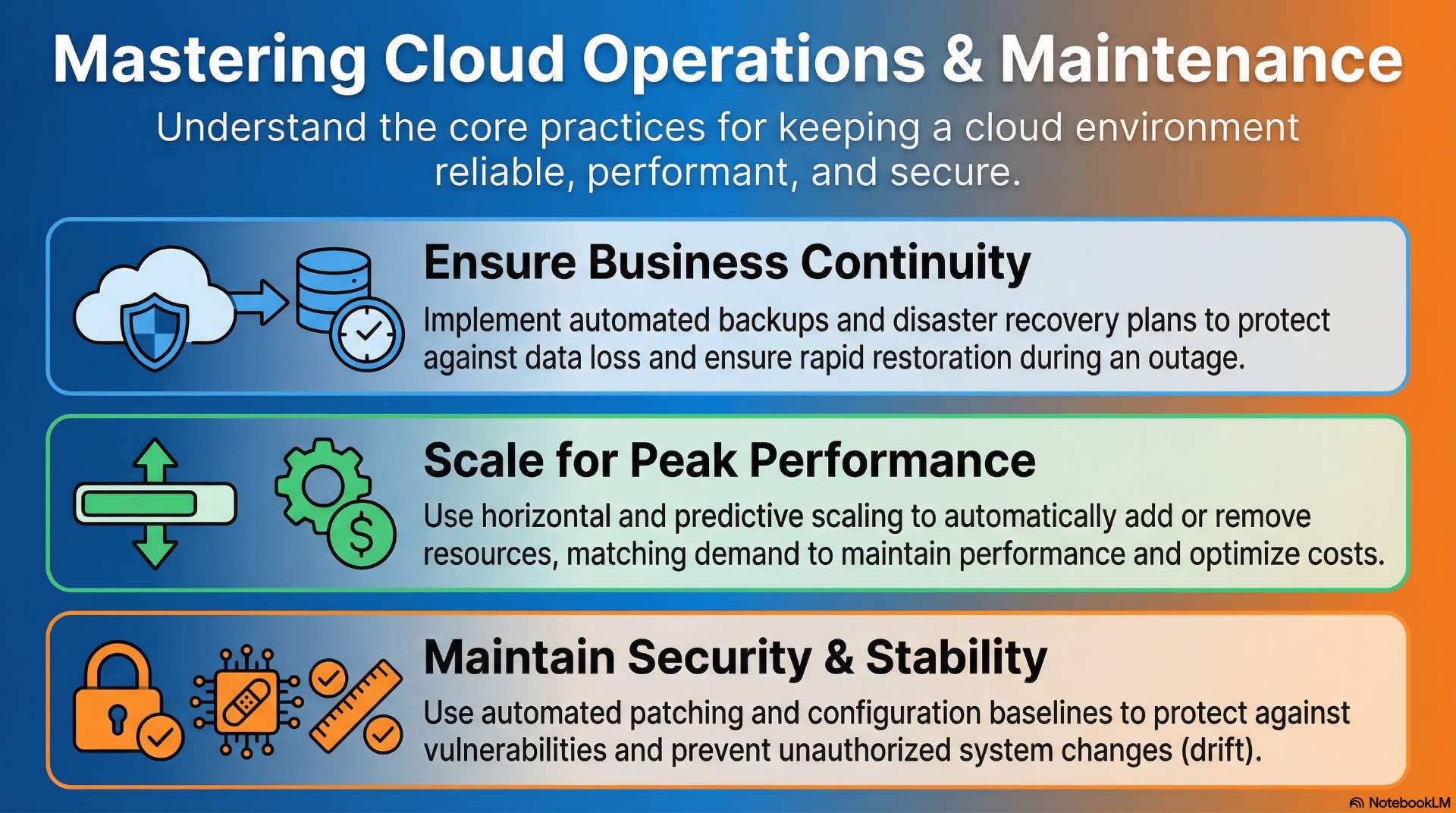
Operational practices maintain environment health and performance. Consistent processes ensure reliability and security over time. Virtualization simplifies many maintenance tasks compared to physical infrastructure.
Cloud backup and disaster recovery
Backup services capture snapshots on automated schedules. Retention policies define backup availability duration based on compliance requirements.
Recovery plans define recovery objectives. Pilot light configurations maintain minimal standby infrastructure ready for disasters. Testing validates failover procedures work as documented before actual emergencies occur.
Performance scaling and optimization
Horizontal scaling adds instances to distribute load. Predictive scaling anticipates demand from historical patterns. Proactive capacity adjustments prevent performance degradation.
Monitoring and profiling identify bottlenecks. Query optimization improves application response times. Spot instances provide steep discounts for interruptible processing.
Patch and configuration management
Automated patching updates systems on defined schedules. Maintenance windows control when updates apply to minimize disruption.
Configuration baselines define required settings. Automated remediation corrects configuration drift. Change processes require approvals for production environment changes.
Cloud Application Use Cases
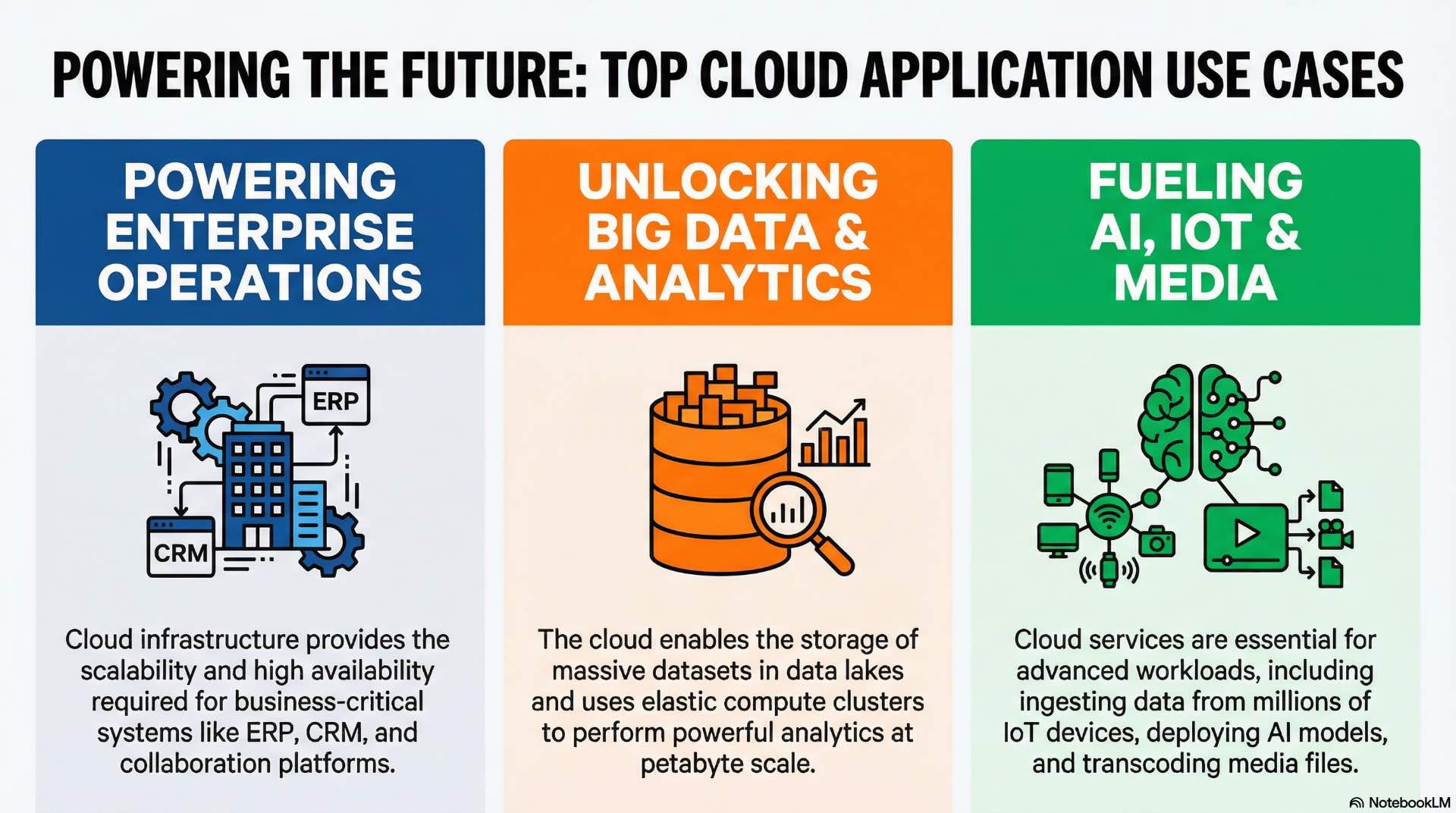
Different workload types use specific cloud capabilities. Understanding common patterns helps organizations plan effective cloud solutions deployments. Software applications across industries benefit from cloud infrastructure and virtualization technology.
Enterprise cloud applications
ERP and CRM systems run on cloud infrastructure for scalability. High availability configurations ensure business-critical uptime through redundant deployments.
Collaboration platforms enable distributed workforces. Productivity tools scale instantly for organizational growth. BI tools provide analytics dashboards accessible from any location.
Big data and analytics workloads
Data lakes store massive datasets in object storage. Elastic compute clusters scale for specific jobs then release resources when complete.
Data warehouses handle petabytes of structured data. Fast query performance spans enormous datasets through columnar storage. ML pipelines deploy predictions through serverless inference endpoints.
AI, IoT, and media cloud solutions
IoT platforms ingest telemetry from millions of devices. Storage services retain device history for analysis and compliance purposes.
AI services provide pre-trained models for vision and language processing. Integrated experiment tracking supports model versioning. Transcoding services convert formats automatically for playback across devices.
Cloud solutions combine infrastructure, platforms, and software services to deliver computing capabilities without hardware management burdens. Organizations selecting appropriate service models gain flexibility through virtualization and can optimize costs while improving agility. Operational frameworks for security, monitoring, and maintenance ensure software applications run reliably on virtualized infrastructure while meeting compliance requirements and performance objectives.