
Burglar alarm design for store and showroom security, detailing intrusion risks, sensor placement, zoning and integration with other retail security systems.
Effective burglar alarm design for store and showroom security protects retail premises from break-ins and after-hours intrusion attempts. Store owners and security managers need a practical framework that addresses perimeter defense, zone planning and technology choices. This guide walks through the steps needed to design reliable protection for showroom environments.
Retailers face different threats than homeowners. High foot traffic, multiple access points and valuable merchandise create unique challenges. A well-planned system balances robust detection with minimal false triggers. The following sections explain how to assess risk, choose sensors, and configure zones. They also show how to integrate with existing infrastructure.
What is a burglar alarm system for retail stores and showrooms?
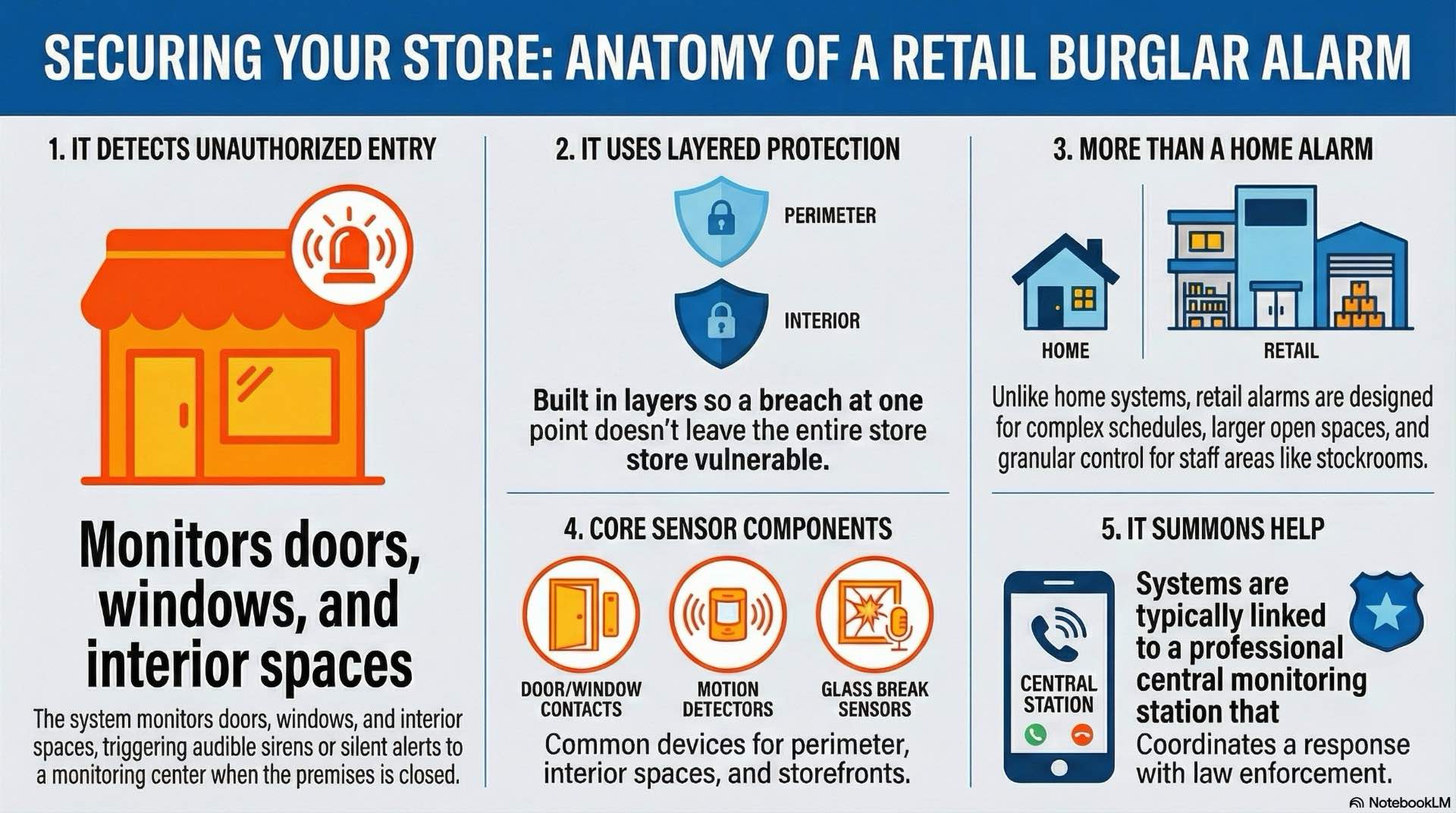
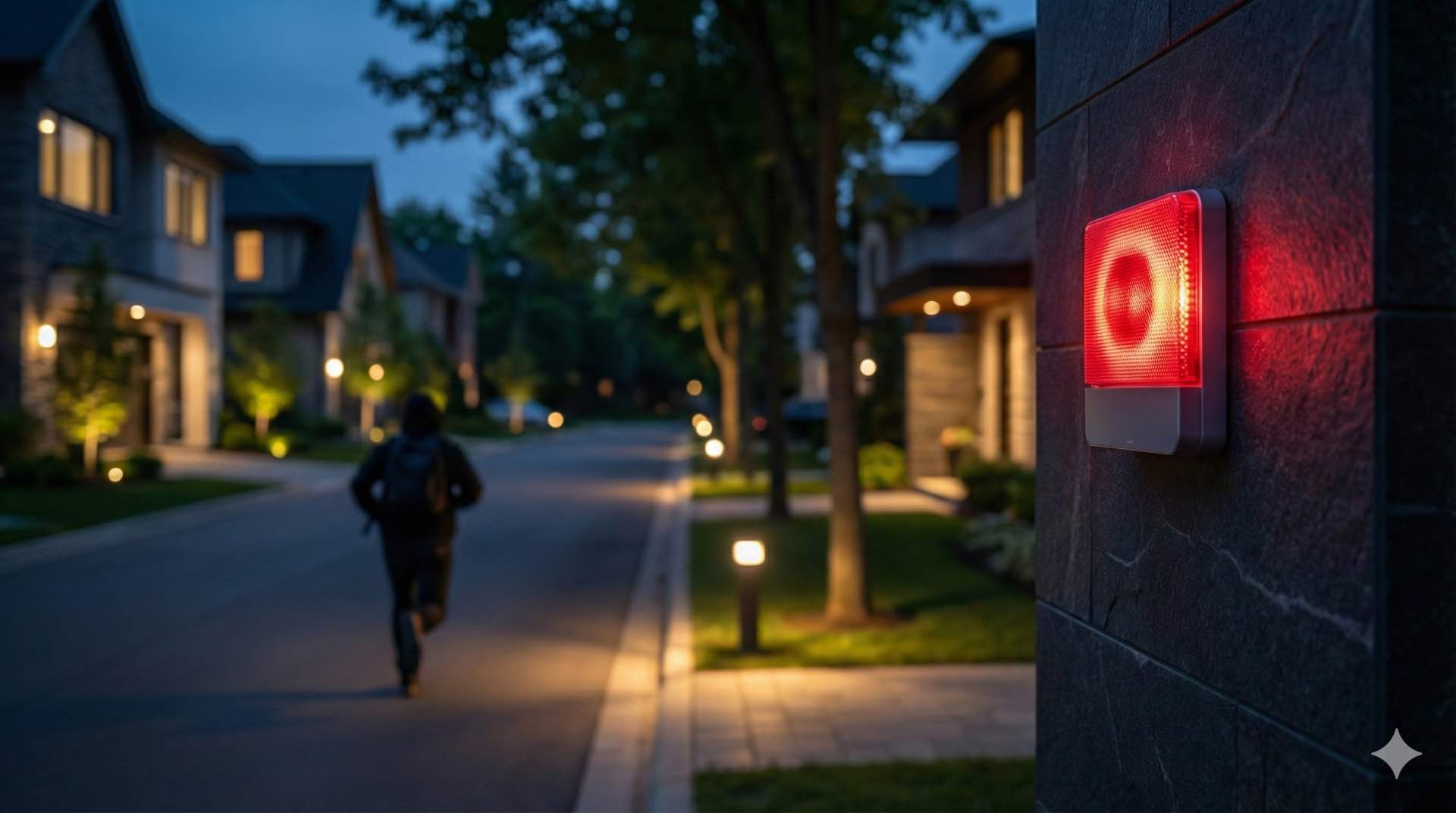
A retail intrusion alarm detects unauthorized entry when the premises is closed or restricted. The system monitors doors, windows and interior spaces using sensors that trigger audible or silent alerts. Response options include local sirens, remote notifications to a monitoring center or direct dispatch to law enforcement.
Key reasons stores and showrooms need intrusion security
Retail spaces hold high-value inventory and cash. Intrusion events can cause significant financial loss through stolen goods and property damage. Beyond theft, forced entry increases insurance premiums and disrupts business operations. Many jurisdictions require security protection as a condition of coverage. Customer confidence also depends on visible security measures that demonstrate the owner’s commitment to safety.
Main differences between home and retail burglar alarm design
Residential systems protect a single family dwelling with predictable routines. Retail and showroom systems must accommodate staff movement, delivery schedules and varying occupancy patterns. Commercial zones require more granular control to support partial arming during cleaning or restocking. Glass facades and open showroom layouts demand specialized sensors that reduce nuisance triggers. Regulatory standards often mandate supervised circuits and tamper detection in commercial security environments.
How to assess burglary and intrusion risks in retail stores and showrooms
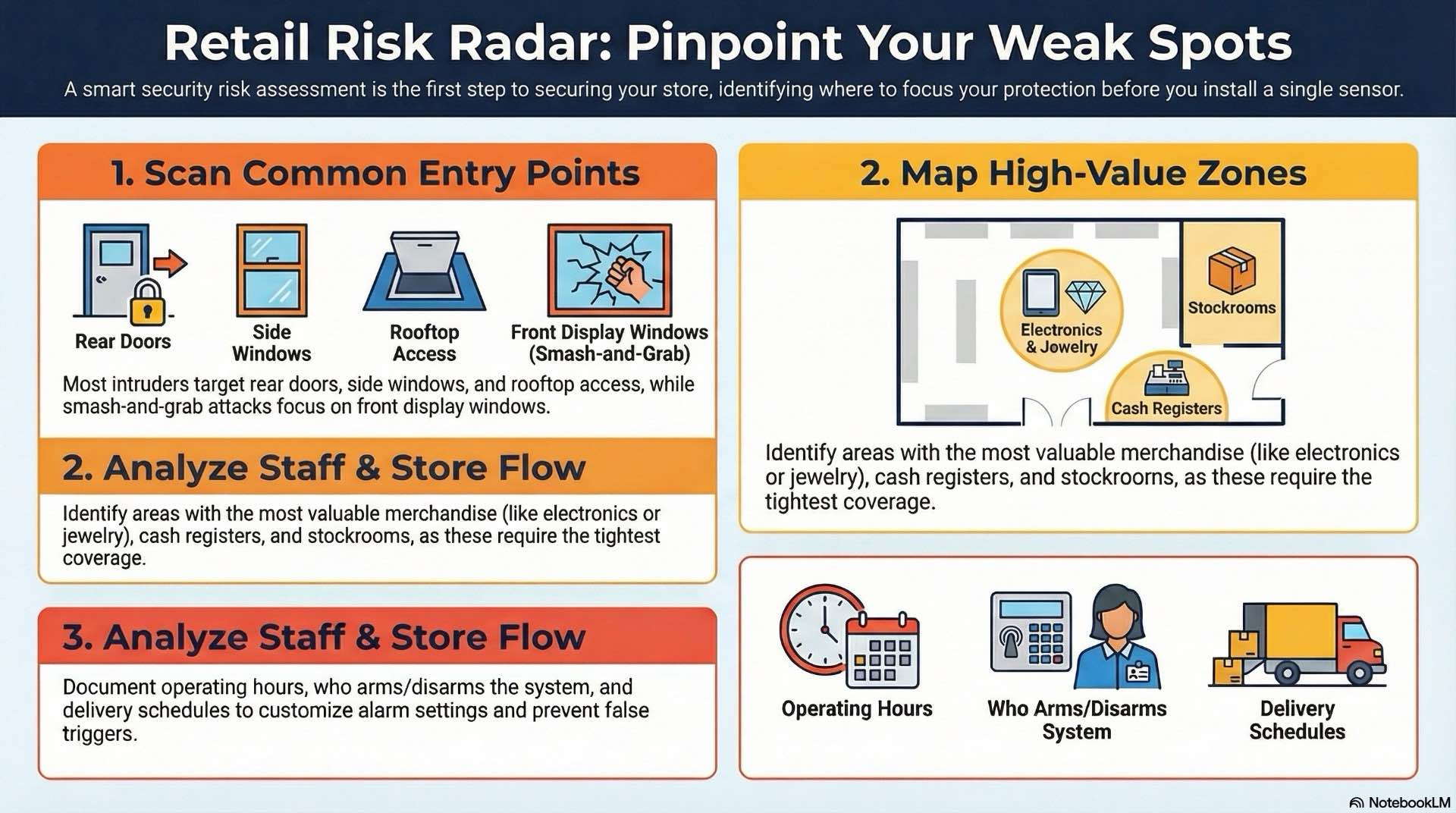
Risk assessment identifies vulnerable points and prioritizes security protection measures. Begin by documenting all entry paths and high-value zones. Consider the building’s location, visibility and history of local crime. Review insurance requirements and consult local law enforcement for area-specific intrusion risk guidance.
Common burglary scenarios and break-in entry points in retail
Most intrusion attempts target rear doors, side windows and rooftop access hatches. Delivery entrances with minimal visibility attract forced entry. Smash-and-grab attacks focus on front windows near valuable displays. Internal theft by former employees or accomplices can involve disabling intrusion detection systems from inside. Roof penetrations through skylights or ductwork occur in buildings adjacent to taller structures.
How to identify high-value zones and vulnerable store areas
Map out merchandise value by section. Electronics, jewelry and small portable goods require the tightest coverage. Cash handling areas need panic button protection. Stockrooms and back offices hold both inventory and sensitive documents. Showroom loading docks present dual risks of theft and unauthorized access. Perimeter walls adjacent to alleys or parking areas offer concealment for tampering.
Using opening hours and staff flow in your alarm risk assessment
Document normal operating hours and closing procedures. Identify who arms and disarms the system. Note cleaning schedules, maintenance windows and delivery times. This information shapes zoning decisions and helps prevent false events caused by legitimate activity. Part-time or seasonal staff patterns affect user code management and access level planning.
How to plan burglar alarm zones and architecture for a retail store
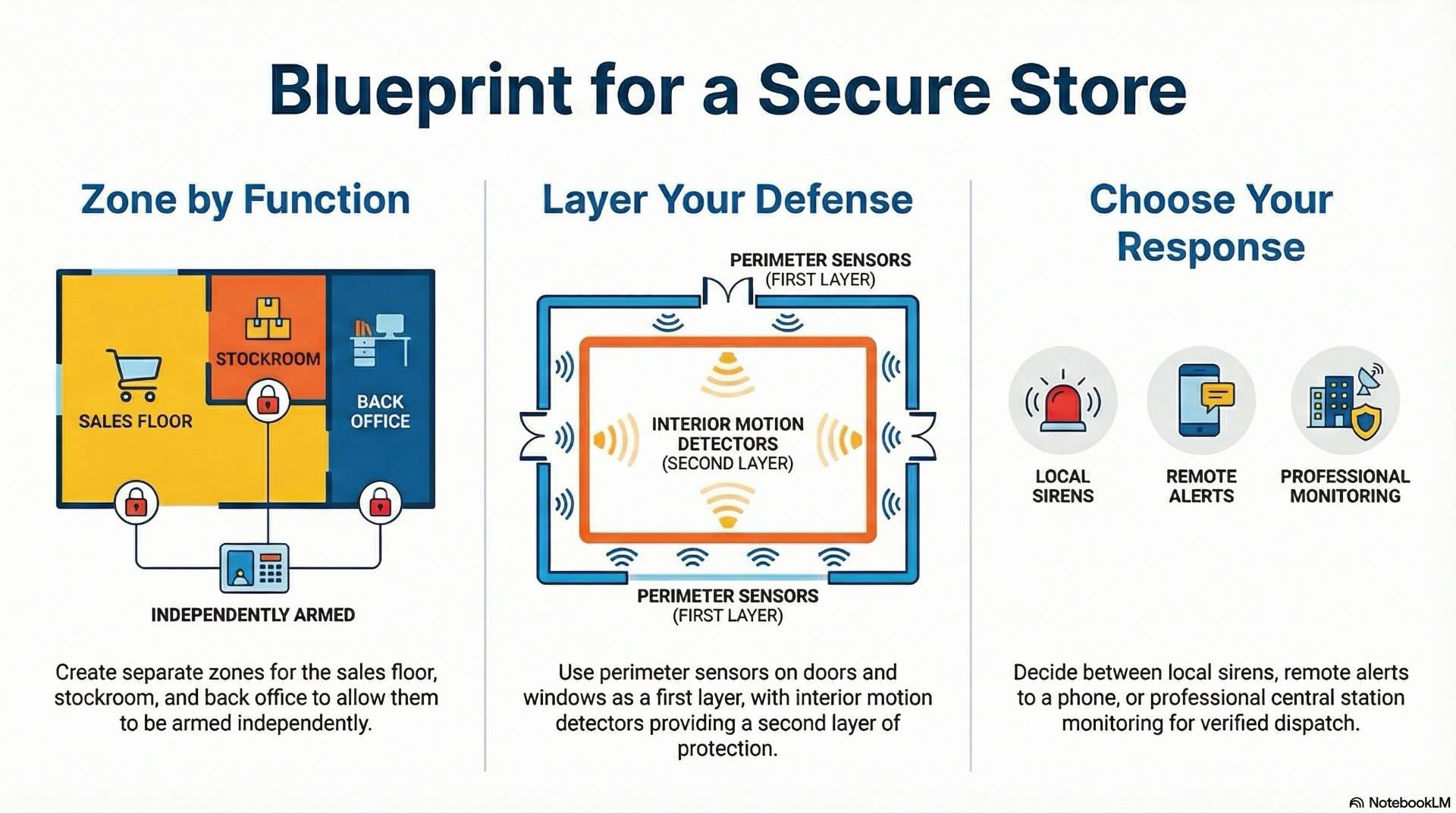
Effective burglar alarm design for store and showroom security relies on zoning that divides the premises into logical areas that can be armed independently. This approach supports flexible operation while maintaining consistent security coverage. Each zone should correspond to a distinct functional space or security risk level.
Creating zones for sales floor, stockroom and back office areas
The sales floor typically operates as a single large zone covering customer-accessible space. Stockrooms form separate zones because they remain restricted even when the sales floor is open. Back offices hold cash and records, warranting independent control. Service corridors and restrooms can be grouped or isolated based on layout. Separate zoning allows staff to work in the office while the main sales area is armed.
Separating perimeter, interior and high-risk alarm protection
Perimeter intrusion detection monitors all doors and windows using magnetic contacts. Interior motion detectors provide a second layer inside the space. High-risk areas like safes or display cases may justify additional spot protection. Layered coverage ensures that a single sensor failure or bypass does not leave the premises unprotected. This architecture also reduces false triggers by isolating environmental factors.
Choosing between local alarms, remote alerts and central monitoring
Local sirens deter intruders and alert neighbors but rely on someone responding. Remote alerts send notifications to the owner’s phone via cellular or internet links. Central station monitoring provides professional response coordination and verifies events before dispatching authorities. Many insurers require monitored systems to qualify for premium discounts. Redundant communication paths using both cellular and IP connections increase reliability.
Best burglar alarm sensors and devices for stores and showrooms
Sensor selection directly impacts detection performance and false rates. Retail environments demand devices that tolerate environmental changes while maintaining sensitivity. The right mix depends on layout, construction and operational patterns.
Using door and window contacts to protect retail entrances
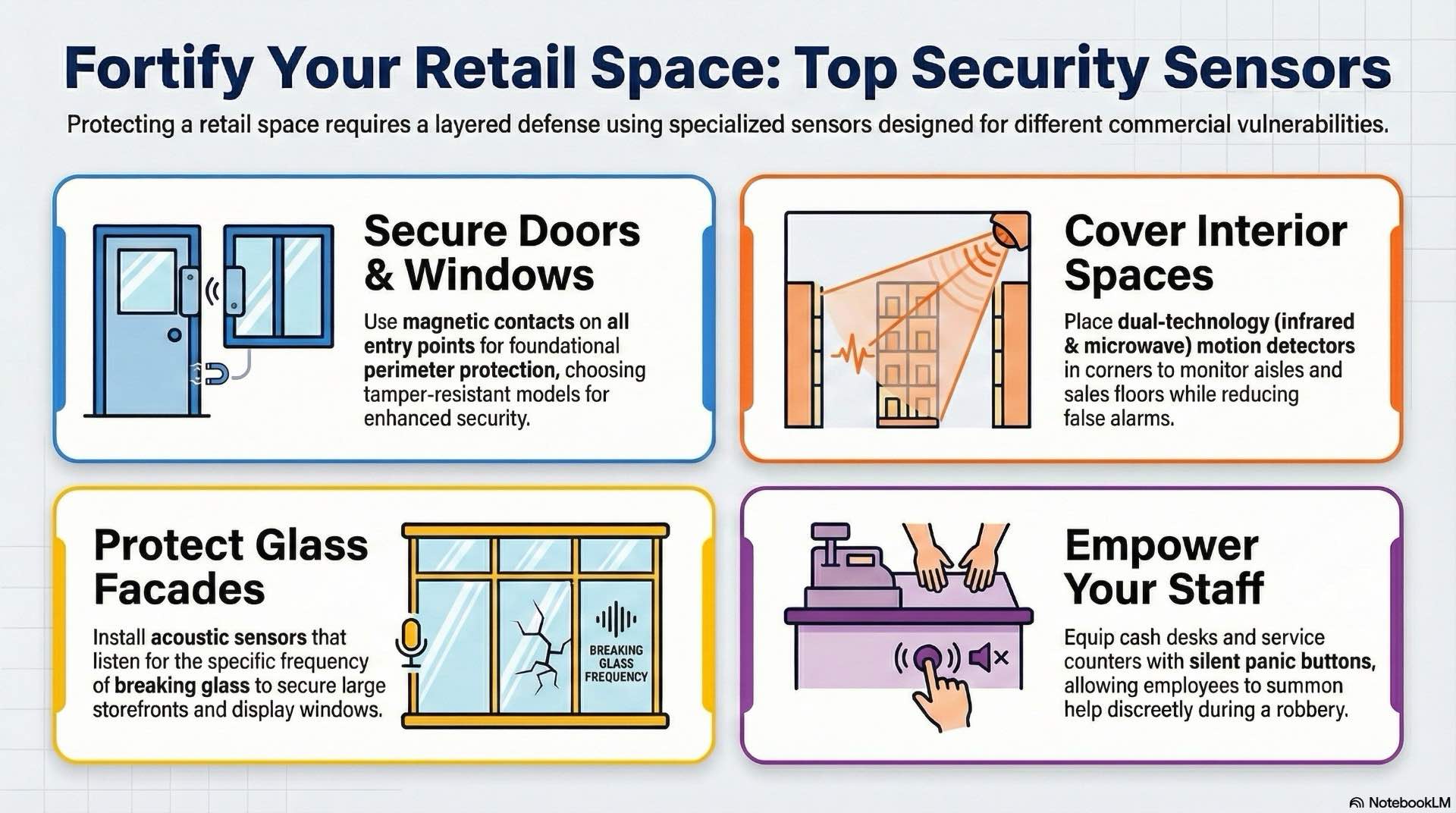
Magnetic contacts are the foundation of perimeter protection. Surface-mount models install quickly on metal or wood frames. Concealed contacts in door edges offer tamper resistance. Wide-gap versions accommodate commercial door tolerances. All perimeter contacts should include tamper switches that trigger if the sensor is removed. Supervised circuits continuously verify wiring integrity.
Motion detector placement for aisles, corridors and sales areas
Passive infrared sensors detect body heat changes in their coverage cone. Mount detectors in corners to maximize aisle coverage while avoiding HVAC vents. Ceiling-mounted units work well in open-plan spaces. Dual-technology models combine infrared with microwave sensing to reduce false positives. Pet-immune settings prevent triggers from small animals without sacrificing intrusion detection sensitivity.
Protecting glass façades and display windows with glass break sensors
Acoustic detectors listen for the specific frequency signature of breaking glass. Position sensors centrally on walls or ceilings to cover multiple panes. Shock sensors mounted directly on the glass frame detect forced entry attempts before breakage occurs. Large storefront and showroom windows may require multiple sensors to ensure complete coverage. Test devices with recorded sounds to verify proper sensitivity.
Panic buttons and hold-up alarms for cash desks and service counters
Silent panic devices allow staff to summon help during robberies or threatening situations. Install buttons under counters at cash registers and customer service desks. Wireless fobs offer portable protection for employees moving through the space. These triggers bypass normal entry delays and generate priority dispatch notifications. Regular training ensures staff understand proper usage and avoid accidental activation.
Sensor placement tips to reduce false alarms in stores and showrooms
False triggers erode confidence in the system and can result in fines from repeat dispatch calls. Proper placement and configuration minimize nuisance events while maintaining effective intrusion detection capability.
Covering entrances, exits and display areas without blind spots
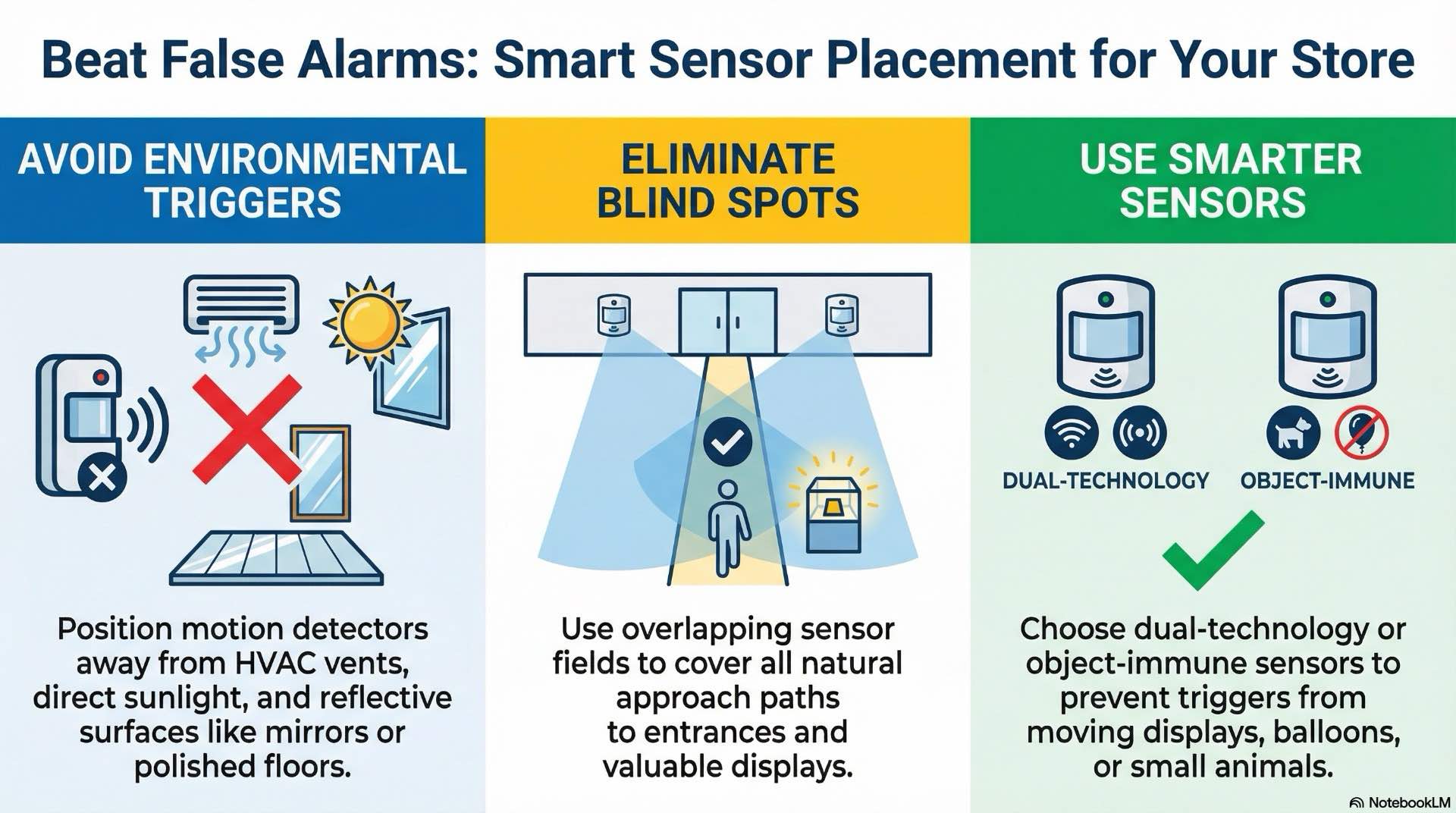
Survey each entry point from multiple angles. Overlapping sensor fields prevent gaps where intruders could evade detection. Place motion sensors to cover the natural approach paths to doors and valuable displays. Avoid aiming detectors at glass surfaces that reflect heat signatures. Test walk patterns during commissioning to confirm coverage extends to floor level.
Avoiding false burglar alarms from HVAC, lighting and reflections
Air vents create thermal currents that can trigger infrared sensors. Position detectors away from supply and return registers. Fluorescent ballasts and LED drivers generate electrical noise that affects some devices. Sunlight through windows causes temperature shifts; use curtains or reposition sensors. Reflective surfaces like mirrors or polished floors can bounce signals and create phantom detections.
Pet-immune and object-immune detection options for retail spaces
Some retail environments permit service animals or have resident cats for pest control. Pet-immune motion detectors use height and mass discrimination to ignore small animals. Adjust sensitivity thresholds based on the largest expected animal. Object-immune settings prevent triggers from moving merchandise like balloons or hanging displays. Dual-technology sensors reduce environmental false positives through cross-verification.
Choosing a burglar alarm control panel and communication for retail
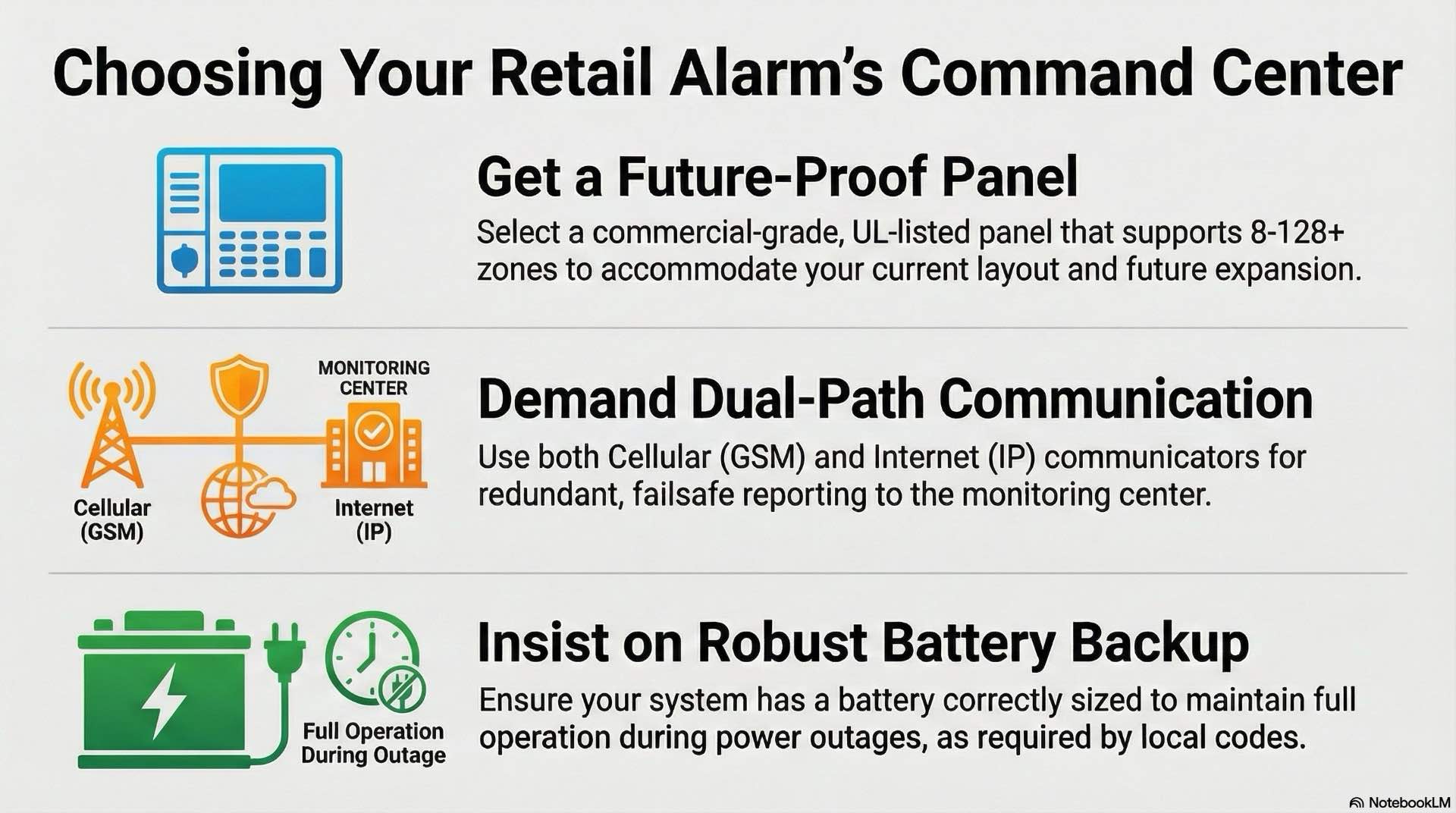
The control panel is the system’s central intelligence. It must support the required number of zones, user codes and communication paths. Modern security panels offer network connectivity and remote programming capabilities.
Selecting a control panel that supports multi-zone retail security
Commercial panels typically support eight to 128 zones depending on scale. Modular systems allow expansion as the business grows. Look for panels with flexible arming schedules and user permission levels. On-board event logging stores thousands of entries for audit and troubleshooting. Battery backup should support the standby duration required by local codes, often many hours of continued operation during outages. Choose UL-listed or equivalent certified equipment.
GSM and IP communication paths for monitoring center reporting
Cellular communicators use encrypted signals over mobile networks. IP modules transmit via the local network or dedicated internet connection. Dual-path systems use both methods for redundancy. Test signal strength before installation and consider backup power for network equipment. Many monitoring centers require specific communication protocols; verify compatibility early. Remote access features allow authorized users to view system status and arm remotely.
Power backup and battery design for store alarm resilience
Primary power comes from a dedicated circuit with surge protection. Battery backup maintains operation during outages. Calculate battery capacity based on total current draw and desired standby time. Larger systems may need multiple batteries or auxiliary power supplies. Sealed lead-acid batteries require replacement every three to five years. The panel should monitor battery voltage and alert before capacity drops below safe levels.
Integrating burglar alarms with CCTV and access control in retail
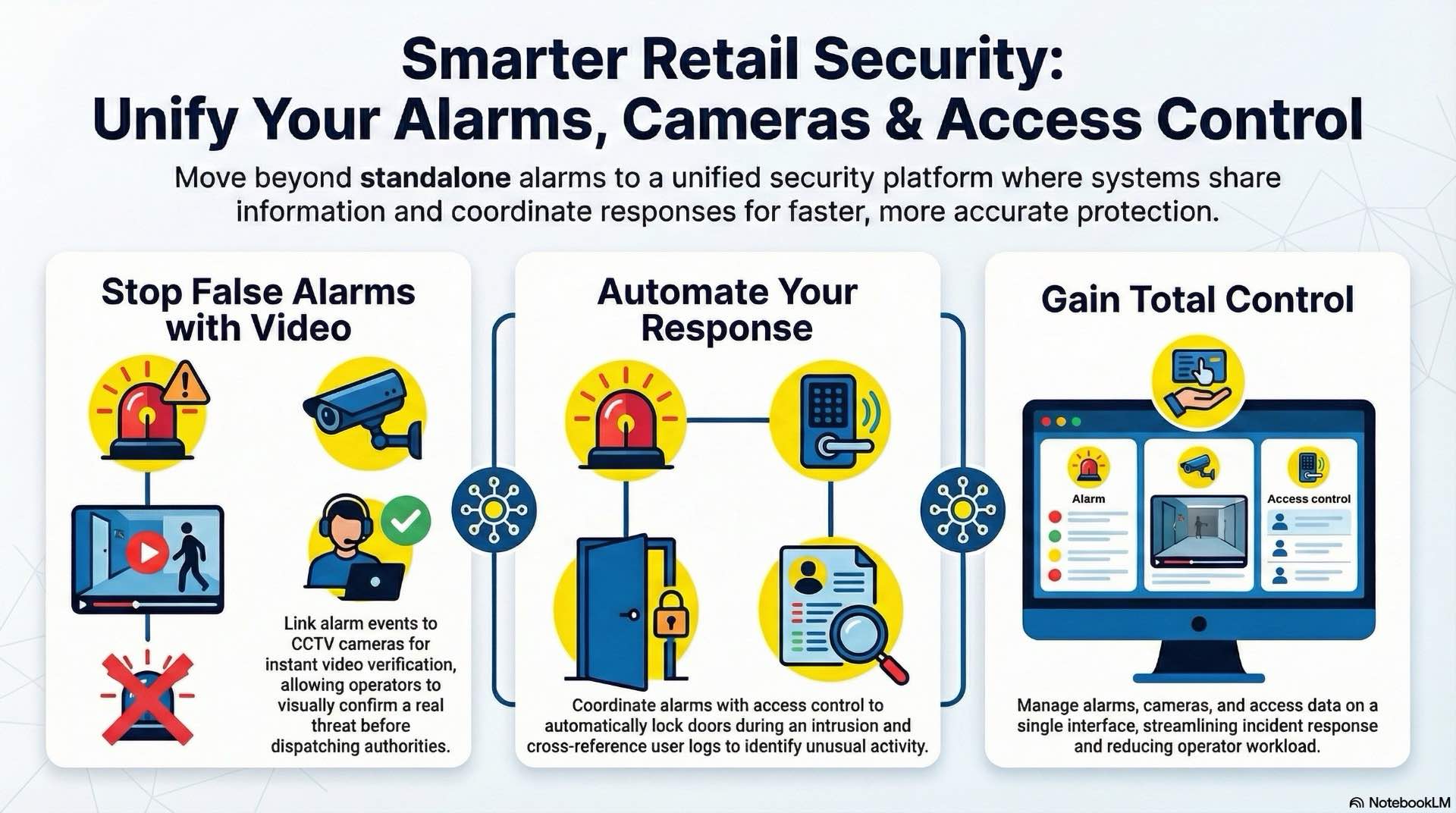
Integration creates a unified security platform where systems share information and coordinate responses. This approach improves verification accuracy and reduces operator workload.
Linking alarm events with CCTV cameras for video verification
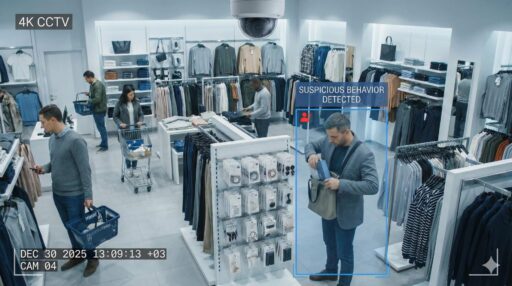
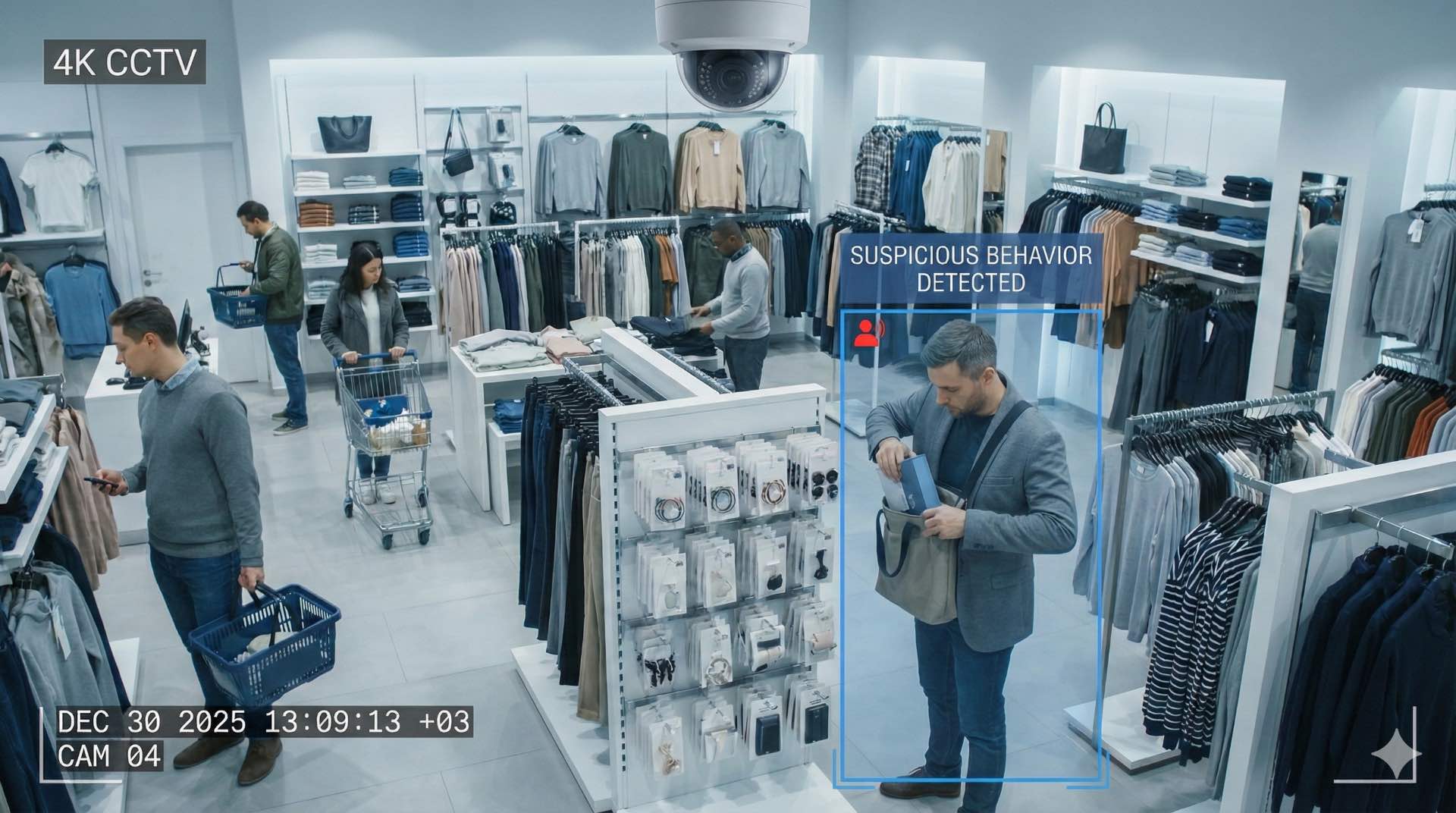
When an intrusion zone triggers, linked cameras automatically record or display live feeds. Video verification reduces false dispatch by allowing operators to visually confirm activity before calling authorities. Pre-alarm recording captures events leading up to the trigger. Some systems use video analytics to confirm human presence and differentiate from environmental motion. Camera health status can integrate with logs to flag coverage gaps.
Coordinating burglar alarms with access control and emergency plans
Access control systems can automatically lock or unlock doors based on intrusion alarm status. Valid card reads during armed periods generate different responses than forced entry. User logs from access control cross-reference with arming records to identify pattern anomalies. Emergency evacuation modes override normal locking to ensure safe egress. Integration streamlines incident response by presenting all relevant data on a single interface.
Using POS and store management data to improve alarm responses
Point-of-sale systems track cash drawer activity and closing procedures. Integration allows the system to expect arming within a defined window after the last transaction. Deviations trigger additional verification steps. Inventory management data identifies when high-value merchandise is on-site, allowing dynamic adjustment of monitoring priorities. Scheduling systems coordinate with partial arming modes to accommodate planned after-hours work.
Setting up user codes and arming modes for store staff
User management controls who can arm, disarm and configure the system. Proper code discipline prevents unauthorized access and maintains accountability.
Defining user roles and access levels for retail employees
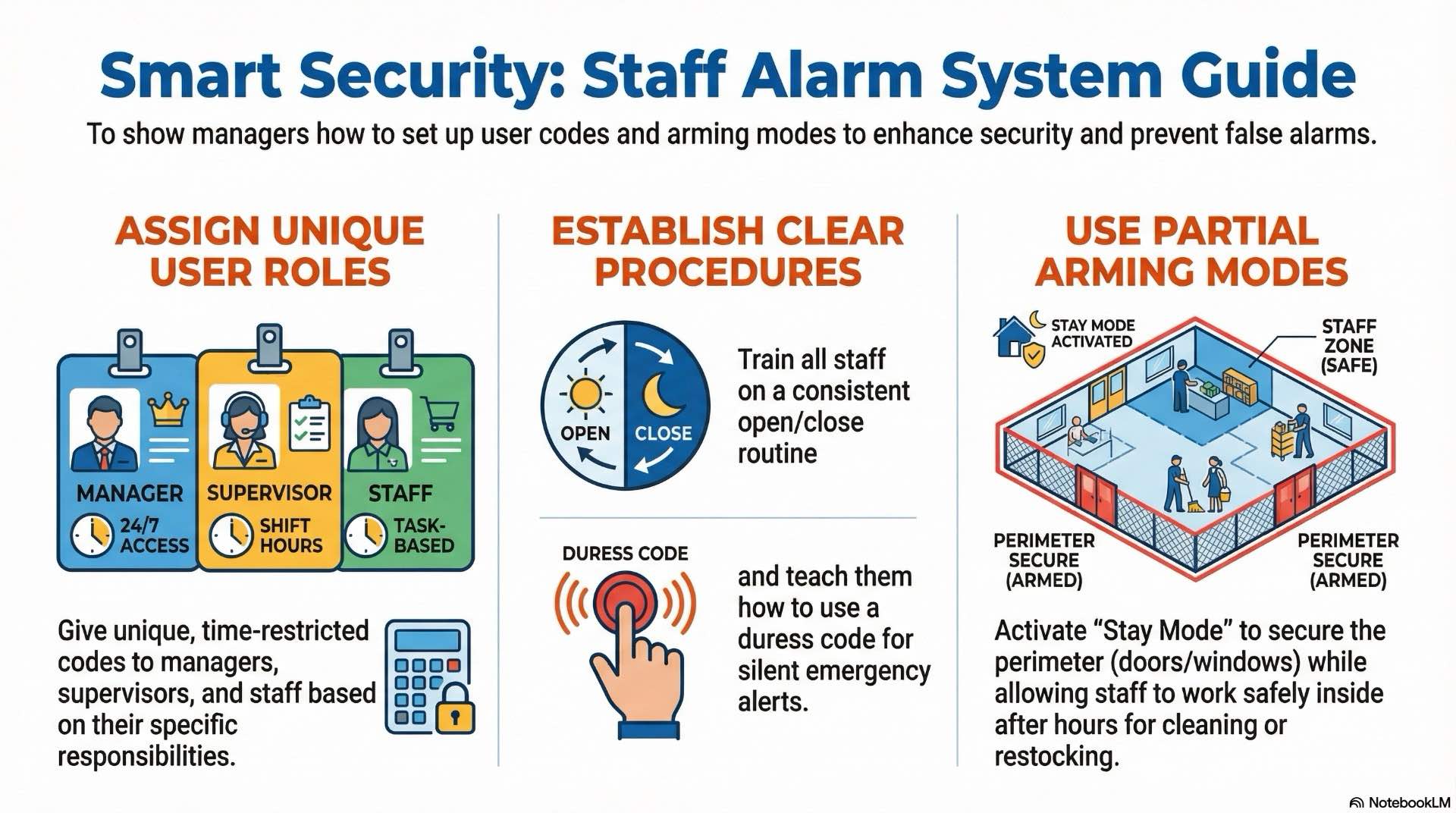
Assign unique codes to each authorized user. Managers receive full system control including zone bypass and programming. Supervisors get arming and disarming rights without configuration access. Opening and closing staff have time-restricted codes valid only during shift windows. Maintenance personnel receive escort codes that require simultaneous manager authorization. Log all code usage with timestamps and user identification.
Open and close procedures to prevent accidental burglar alarms
Establish clear routines for arming and disarming. Train staff to check all zones before arming. Entry delays should allow sufficient time to reach the keypad without rushing. Exit delays must accommodate walking to the farthest door. Duress codes look normal but silently notify authorities while appearing to disarm. Post step-by-step instructions near keypads for reference. Conduct periodic refresher training as staff turnover occurs.
Partial arming modes for night cleaning and stock work
Stay mode arms perimeter zones while leaving interior motion disabled. This allows authorized personnel to work inside without triggering alerts. Cleaning crews operate under stay mode with predetermined time windows. Inventory teams use similar configurations for overnight restocking. Each partial mode logs separately to track usage patterns. Consider requiring check-in calls at intervals during extended partial arming periods.
Testing, commissioning and maintaining retail burglar alarm systems
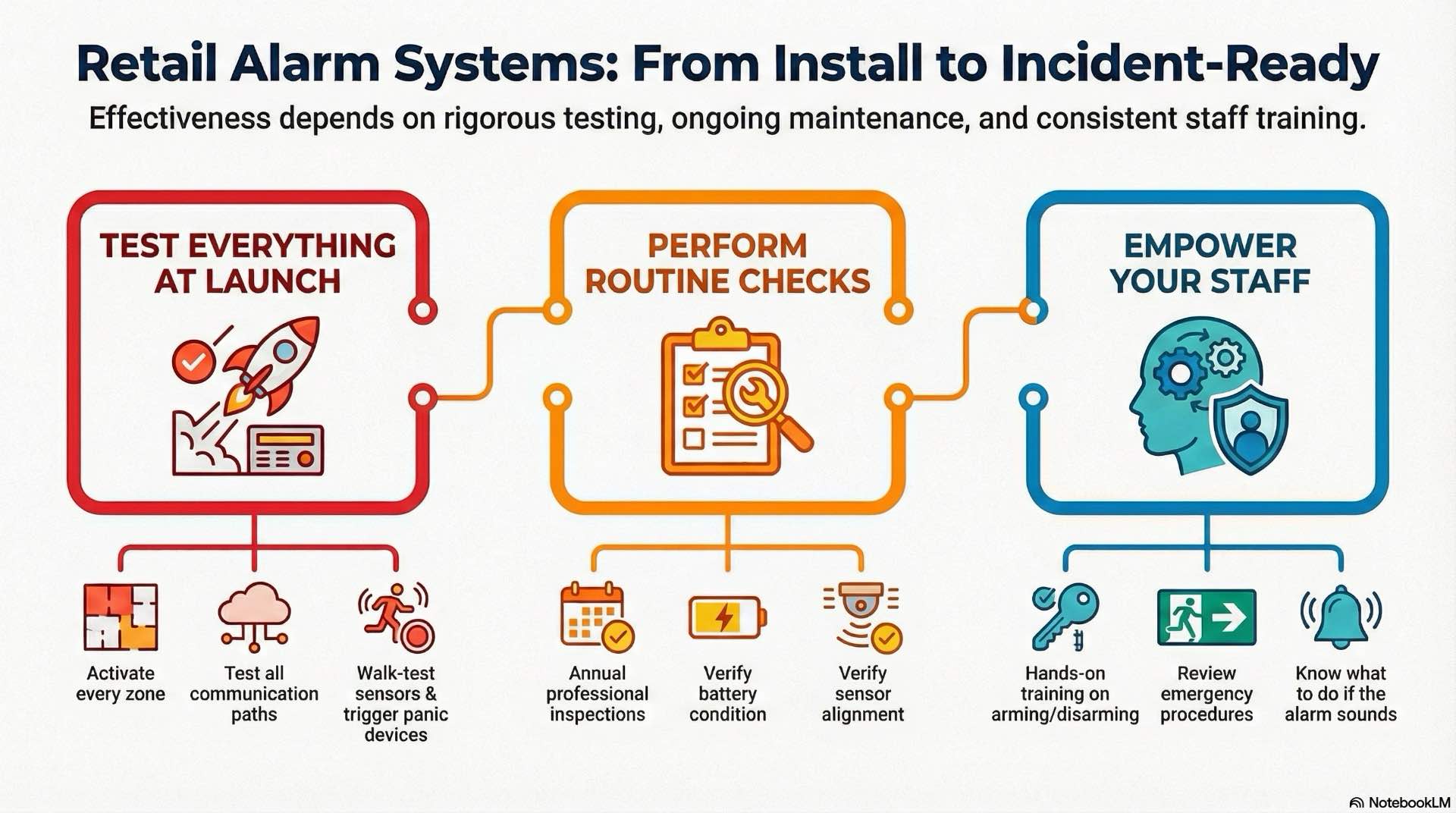
Proper validation ensures the intrusion detection system performs as designed. Ongoing maintenance prevents degradation and keeps equipment within specification.
Site acceptance testing checklist for new store alarm projects
Activate each zone individually and verify panel response. Test all communication paths including primary and backup. Walk test motion sensors to confirm coverage and absence of blind spots. Trigger panic devices from all locations. Verify siren audibility throughout the premises. Confirm user codes and permission levels function correctly. Document baseline battery voltage and charge cycle. Generate intentional false conditions to test reset procedures.
Routine inspections, log reviews and remote health checks
Monthly log reviews identify patterns of false triggers or user errors. Annual professional inspections verify sensor alignment and battery condition. Clean detector lenses and test backup power under load. Review communication signal strength and update firmware as available. Remote diagnostics monitor system health continuously and alert to failures before they impact protection. Replace batteries proactively based on manufacturer schedules.
Staff training for correct alarm use and incident response
New employees must complete hands-on training before receiving codes. Cover normal operation, emergency procedures and what to do if the system sounds. Conduct quarterly drills including simulated scenarios. Update training materials when system changes occur. Document training completion for compliance records. Encourage staff to report any unusual behavior or suspicious activity near the premises.
Common burglar alarm design mistakes in stores and showrooms
Avoiding frequent errors improves system effectiveness and reduces long-term costs. Many issues stem from inadequate planning or failure to account for store and showroom operational realities.
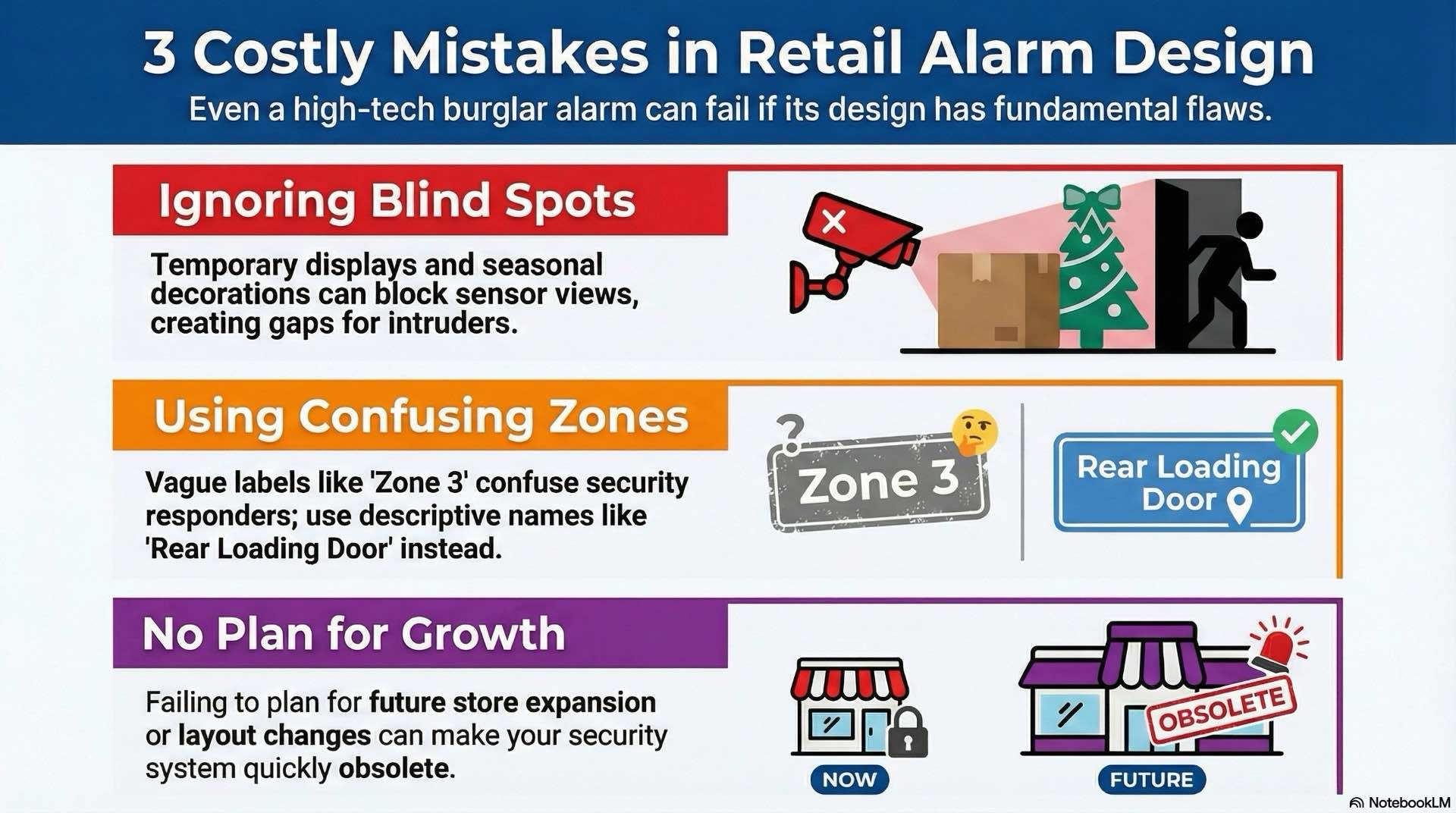
Overlooking blind spots around displays and promotional areas
Temporary displays and seasonal decorations block sensor views. Plan coverage with worst-case merchandising layouts in mind. Review sensor fields whenever store or showroom configurations change. Use ceiling-mounted detectors in areas prone to rearrangement. Test coverage after major layout modifications. Document permanent fixtures and protected zones on as-built drawings.
Poor zoning that confuses security teams during alarm events
Vague zone labels like “Zone 3” force responders to guess locations. Name zones descriptively: “Rear Loading Door” or “Electronics Display.” Excessive zones create management overhead without added security value. Too few zones provide insufficient detail for troubleshooting. Balance granularity with operational simplicity. Provide zone maps to monitoring centers and local authorities before activation.
Failing to plan for store expansion or layout changes
Fixed-wiring systems resist modification as the business grows. Choose panels with expansion capacity. Use structured wiring that supports future sensor additions. Wireless devices simplify reconfiguration but require battery maintenance. Budget for system updates when planning renovations. Maintain current documentation including wiring diagrams and device locations.
Best practice checklist for burglar alarm design in retail stores
A structured approach ensures comprehensive protection and long-term reliability. These checklists guide both new installations and periodic reviews.
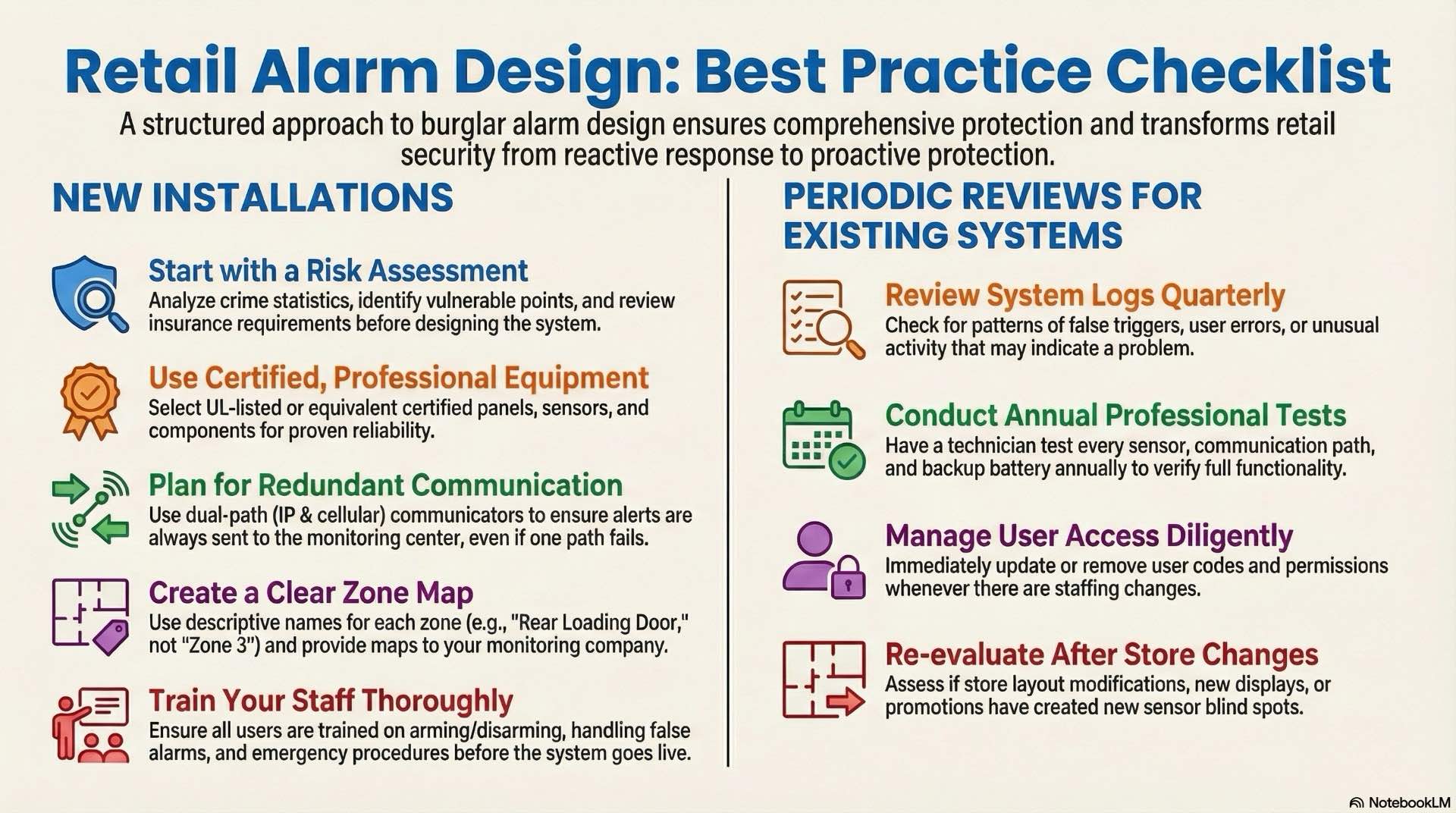
Design and documentation checklist for new retail locations
Complete thorough risk assessment including crime statistics and insurance requirements. Select UL-listed or equivalent certified equipment. Design with expansion capacity for future zones. Plan dual-path communication with independent networks. Document all intrusion zones with descriptive names and floor plan annotations. Specify battery capacity for required standby duration. Include tamper protection on all accessible devices. Verify local code compliance and permit requirements. Create operations manual with arming procedures and emergency contacts. Schedule comprehensive user training before system handover.
Periodic review checklist for existing store and showroom security
Review system logs quarterly for false trigger patterns. Test all intrusion zones and communication paths annually. Update user codes after staff changes. Inspect battery condition and replacement dates. Verify monitoring center contact information remains current. Assess layout changes that affect sensor coverage. Check for new merchandise categories requiring additional protection. Confirm insurance compliance and update as policies change. Review integration points with CCTV and access control. Schedule refresher training for existing staff.
Proper burglar alarm design for store and showroom security transforms retail security from reactive response to proactive protection. The combination of thorough risk assessment, appropriate technology selection and ongoing maintenance creates reliable defense against burglar threats. Store and showroom owners who follow structured implementation principles achieve consistent protection while minimizing operational disruptions and false trigger events.