
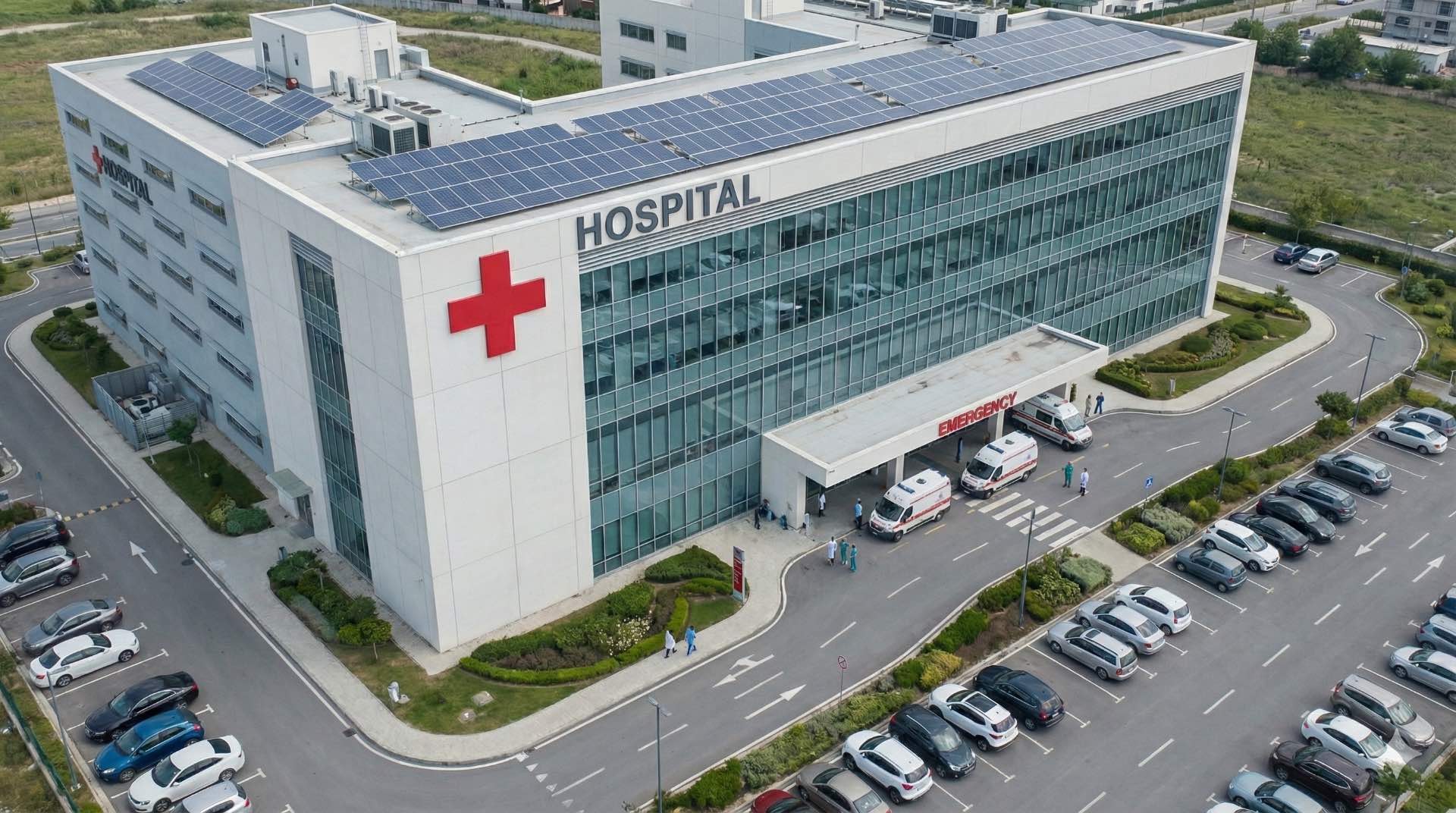
Solar energy solutions for hospital and healthcare facilities provide backup power and energy resilience to protect critical loads and keep operations reliable.
Modern solar energy installations transform how hospital and healthcare campuses maintain electrical reliability, delivering backup power through photovoltaic arrays combined with battery storage and emergency generators. This integration creates comprehensive energy resilience that protects intensive care units, operating rooms, diagnostic imaging, and life-support equipment during grid outages or peak demand conditions.
Critical care environments can’t tolerate power interruptions. Traditional diesel generators provide emergency electricity, but they’re expensive to operate and maintain. Solar energy changes this by delivering clean backup power that works alongside conventional healthcare systems. Hospital administrators gain both sustainability credentials and operational energy resilience—reducing energy costs while strengthening facility protection against outages.
Solar Energy Role in Hospital and Healthcare Resilience
Why Hospitals Need Reliable Solar-Backed Power
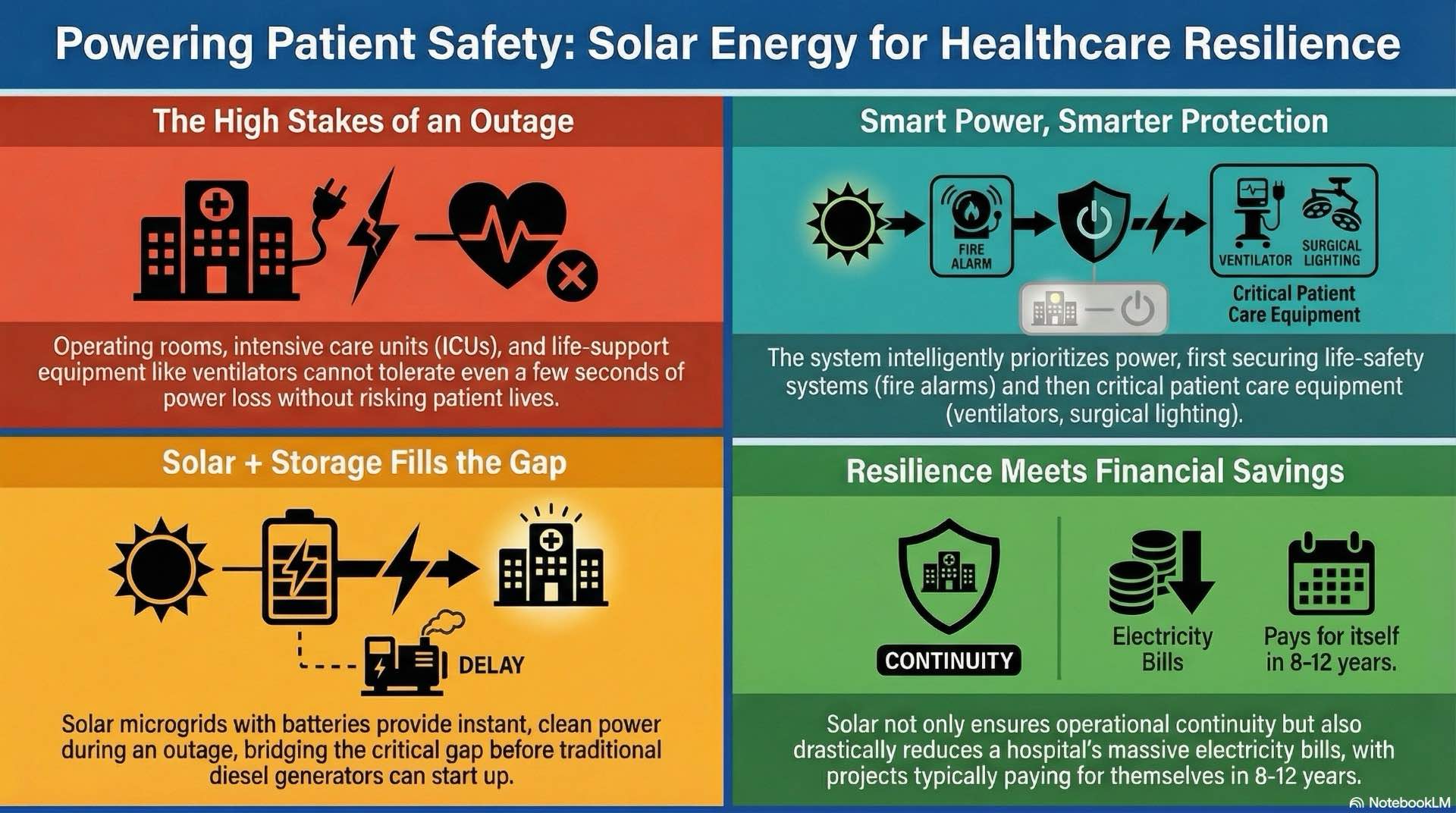
Operating rooms performing complex surgeries require uninterrupted electricity. Intensive care units running ventilators, dialysis machines, and cardiac monitors can’t experience disruptions without risking lives. Emergency departments depend on reliable diagnostic imaging and life-support equipment that hospital backup power systems must protect continuously.
Grid failures occur from weather events, equipment breakdowns, and infrastructure aging. When utilities fail, hospital generators activate—but these systems take precious seconds to start. That gap creates risk for sensitive medical devices in healthcare settings. Solar energy backup power fills these gaps by providing immediate response without starting delays, delivering superior energy resilience for operations.
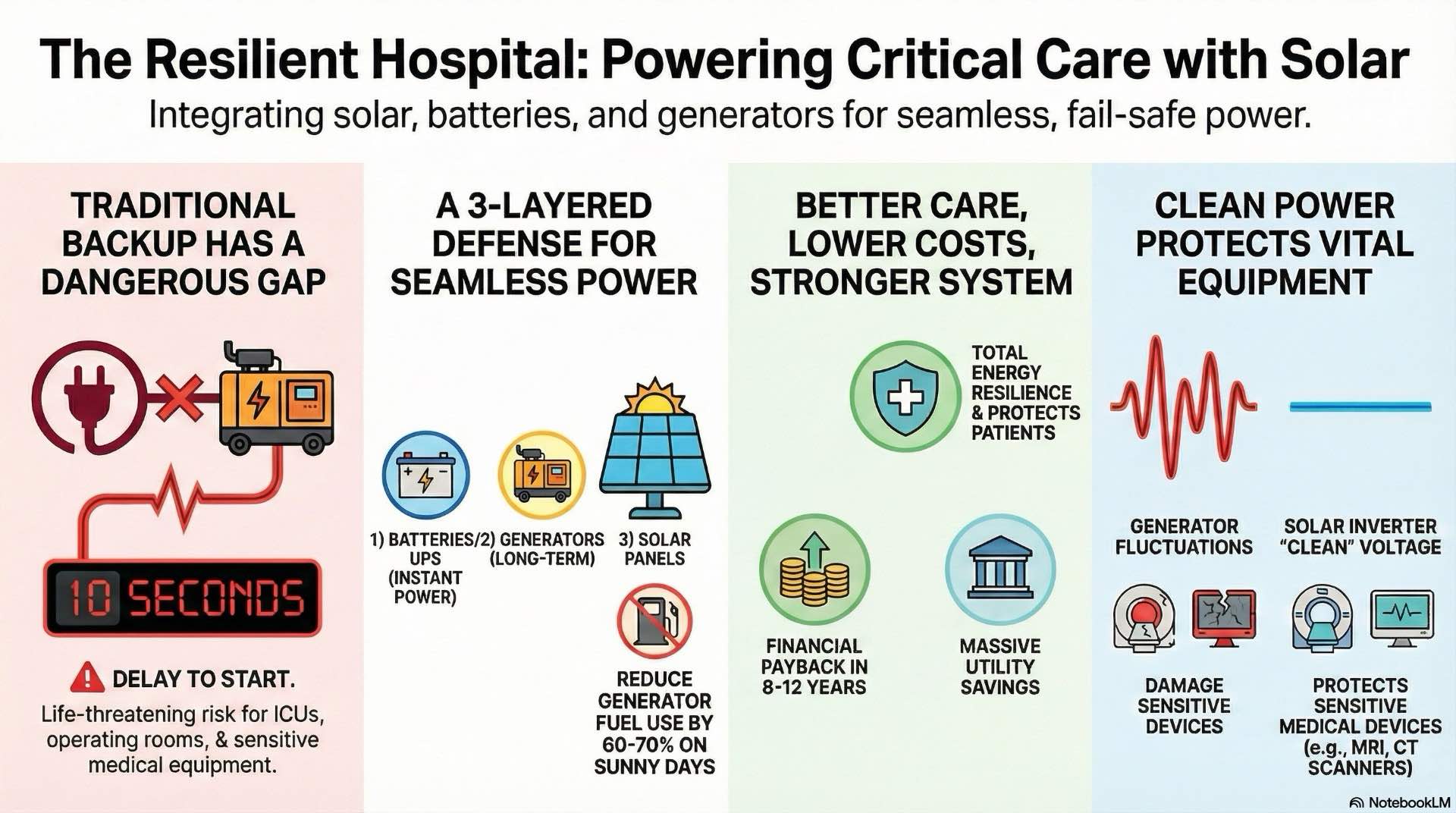
Power quality matters enormously in healthcare facilities. Medical electronics require clean voltage without harmonics or transients. Solar energy inverters paired with battery storage deliver superior power quality compared to generators, which produce mechanical vibrations and voltage fluctuations during load changes.
Drivers for Solar Energy in Healthcare Facilities
Financial pressures drive solar energy adoption across the healthcare sector. Hospital campuses spend millions annually on electricity bills. Solar energy installations reduce these costs dramatically by generating free electricity once systems achieve payback periods of seven to twelve years. Regulatory requirements increasingly mandate sustainability performance for healthcare facilities—solar energy installations provide tangible proof of climate action while enhancing backup power capabilities.
Grid reliability concerns have intensified across hospital networks. Wildfires, winter storms, and hurricanes demonstrate centralized power vulnerability. Healthcare facilities can’t rely solely on utilities. Installing solar energy backup power creates independence and energy resilience protecting operations regardless of external grid conditions. Community reputation influences decisions—visible solar energy installations at healthcare campuses communicate environmental commitment and forward-thinking leadership.
Critical Clinical Loads and Life-Safety Power Priorities
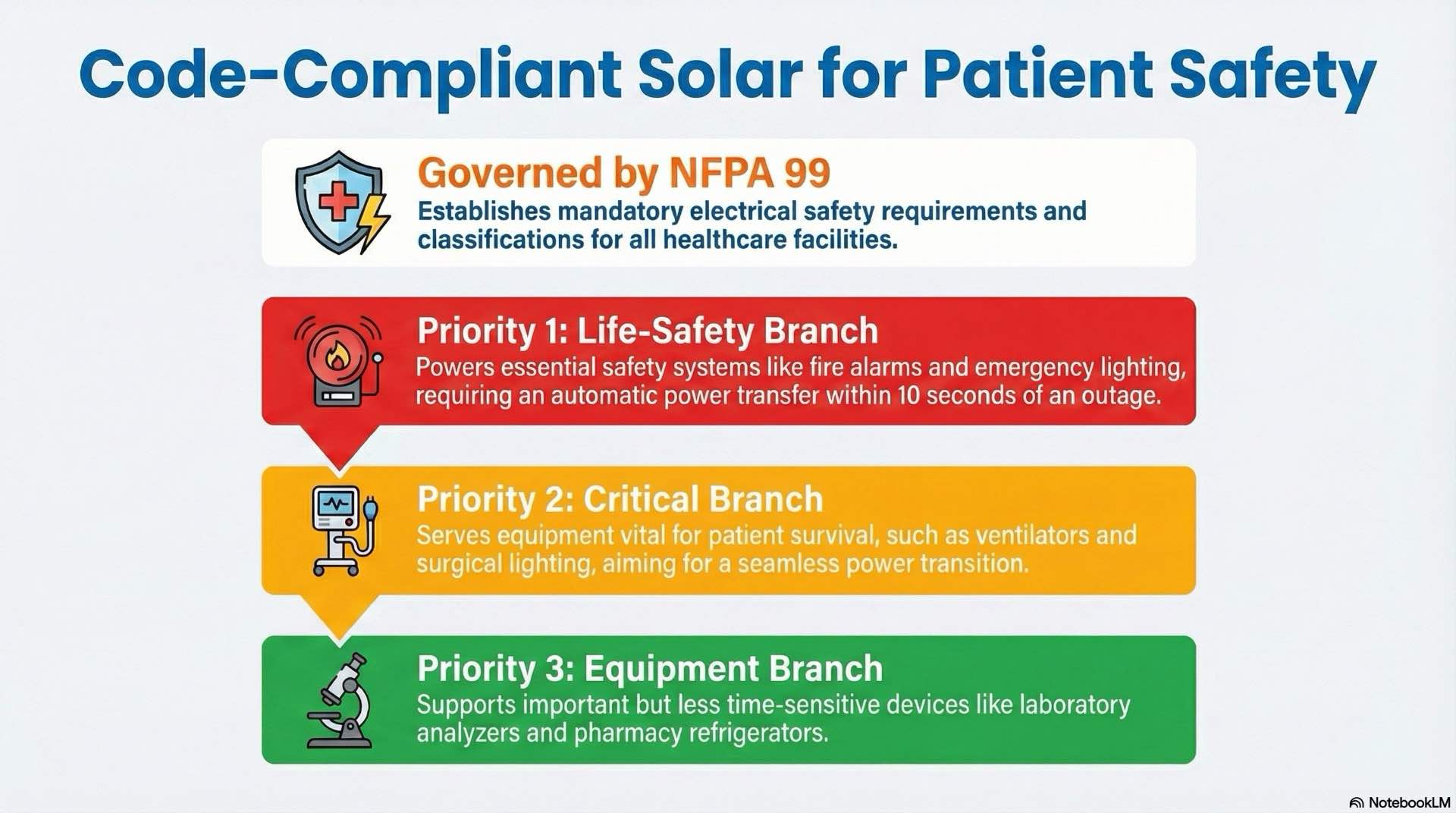
Not all hospital electrical loads deserve equal backup power protection. Life-safety systems receive highest priority—fire alarms, emergency lighting, exit signs, smoke evacuation. These must remain energized under all circumstances to protect healthcare facility occupants. Critical branch circuits serve equipment essential for patient survival: ventilators, anesthesia machines, surgical lighting, blood banks, patient monitors at hospital locations. Loss of backup power to these loads could directly cause deaths.
Equipment branch circuits support important but less critical devices in healthcare settings—laboratory analyzers, radiology equipment, pharmacy refrigerators. These receive secondary priority when backup power capacity runs low during extended outages. Administrative loads get lowest priority. Solar energy microgrid controllers intelligently shed these loads first, preserving energy resilience and runtime for truly critical hospital equipment.
Hospital Energy Profiles and Backup Power Needs
Baseline Electricity Use in Hospitals and Clinics
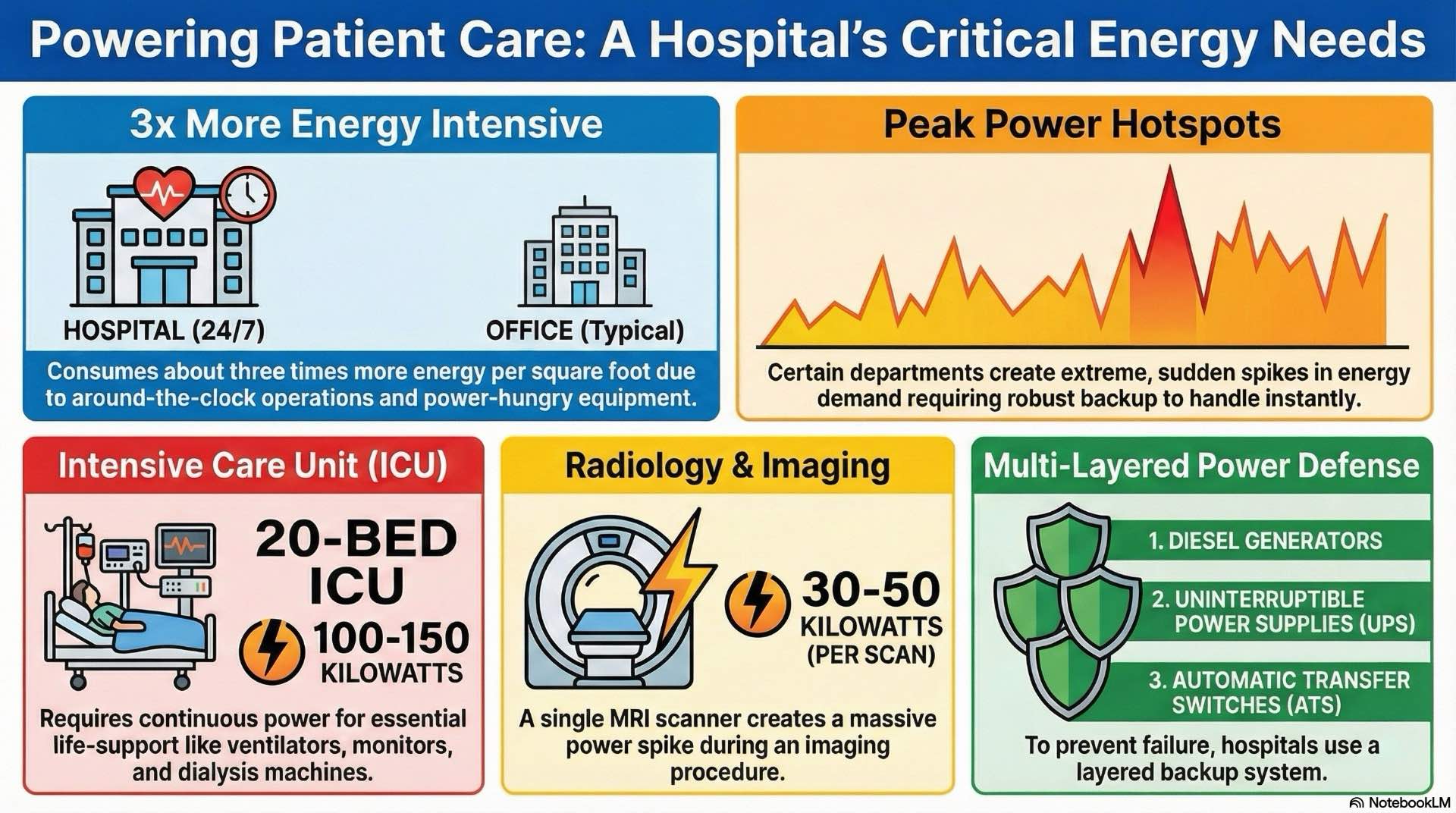
Healthcare facilities consume extraordinary electricity—25 to 35 kilowatt-hours per square foot annually, triple the intensity of office buildings. This massive consumption stems from 24/7 operations, complex mechanical systems, and power-hungry medical equipment that campuses must support. Climate control represents the largest load—operating rooms require precise temperature control, isolation rooms need negative pressure ventilation, pharmaceutical storage at healthcare facilities demands continuous refrigeration.
Medical equipment adds tremendous demand across operations. MRI machines, CT scanners, linear accelerators, and laboratory analyzers all draw significant power. Large imaging equipment may require dedicated electrical feedersand special conditioning to prevent interference with sensitive electronics at healthcare facilities.
Peak Demand from Operating Theatres, Imaging and ICU
Operating rooms create intense peak loads during surgical procedures at facilities. A single OR draws 15 to 25 kilowatts—multiply across ten operating suites and you’re looking at tremendous instantaneous demand that backup power systems must handle. Radiology departments generate massive spikes when imaging equipment activates in healthcare settings. An MRI scanner draws 30 to 50 kilowatts during operation.
Intensive care units at facilities maintain high baseline loads continuously. Each ICU bed supports ventilators, infusion pumps, monitors, dialysis equipment. A twenty-bed ICU consumes 100 to 150 kilowatts—this load can’t drop during outages without risking patient lives. Energy resilience through solar energy backup power proves absolutely critical for protecting these sensitive healthcare areas.
Existing Backup Power Infrastructure (Generators, UPS, ATS)
Most facilities deploy multi-layered backup power systems meeting code requirements for healthcare operations. Diesel generators provide primary emergency power, typically sizing for 100% of critical loads plus margin. These units start within ten seconds of utility failure. Uninterruptible power supply systems bridge the gap—online double-conversion UPS units deliver continuous clean power to critical hospital loads, providing immediate energy resilience.
Automatic transfer switches manage transitions between power sources at healthcare campuses. When voltage drops, the ATS signals generators while UPS maintains critical hospital loads. Once generators stabilize, ATS transfers non-UPS loads to emergency power. Existing backup power infrastructure creates opportunities for solar energy integration—current UPS batteries can support solar energy storage, reducing deployment costs for healthcare facilities.
Solar Energy System Architectures for Healthcare Campuses
Grid-Tied Hospital Solar with Generator Backup
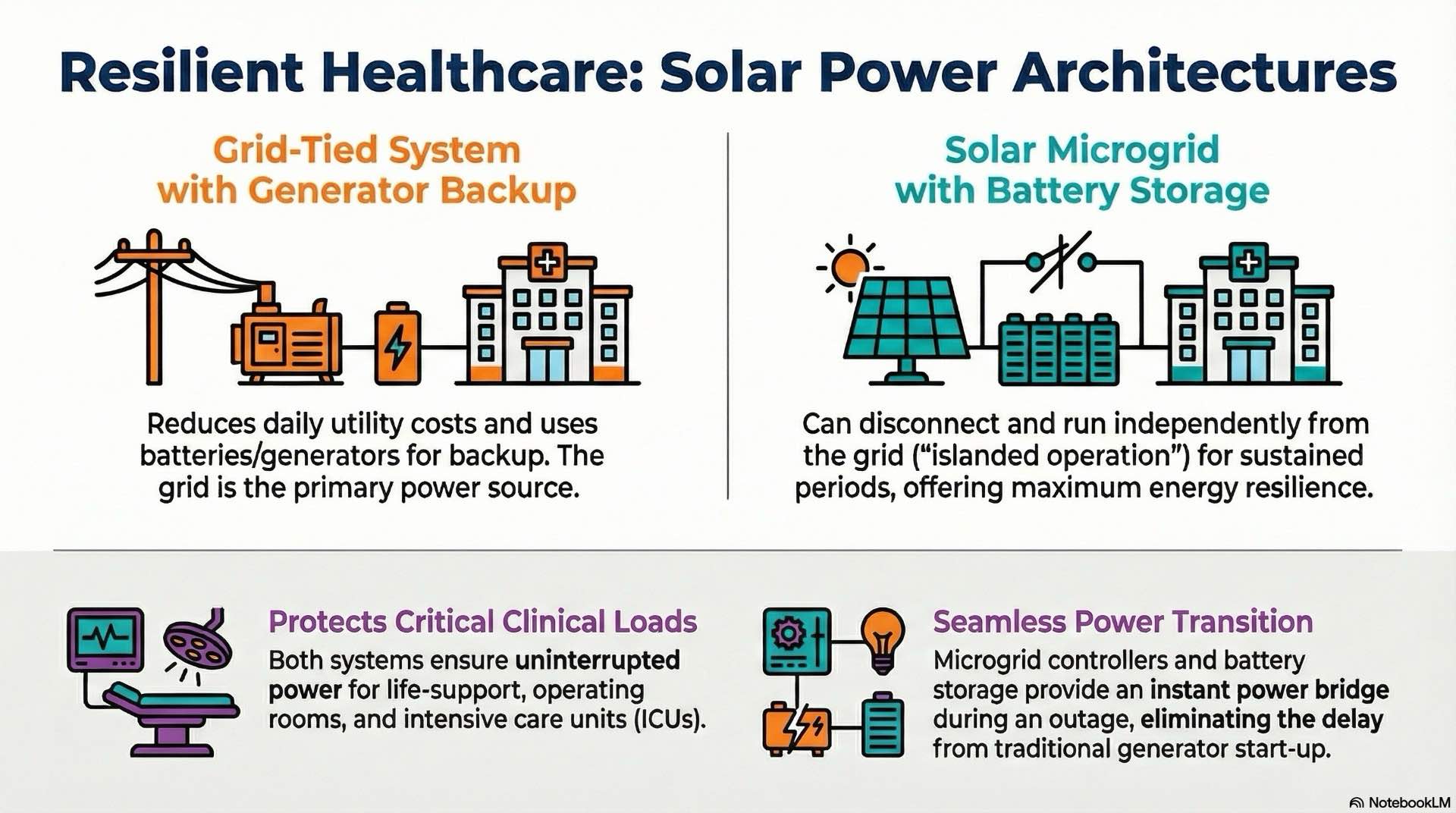
Most hospital solar energy installations connect to utility grids as primary configuration. During normal operation, solar energy panels generate DC electricity that inverters convert to AC power serving building loads directly. This reduces purchased power for healthcare facilities. When grid power fails, battery storage with islanding capability transforms systems into functioning microgrids providing backup power and energy resilience.
Generator backup power integrates through automatic transfer switches at campuses. When grids fail, batteries maintain critical hospital loads while generators start. Once stabilized, solar energy inverters reconnect in grid-forming mode, treating generator-powered isolated grids as valid references. This coordination maximizes fuel efficiency by offsetting generator loads with solar energy production during daylight hours, stretching limited diesel reserves for extended healthcare facility operations.
Solar Microgrids with Battery Storage for Critical Care Buildings
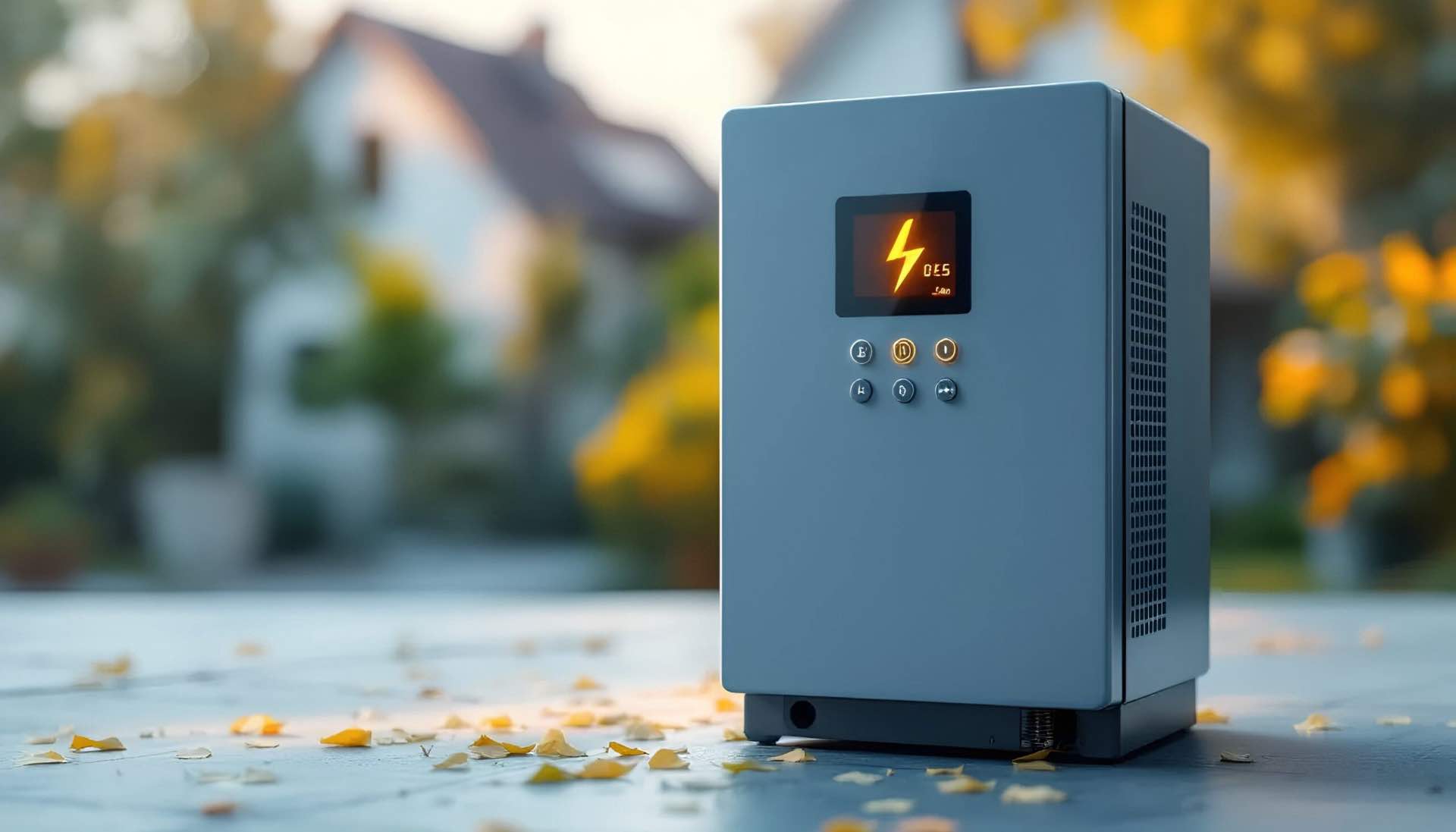
Advanced systems create true microgrids capable of sustained islanded operation at facilities. Battery energy storage systems sized for four to eight hours of critical load runtime provide foundations for backup power. Lithium-ion batteries offer high energy density, long cycle life, and rapid response for demanding healthcare applications requiring robust energy resilience.
Solar energy inverters in microgrid configurations form voltage and frequency references independent of grid connection at campuses. When utility power fails, systems transition to islanded mode without disrupting sensitive medical equipment. Solar energy production charges batteries during daylight in islanded mode, extending backup power duration indefinitely during sunny conditions and maximizing energy resilience for healthcare operations.
Integrating Solar with Hospital Backup Systems
Coordinating Solar, Diesel Generators and UPS in Hospitals
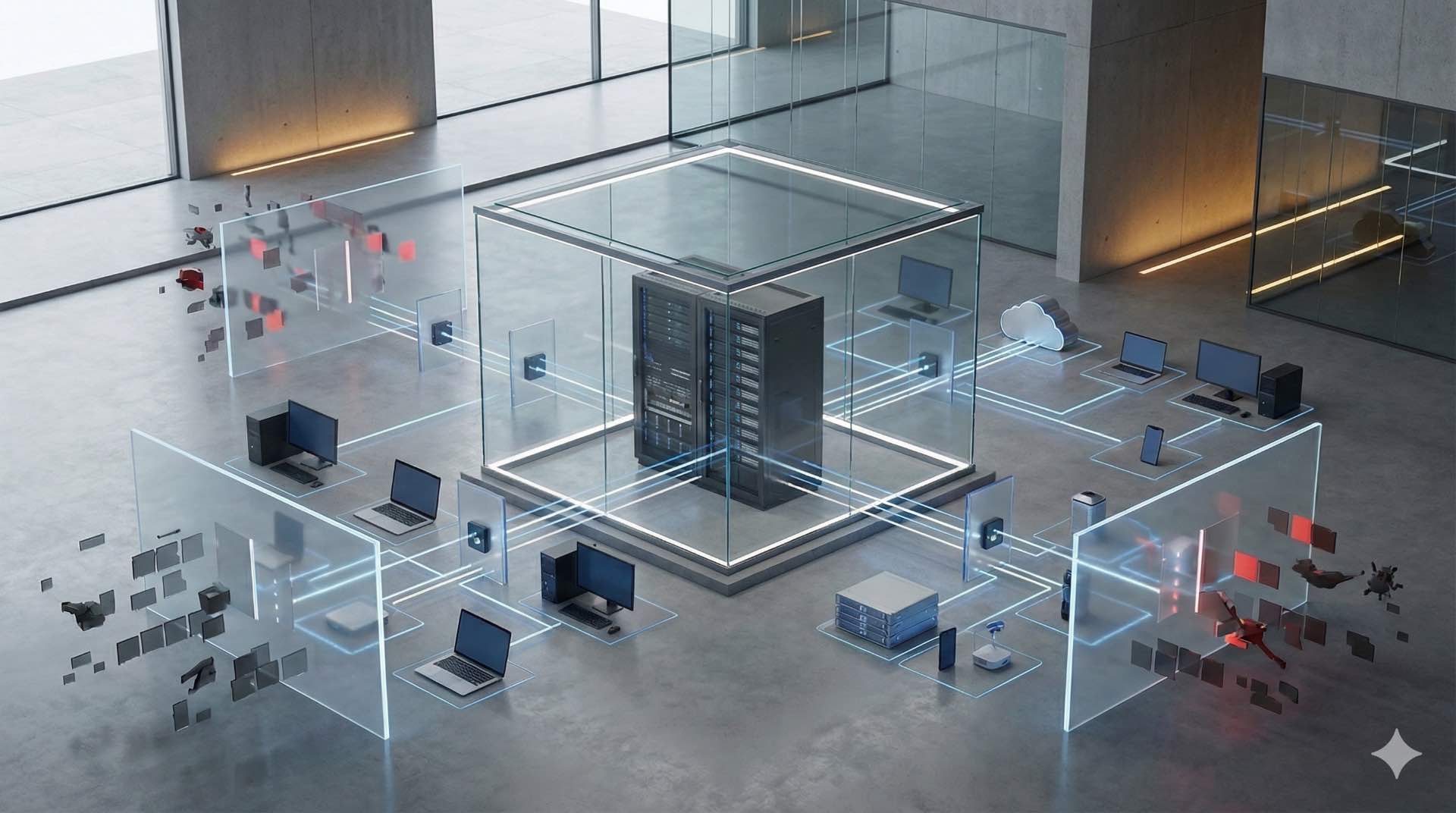
Successful integration requires seamless coordination between all power sources at healthcare facilities. Microgrid controllers serve as central intelligence, monitoring grid status, solar energy production, battery charge, and generator availability. These systems make millisecond decisions about which sources supply hospital loads under varying conditions, ensuring continuous backup power and energy resilience.
During normal operation, solar energy provides base electricity while grids supply additional demand at healthcare campuses. When grid power fails, UPS batteries immediately support critical hospital loads while generators receive starting signals. Fuel conservation becomes critical during extended outages—solar energy production offsets generator loads during daylight, reducing diesel consumption by 60-70% on sunny days and providing exceptional energy resilience.
Battery Storage Sizing for ICUs, ORs and Emergency Departments
Proper battery sizing for these backup power starts with detailed load analysis of healthcare facility requirements. An intensive care unit with twenty beds requires 8 to 12 kilowatts continuous power for life-support systems. Sizing batteries for four-hour runtime demands roughly 40 to 50 kilowatt-hours of usable capacity to ensure adequate energy resilience.
Operating rooms create variable loads at facilities—a surgical suite with five ORs might draw 75 kilowatts during maximum utilization. Emergency departments need substantial backup power capacity for diagnostic equipment, trauma bays, triage systems at healthcare facilities. A medium-sized ED consuming 150 kilowatts requires 600 kilowatt-hours for four-hour protection, ensuring robust energy resilience for critical patient care.
Compliance and Healthcare Regulations for Solar Projects
Emergency Power Codes and Essential Electrical Systems in Hospitals
NFPA 99 establishes requirements for healthcare facilities electrical systems, defining life-safety branch, critical branch, and equipment branch classifications. Solar energy backup power systems must comply with these categories to receive regulatory approval for installations. Life-safety branch circuits receive automatic transfer to emergency power within ten seconds of failure, ensuring continuous energy resilience for healthcare facility safety systems.
Critical branch circuits serve task lighting and receptacles in patient care areas at facilities. Transfer times up to thirty seconds are acceptable for some critical branch loads, but most healthcare facilities aim for seamless transitions that sensitive medical equipment won’t detect during backup power activation.
Monitoring, Power Quality and Medical Equipment Protection
Real-Time Monitoring of Solar Energy and Backup Assets in Hospitals
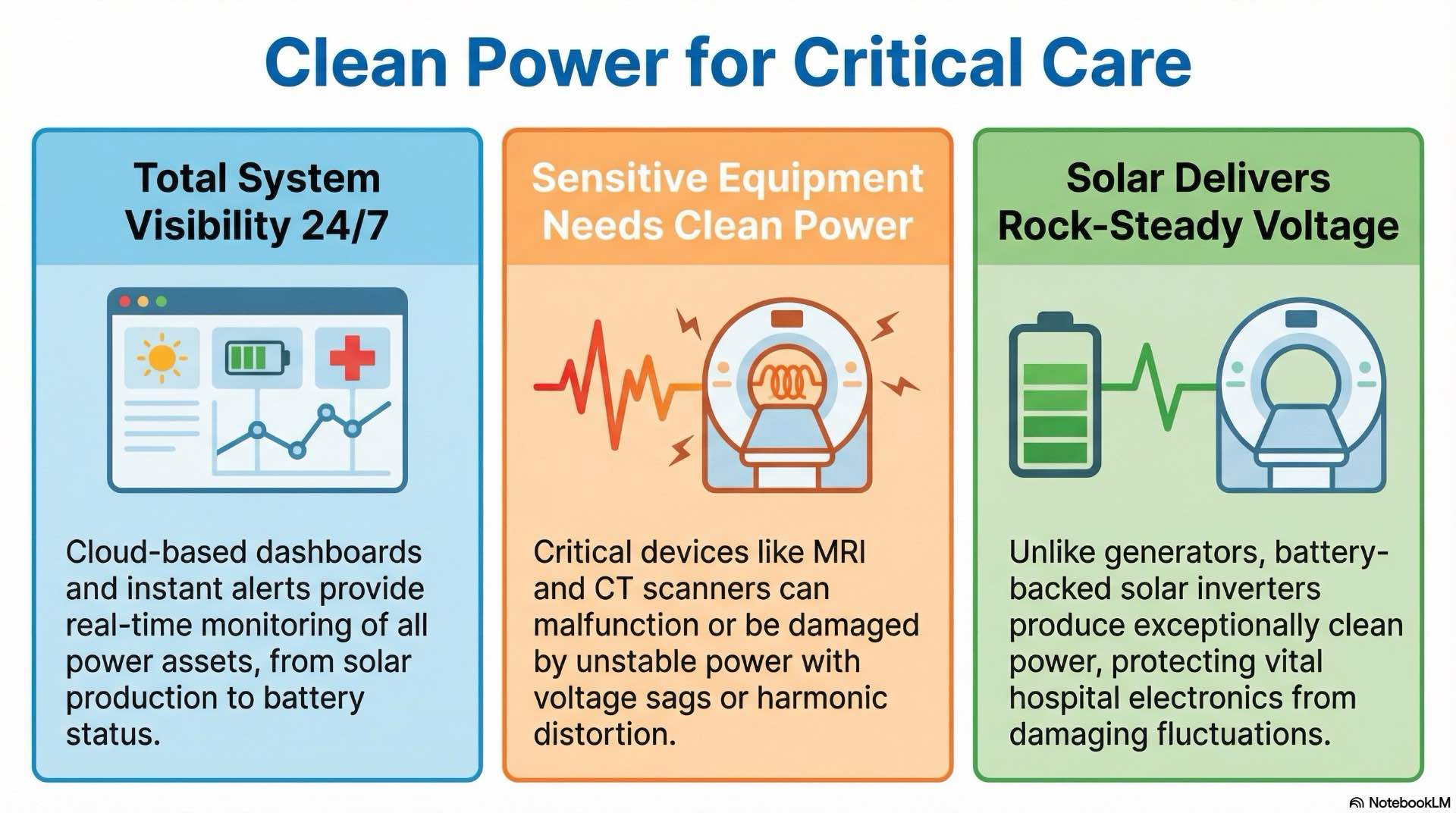
Modern solar energy installations at healthcare facilities deploy comprehensive monitoring platforms tracking every system parameter. Production meters measure DC output, inverter efficiency, AC delivery, cumulative generation for these solar energy systems. Battery management systems report state of charge, charge/discharge rates, cell temperatures, cycle counts supporting backup power and energy resilience.
Cloud-based dashboards aggregate data from distributed sensors at healthcare campuses, providing facilities managers complete visibility into operations. Alert systems notify personnel when abnormal conditions develop—low battery voltage, inverter faults, reduced solar energy production trigger immediate notifications, protecting backup power availability and energy resilience.
Managing Power Quality and Harmonics for Sensitive Medical Devices
Medical equipment at facilities demands exceptionally clean electrical power. MRI scanners, CT equipment, laboratory analyzers contain sensitive electronics that malfunction when exposed to voltage sags, transients, or harmonic distortion. Solar energy backup power systems must maintain power quality meeting or exceeding grid standards for healthcare applications requiring energy resilience.
High-quality solar energy inverters achieve THD under two percent through advanced filtering at installations. Solar energy inverters with battery storage excel at voltage regulation because they generate output independent of varying input conditions. Unlike generators whose voltage fluctuates with load changes at healthcare facilities, battery-backed inverters produce rock-steady voltage supporting superior energy resilience.
Planning, Implementation and Lifecycle Management for Hospital Solar
Business Case for Hospital and Healthcare Solar Investments
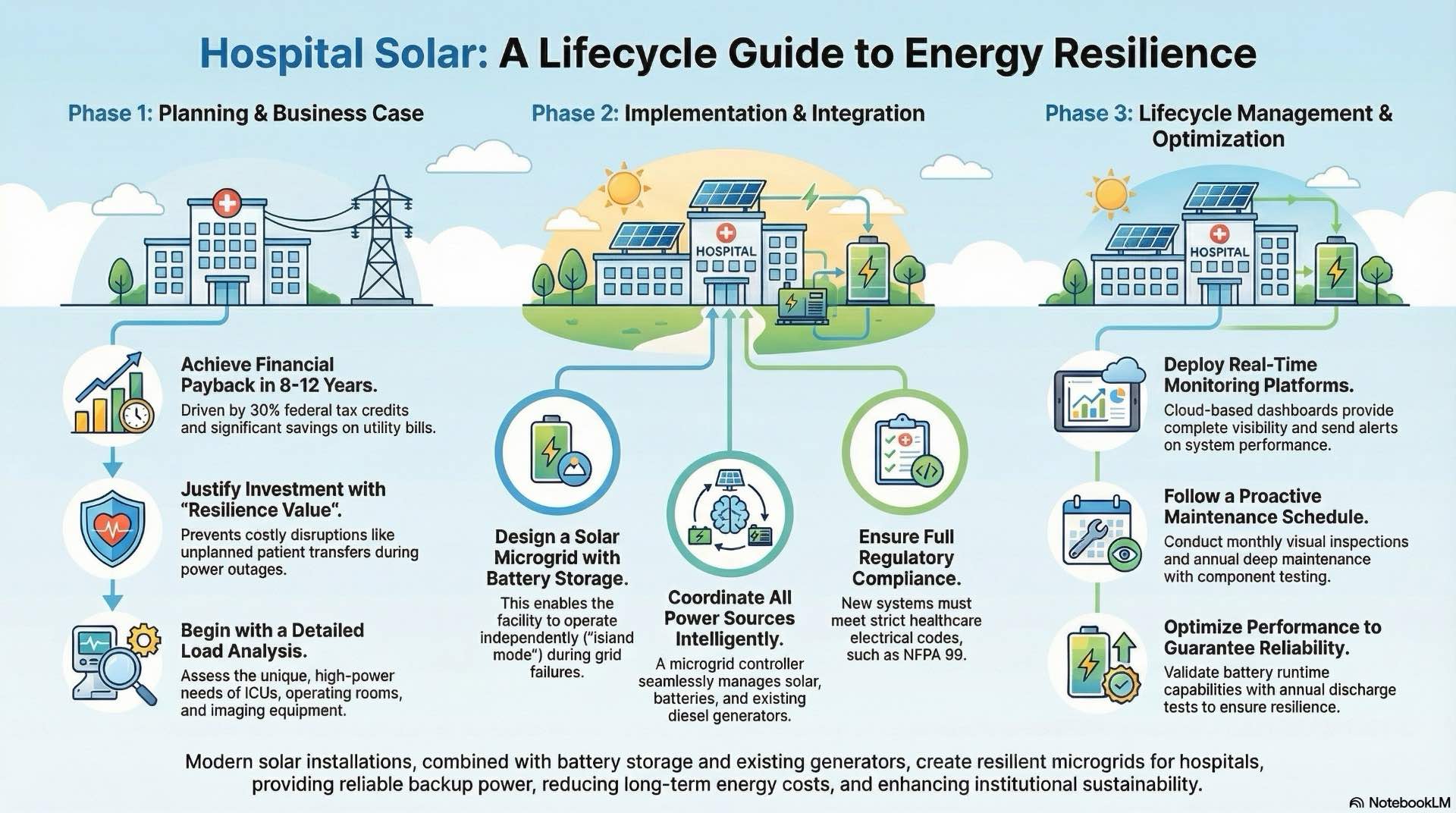
Most hospital solar energy projects achieve payback within eight to twelve years for healthcare facilities. Federal tax credits provide 30% cost recovery through tax benefits. Avoided utility costs represent the primary financial benefit—facilities paying fifteen to twenty cents per kilowatt-hour save millions annually from solar energy installations while improving backup power capabilities.
Resilience value justifies solar energy investment beyond pure energy savings for healthcare operations. Preventing one unplanned outage that forces patient transfers at facilities saves hundreds of thousands in lost revenue. Solar energy backup power systems provide insurance against costly disruptions while reducing operating expenses and enhancing energy resilience.
Operations, Maintenance and Performance Optimization in Healthcare Environments
Proactive maintenance prevents failures in hospital solar energy systems. Monthly visual inspections identify damage, loose connections, environmental hazards affecting backup power. Quarterly electrical testing verifies proper operation at healthcare facilities. Annual deep maintenance includes detailed component testing and performance validation ensuring continued energy resilience.
Performance monitoring identifies underperforming equipment at installations. Comparing actual solar energy production against modeled expectations reveals problems like failed panels, inverter issues, or shading affecting backup power generation. Battery capacity testing validates backup power runtime capabilities for healthcare facilities through annual discharge tests, ensuring robust energy resilience when operations need it most.
Modern solar energy installations have transformed how hospital and healthcare campuses approach electrical reliability, combining photovoltaic generation with sophisticated battery storage and existing generators to create comprehensive backup power systems. These integrated microgrids deliver exceptional energy resilience that protects critical medical operations during grid outages while reducing long-term operating costs, carbon emissions, and vulnerability to utility disruptions—ultimately strengthening institutional sustainability and improving patient safety outcomes across all conditions.