



Emergency evacuation systems coordinate alerting, communication, and controlled movement during emergency events to support occupant safety.
Modern evacuation systems deliver clear instructions during emergency events through integrated networks of voice alarms, communication pathways, and visual alerting devices. These systems replace abstract sirens with intelligible voice messages that guide occupants toward safety through coordinated egress routes and staged response protocols. Building owners, facility managers, and safety professionals rely on these platforms to manage crises ranging from fire events to security threats, ensuring that emergency response follows predictable patterns that reduce confusion and prevent panic.
Digital audio networks now distribute high-fidelity voice messages across entire campuses with sub-millisecond latency. Control panels coordinate inputs from fire alarm systems, security sensors, and manual call stations to trigger automated responses tailored to specific scenarios. This technical overview examines the core technologies, architectural principles, and operational requirements that define contemporary evacuation systems.
What Is Emergency Evacuation and How Does It Work
Emergency evacuation encompasses the technologies, procedures, and architectural designs that enable controlled movement of building occupants away from danger. Voice evacuation control panels serve as the operational brain, receiving inputs from fire alarm initiating devices and executing pre-programmed response sequences. When a smoke detector activates in a specific zone, the panel triggers targeted announcements for that area while preparing adjacent zones for phased evacuation.
The physical network extends from control equipment through amplifiers and audio routers to speakers positioned throughout protected areas. Each component operates within strict performance parameters defined by EN 54-16 for control equipment and EN 54-24 for loudspeakers. These standards ensure voice messages remain intelligible even in acoustically challenging environments.
Emergency Evacuation Technologies
Voice evacuation systems
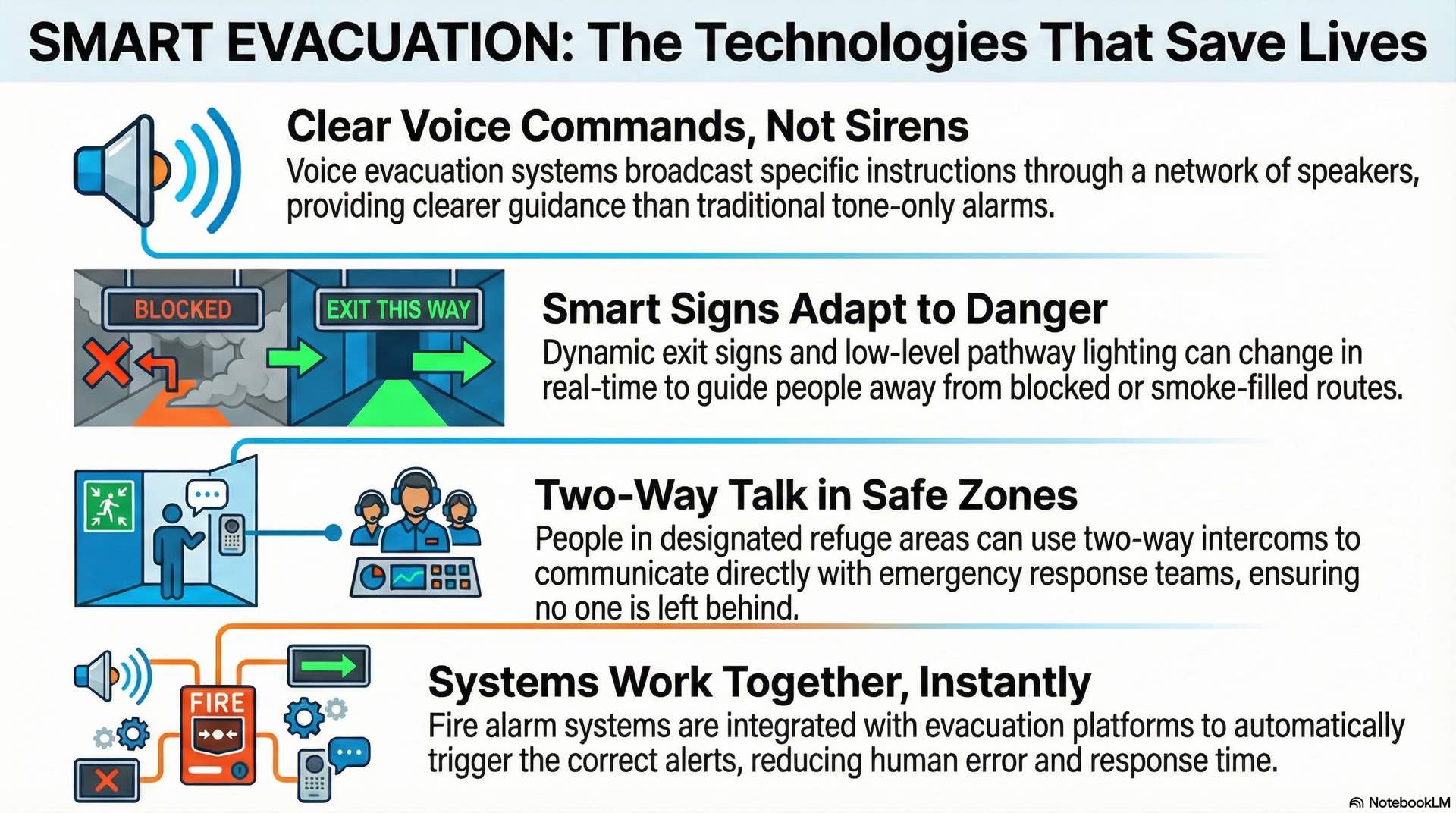
Voice evacuation systems replace traditional alarm bells with clear, pre-recorded or live vocal instructions that tell occupants exactly what to do and where to go. Pre-recorded messages are stored in the voice alarm control panel and triggered automatically based on input conditions. Live announcements allow operators to provide real-time updates as situations evolve.
Message intelligibility depends on speaker selection, placement, and acoustic environment. Speech Transmission Index testing quantifies message clarity, with values above 0.50 considered acceptable for most applications. Facilities with high ceilings, hard surfaces, or significant background noise require careful acoustic design to achieve adequate coverage.
Most systems support both automated and manual modes. Automated messages provide immediate response while operators assess situations and determine whether manual intervention is needed. The psychology behind voice evacuation is straightforward: people respond more effectively to specific instructions than to abstract alarm sounds.
Public address and mass notification systems
PA/VA systems integrate general-purpose public address functions with life-safety voice alarm capabilities. A hospital uses the same speaker infrastructure for routine announcements during normal operations and evacuation instructions during emergencies. Priority logic ensures critical messages take precedence—routine announcements automatically stop when fire alarms activate.
Mass notification extends beyond fire evacuation to address security threats, weather emergencies, and chemical releases. NFPA 72 defines mass notification system requirements in the United States, while UL 2572 provides testing standards. These systems must support multiple input sources including weather alert services and security management platforms.
Emergency lighting and exit guidance systems
When primary power fails and smoke fills corridors, emergency lighting provides visual pathways that guide occupants toward exits. Battery-backed emergency luminaires provide minimum illumination levels along designated egress routes. NFPA 101 specifies 1 foot-candle average maintained illumination along paths of egress with 90-minute battery duration requirements.
Refuge area communication systems
Areas of rescue assistance provide protected spaces where individuals who cannot use stairs await evacuation assistance. Two-way communication devices allow occupants to contact the fire command center, confirm their presence, and receive status updates. Area of rescue intercom devices connect directly to fire command stations or voice evacuation control panels.
Integrated fire and evacuation solutions
Fire system integration modules connect fire alarm control panels to voice evacuation equipment, translating alarm signals into appropriate announcement sequences. Addressable fire alarm systems identify specific device locations, enabling zone-specific messages. Cross-system integration also includes HVAC shutdown sequences, elevator recall, and door release for secured egress paths.
Cloud-connected and remote evacuation platforms
Cloud-based management platforms enable remote monitoring, configuration, and announcement delivery from any internet-connected location. Network security requirements include encrypted communications, multi-factor authentication, and redundant connectivity paths. On-premise controllers must maintain autonomous operation capability when cloud connectivity is interrupted.
Emergency Evacuation System Architecture
Zoning and evacuation route design
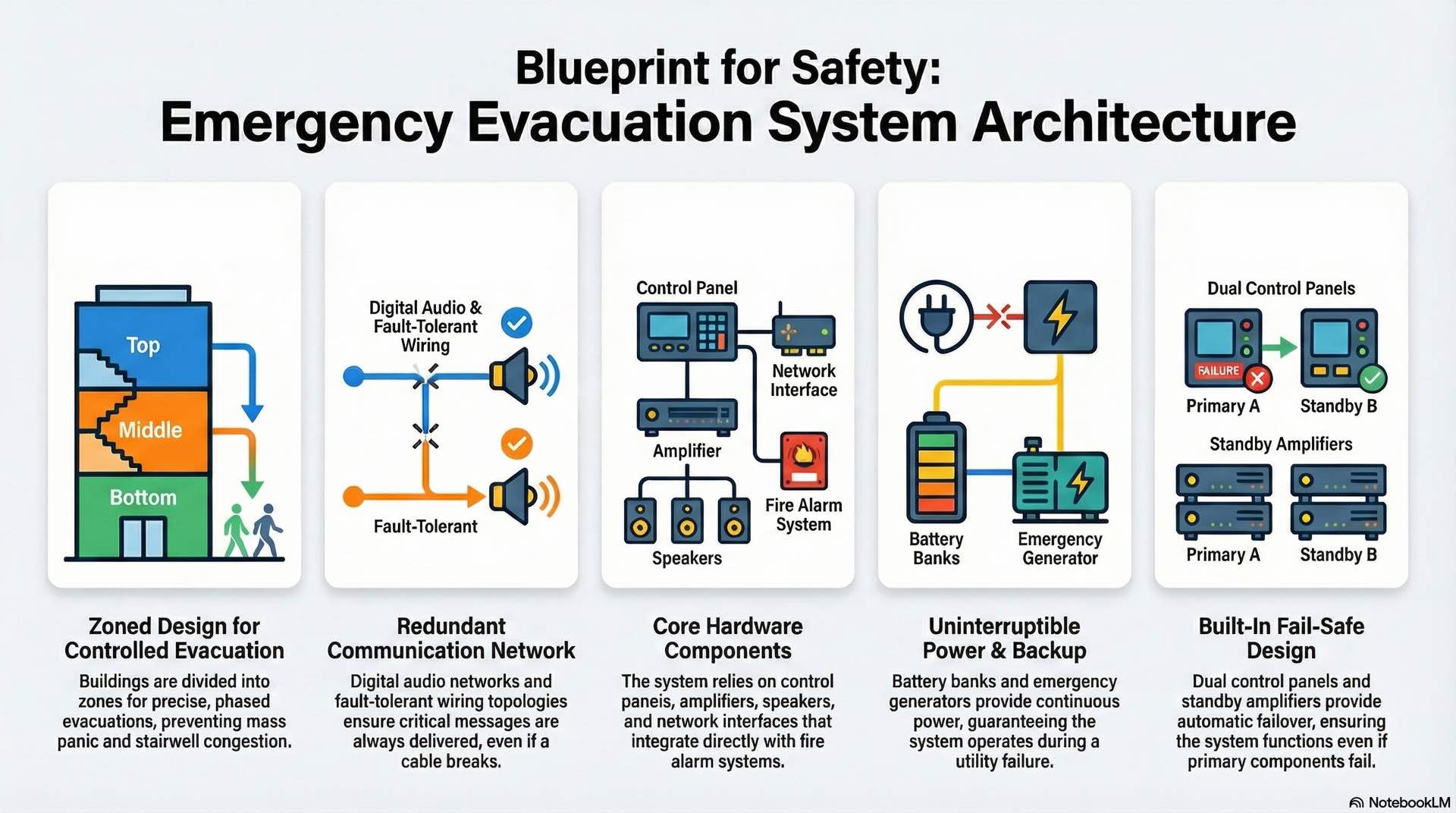
Evacuation zones divide buildings into manageable areas addressed independently during emergencies. Zone boundaries typically align with fire compartments, structural divisions, or functional areas. A high-rise building might define each floor as a separate zone, while a hospital wing might have zones for each patient care unit.
Zone design supports phased evacuation strategies that prevent stairwell congestion. Occupants in immediately threatened areas evacuate first while others shelter in place. The voice evacuation system delivers zone-specific messages based on the evolving situation, enabling incident commanders to direct specific areas to act while others wait.
Evacuation route planning considers stair capacity, horizontal egress distances, and accessibility requirements. Primary and secondary routes provide options when primary paths become blocked.
PA/VA network architecture
Modern PA/VA systems utilize networked audio distribution via digital audio networks like Dante and AES67. These protocols transport uncompressed audio over standard IP infrastructure with sub-millisecond latency. Ring topologies provide automatic failover by routing traffic around breaks in the network.
Speaker line topology and loop design
Speaker circuits connect amplifier outputs to distributed speakers throughout each zone. Class A loop configurations provide circuit redundancy by connecting both ends of the speaker line back to the amplifier. A break anywhere in the loop still allows speakers on both sides to receive audio through the remaining path.
Line supervision circuits continuously monitor speaker connections to detect breaks or shorts without producing audible sound. The amplifier sends low-frequency test tones that measure circuit impedance. Abnormal impedance readings generate trouble conditions that alert maintenance personnel to wiring problems before emergencies occur.
Speaker loading calculations ensure amplifier output matches the combined power requirements of all connected speakers. A typical 100V line system might support 500W of speakers per amplifier channel, with each speaker consuming a portion based on its wattage tap setting.
Power supply and backup systems
Voice evacuation systems require uninterruptible power to ensure operation during emergencies that may involve primary power failure. Dedicated UPS systems provide battery backup with automatic transfer to generator powerfor extended duration events. EN 54-4 specifies 24-hour standby plus 30-minute alarm duration as minimum requirements.
Amplifier power consumption represents the largest load in most installations. A system with 10 amplifier channels at 500W each requires 5kW of backup power during full-alarm conditions. Battery sizing calculations account for peak demand plus control equipment, network infrastructure, and charging losses.
Power distribution architecture includes circuit protection and automatic load shedding for non-critical functions during extended battery operation.
Fail-safe and redundant design strategies
Life-safety systems require fault tolerance exceeding typical commercial equipment standards. Critical components including control panels, primary amplifiers, and network infrastructure have redundant backups that activate automatically upon primary failure. The transition occurs without interruption to ongoing announcements.
Controller redundancy uses hot-standby configurations where backup controllers mirror primary system state. Synchronization occurs in real-time so that backup controllers can assume control immediately without losing event data or configuration settings.
Multi-building evacuation coordination
Campus installations require coordination across geographically separated systems. Wide-area networks connect individual building controllers to central management platforms. Synchronization protocols ensure time-critical announcements reach all buildings simultaneously, preventing confusion when occupants can hear announcements from neighboring buildings.
Notification, Alerting and Communication Devices
PA/VA speakers and sounders
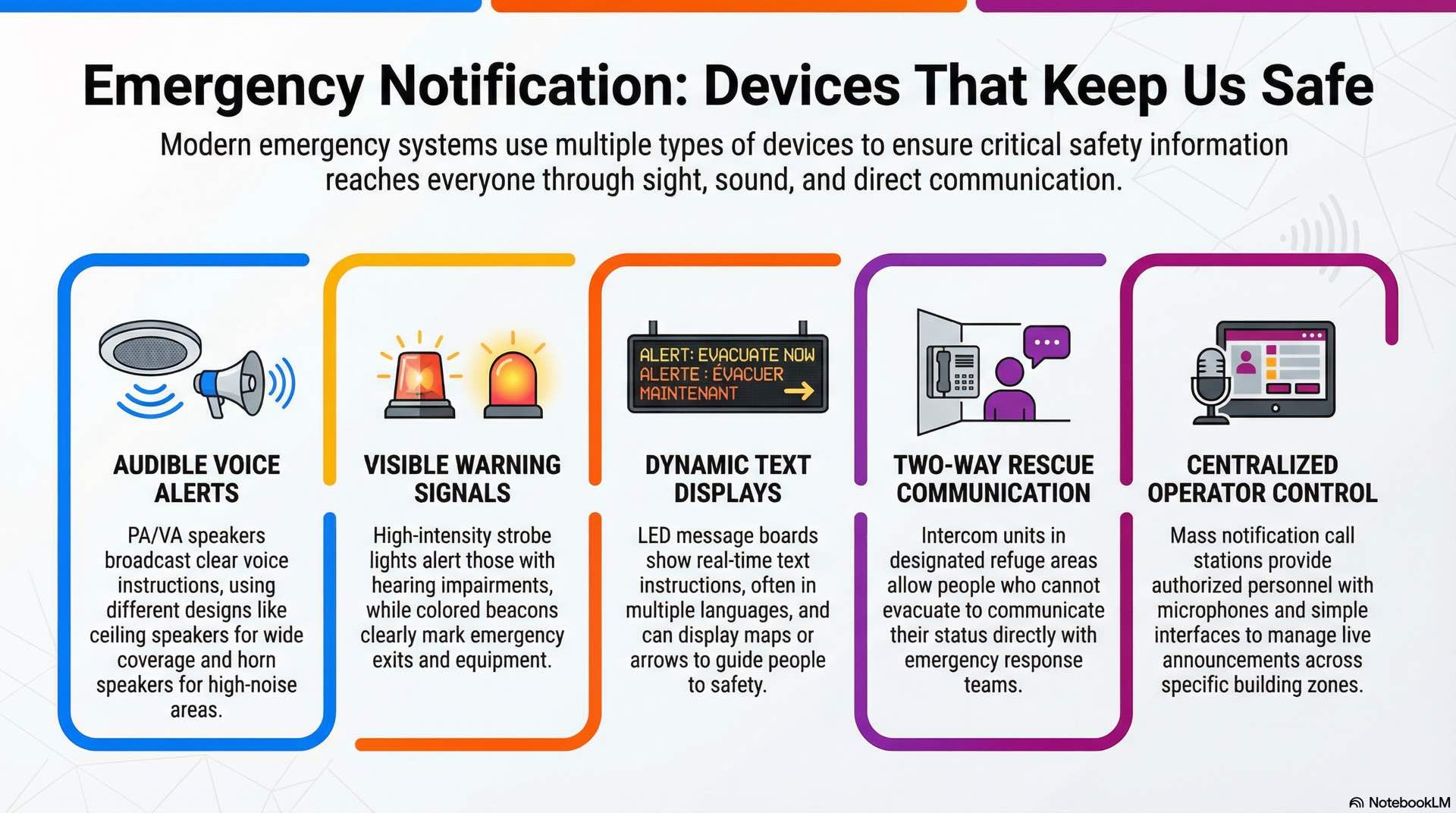
Speaker selection depends on acoustic environment, mounting location, and coverage requirements. Ceiling-mounted speakers work well in suspended ceiling applications. Wall-mounted projector speakers cover larger areas in high-bay industrial spaces. 100V line speakers include internal transformers that allow power tap selection for balanced sound levels across zones.
Visual indicators including strobes and beacons
Visual notification appliances alert individuals who are deaf or hard of hearing. NFPA 72 and ADA requirements define minimum intensity and coverage. Synchronization ensures multiple strobes flash simultaneously rather than at random intervals, preventing disorientation.
Emergency message displays
Digital signage systems display text and graphics reinforcing audio announcements. Integration with voice evacuation systems triggers display content changes when alarm conditions activate. Pre-programmed messages can include evacuation route graphics and assembly point locations.
Refuge point and area of rescue communication units
Two-way communication devices in refuge areas connect occupants to emergency response personnel. Unit design considers accessibility requirements including mounting height, control labeling, and hearing aid compatibility. Fire-rated cables and conduit protect circuits from damage during fire conditions.
Mass notification call stations
Call stations provide distributed locations where authorized personnel initiate live announcements. Access control through key switches, code entry, or credential readers restricts activation to trained personnel. Priority levels determine which operator’s message takes precedence during simultaneous announcements.
Control Panels, Amplifiers and System Hardware
Voice evacuation control panels
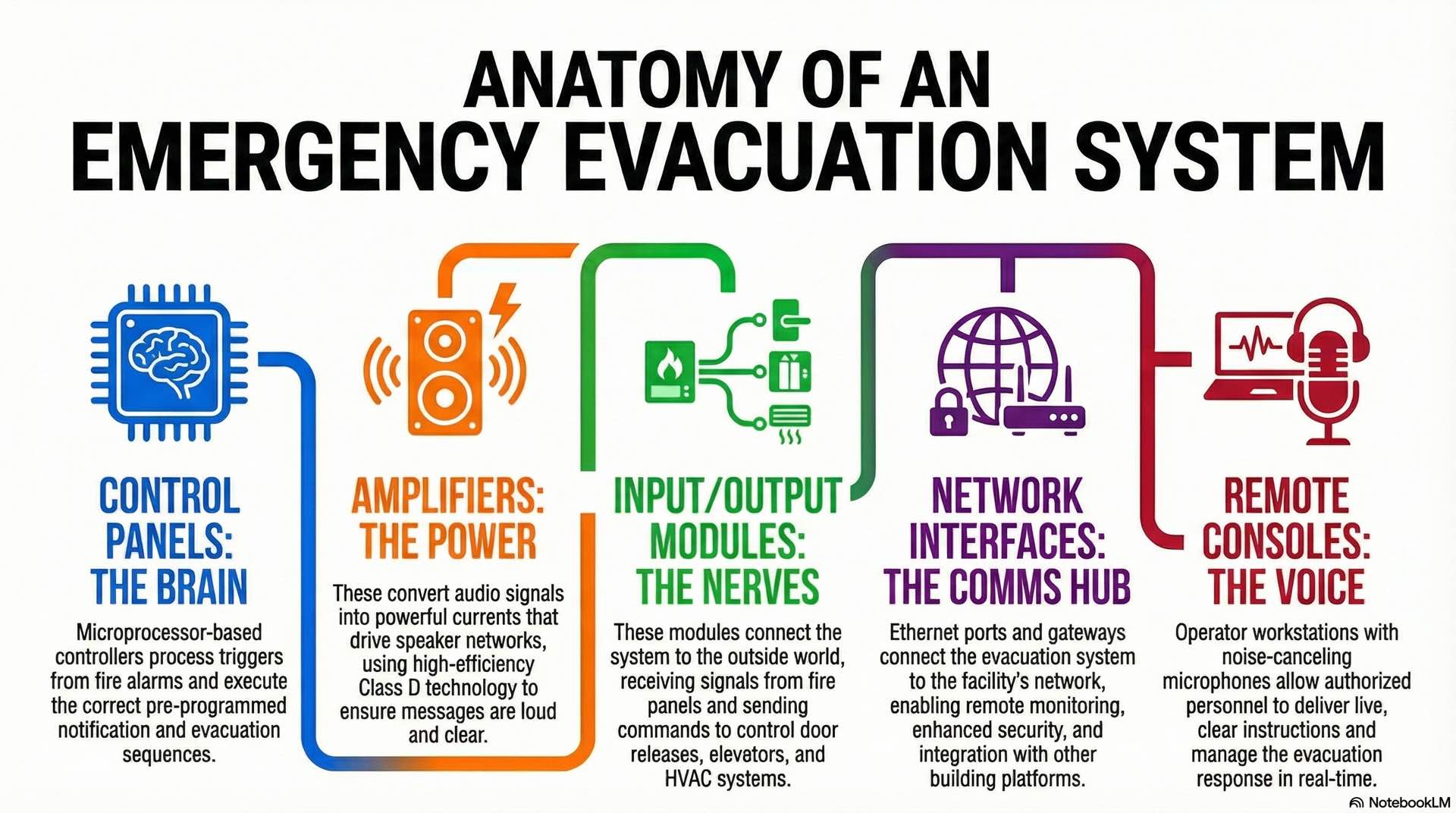
The voice evacuation control panel manages all system functions including message storage, routing, and prioritization. Panels receive inputs from fire alarm systems, manual call stations, and automation interfaces. They execute programmed responses and provide operator interfaces for manual control.
Processing capacity determines maximum zones, audio channels, stored messages, and concurrent announcements. Enterprise installations may require multiple networked panels that share load and provide redundancy. User interfaces range from simple LED indicators to touchscreens with graphical floor plans. Operator training requirements scale with interface complexity.
Amplifiers and audio routers
Amplifiers boost audio signals from control panel line-level outputs to power levels sufficient to drive speaker circuits. Amplifier sizing must match the total speaker load on each circuit with appropriate headroom for peak audio levels. Typical amplifier channels provide 250W to 1000W depending on zone requirements.
Class D amplifier technology provides high efficiency at 85-90%, reducing heat generation and power consumption. This efficiency becomes critical for battery-backed installations where available power is limited. Audio routing equipment directs signals between sources and amplifiers based on programmed configurations. Digital signal processors provide equalization and delay compensation.
Input and output modules
I/O modules expand panel capabilities by providing additional interface points. Input modules receive signals from fire alarm panels and security systems. Output modules send control signals to HVAC systems and door releases. Module addressing allows individual identification within the system.
Network interfaces and gateways
Network interfaces connect voice evacuation equipment to building IT infrastructure. Gateways translate between different communication protocols like BACnet for building management integration. Cybersecurity considerations include network segmentation, access control, and encryption.
Fire system integration modules
Integration modules receive alarm, supervisory, and trouble signals from fire panels and trigger appropriate evacuation responses. Configuration defines mapping between fire alarm zones and evacuation announcements. Testing verification confirms fire signals produce expected responses.
Remote microphone and paging consoles
Paging consoles allow operators to make live announcements from distributed locations. All-call functions broadcast to all zones simultaneously while selective paging targets specific areas. Integration with telephone systems enables paging from standard phone handsets using access codes.
Emergency Communication and Signaling Methods
Digital audio networks including Dante and AES67
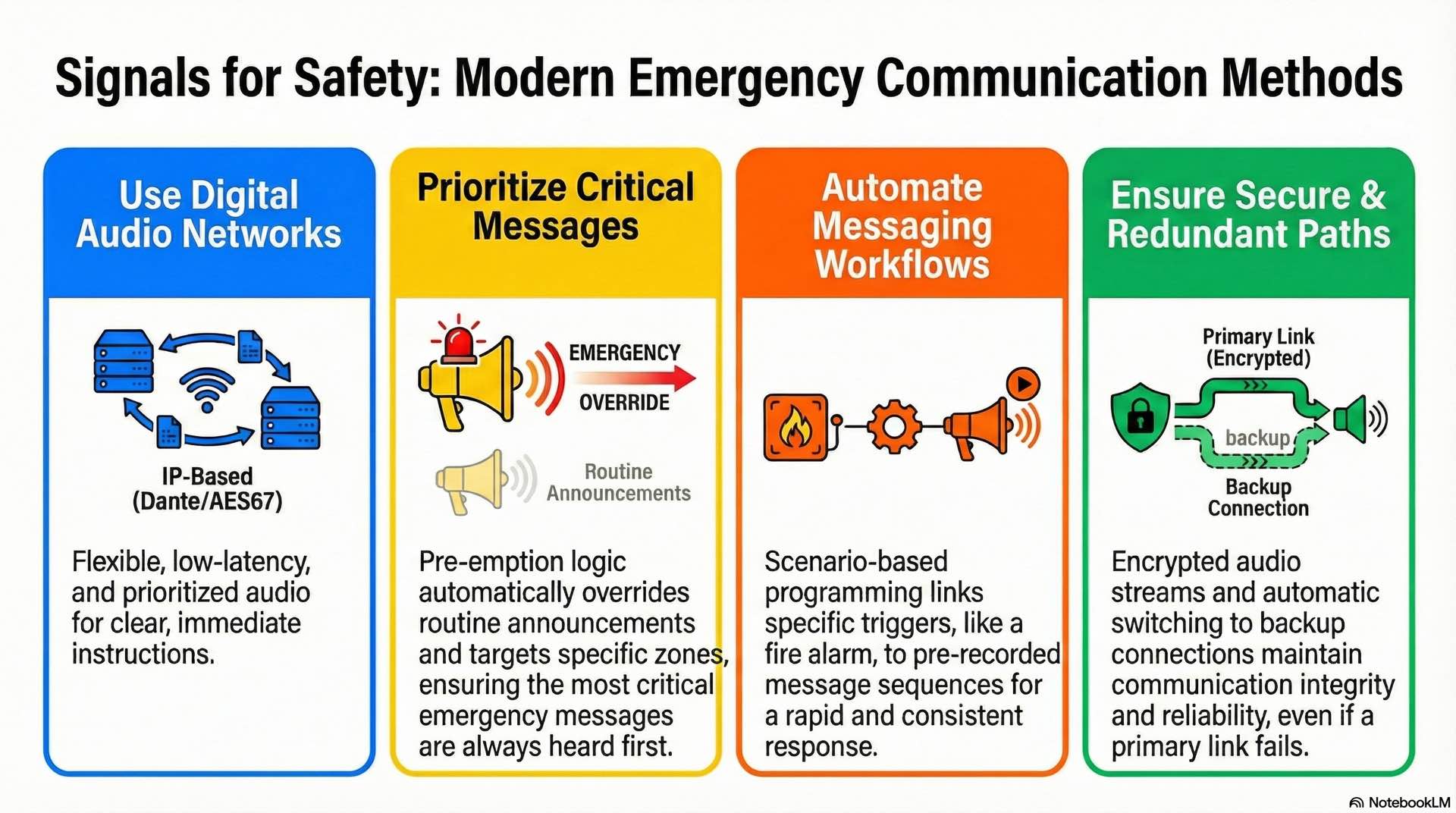
Digital audio networks enable flexible routing over standard IP infrastructure. Dante provides plug-and-play audio networking with automatic device discovery. AES67 establishes interoperability standards between different manufacturers. Both protocols achieve latencies below 5 milliseconds, ensuring synchronized message delivery across all zones.
EN 54-16 and EN 54-24 signaling standards
The EN 54-16 defines requirements for voice alarm control equipment including backup power duration, fault monitoring, and priority handling. EN 54-24 specifies requirements for loudspeakers including frequency response and fire survival performance. Certification is mandatory for EU installations.
Integration with fire alarm systems
Cause-and-effect programming defines which fire conditions trigger which evacuation responses. The programming matrix maps detection zones to announcement zones and message content. Testing activates fire alarm devices and verifies correct announcement playback in appropriate zones.
Multi-zone paging and prioritization logic
Zone selection determines which speakers receive each announcement. Priority logic places fire evacuation at highest priority, followed by security alerts and routine announcements. Lower-priority messages automatically stop when higher-priority conditions activate.
Automated evacuation messaging workflows
Pre-programmed response sequences eliminate delays in manual announcement initiation. Message sequencing delivers information logically—initial alerts capture attention while follow-up messages provide specific instructions. Conditional logic adjusts messaging based on situation development.
Secure and redundant communication paths
Communication path security prevents tampering through physical protection and network encryption. Path redundancy through dual network connections and diverse cable routes ensures message delivery when primary paths fail. Monitoring systems verify path integrity continuously.
Evacuation Management Software and Platforms
Scenario management and automation software
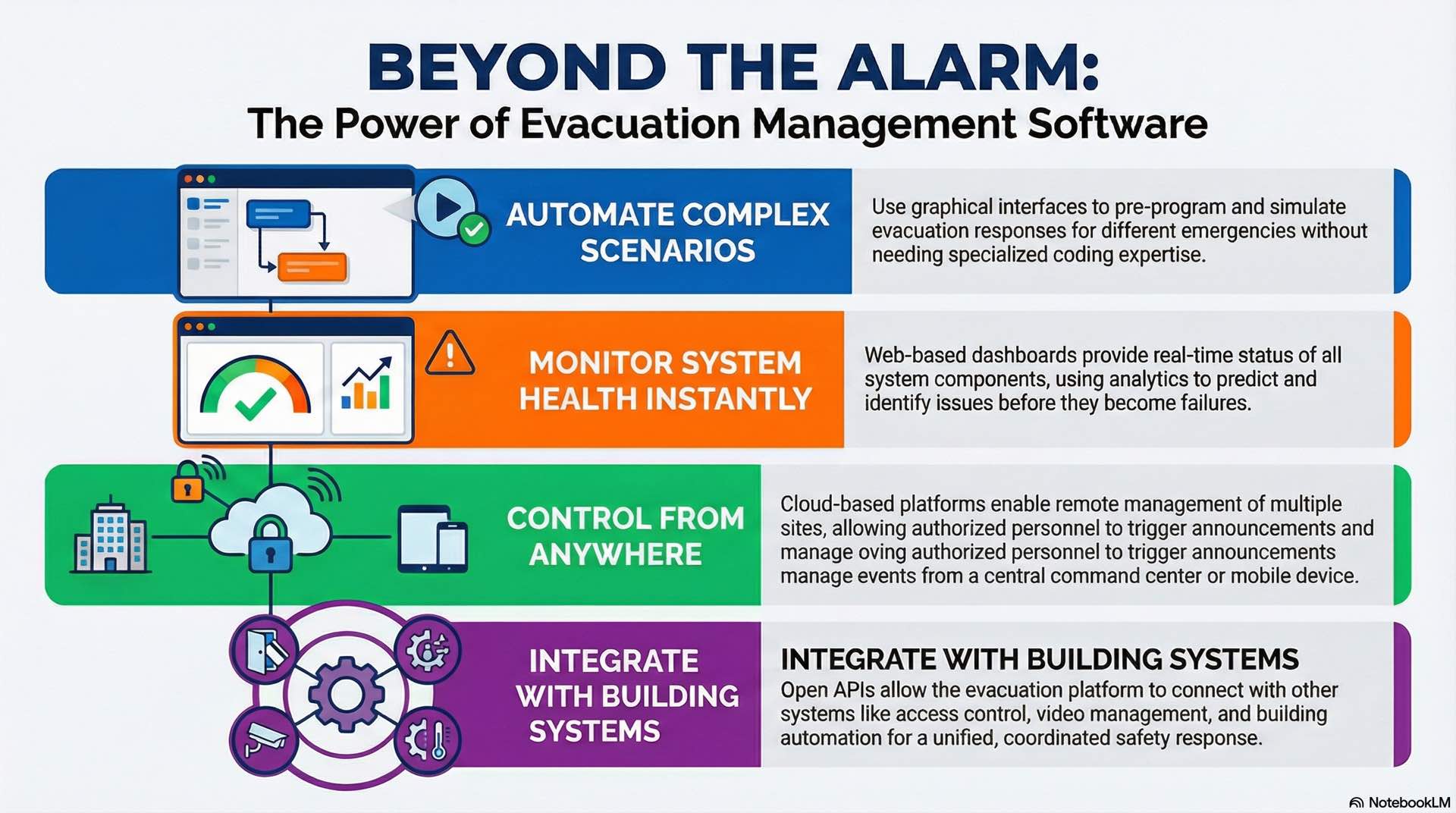
Scenario management software pre-programs responses to anticipated emergency types. Each scenario defines trigger conditions, affected zones, message content, and escalation procedures. Change management prevents unauthorized modifications while enabling necessary updates.
Live paging and announcement tools
Live paging interfaces enable real-time voice announcements during emergencies. Text-to-speech converts typed messages to spoken announcements. Mobile applications extend paging capability to smartphones for authorized personnel.
Monitoring dashboards and health reporting
Real-time dashboards display system status including zone conditions, amplifier loading, and fault conditions. Historical reporting tracks performance over time for predictive maintenance. Alert notifications inform personnel of conditions requiring attention.
Event logging, analytics and documentation
Event logging records all system activity including alarms, announcements, and operator actions. Analytics tools identify patterns and trends supporting continuous improvement. Documentation requirements vary by jurisdiction and facility type.
API and SDK-based integration options
APIs enable integration between evacuation systems and third-party platforms. SDKs provide tools for creating custom integrations. Integration security requires authentication, authorization, and data validation.
Cloud management and remote announcement
Cloud platforms provide centralized management for distributed systems. Remote announcement capability enables broadcasts from anywhere with internet connectivity. Hybrid architectures maintain local control during cloud connectivity interruptions.
Installation and Commissioning Requirements
Speaker placement and coverage validation
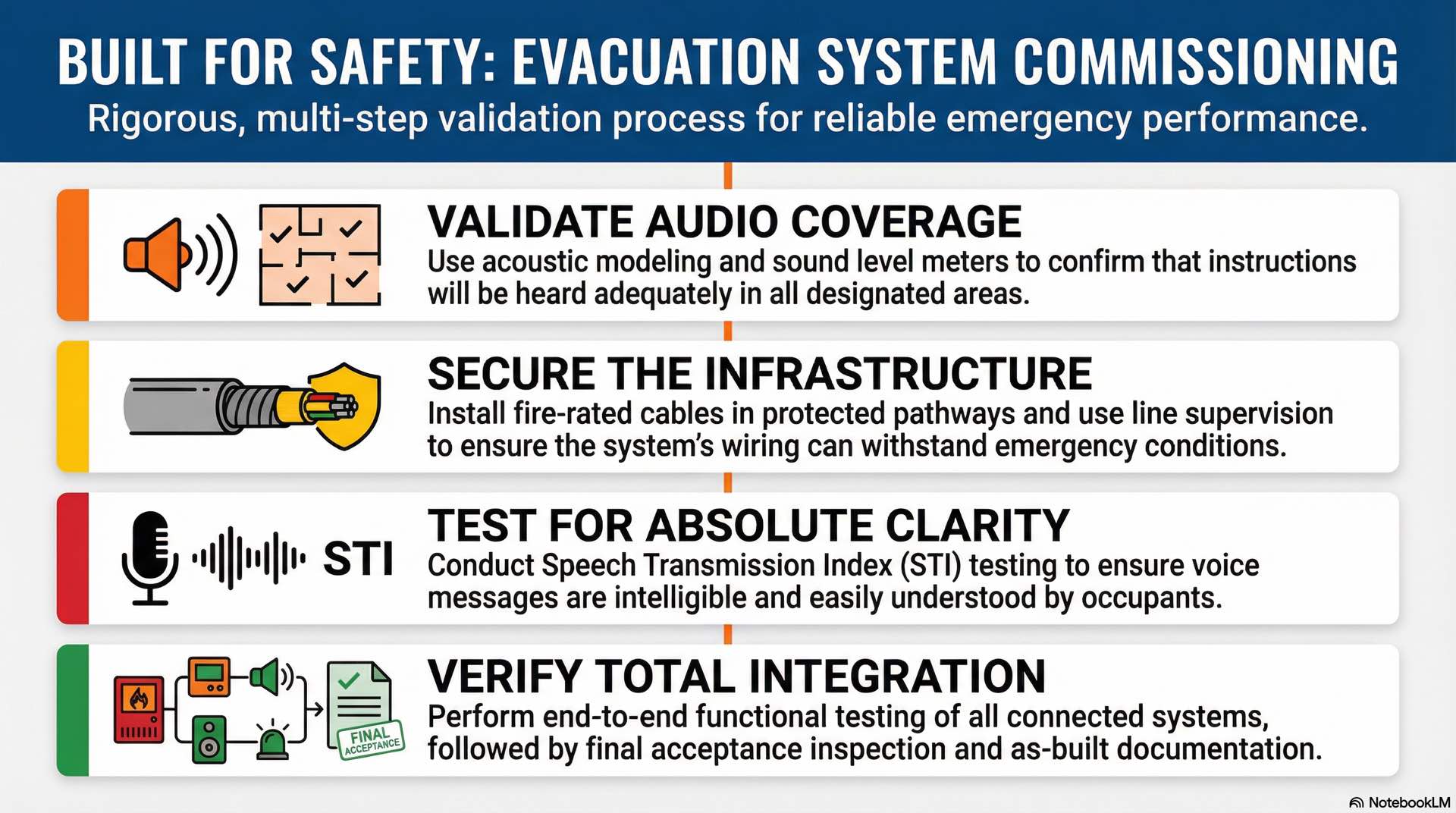
Acoustic modeling software predicts coverage based on speaker specifications and room geometry. Coverage validation measures actual sound levels to verify design targets are achieved. Uniformity requirements ensure consistent sound levels throughout all protected zones.
Cabling, conduits and line supervision
Fire-rated cables may be required for circuits surviving fire exposure. Line supervision circuits monitor cable integrity continuously. Documentation records cable routes and connection details.
Amplifier load testing and configuration
Load testing verifies amplifiers can drive assigned speaker circuits without distortion. Configuration settings optimize performance for specific speaker loads. Redundancy verification confirms backup amplifiers activate correctly.
Audio quality and STI intelligibility testing
STI testing provides objective measurement of message intelligibility with values ranging from 0 to 1. Testing occurs under conditions simulating emergency scenarios including background noise. Results must meet specified thresholds throughout all protected areas to achieve compliance.
System integration and end-to-end verification
Integration testing verifies connected systems communicate correctly. End-to-end testing follows alarm conditions from detection through occupant notification. Acceptance criteria define pass/fail thresholds referencing applicable standards.
Final acceptance and as-built documentation
Final acceptance marks formal transition from installation to operational status. As-built documentation provides complete records including drawings, configurations, and training documentation.
Operations, Maintenance and Testing Procedures
Routine system testing and walkthroughs
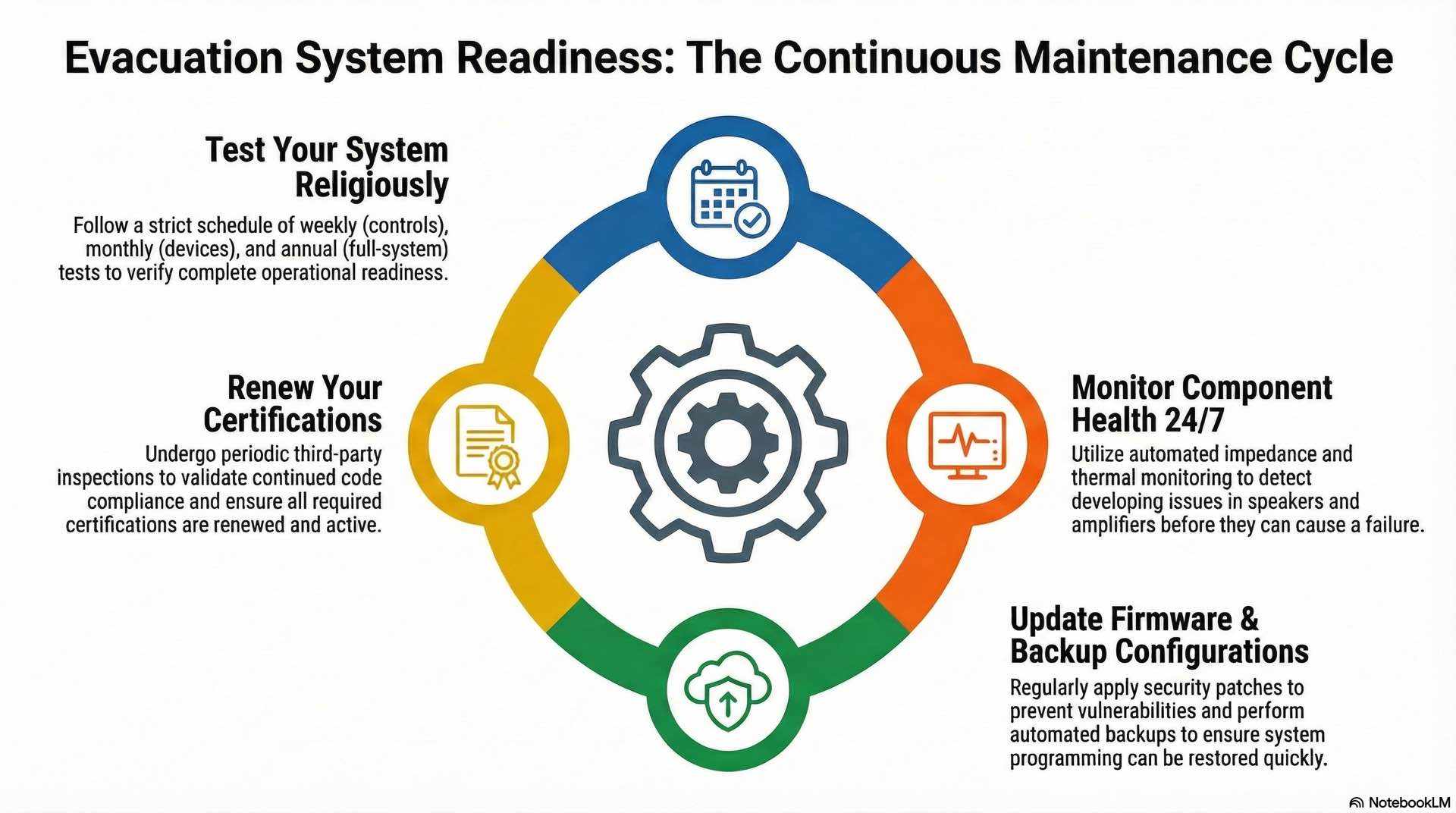
Regular testing verifies component functionality per manufacturer recommendations and regulatory requirements. Functional tests activate system components and verify correct operation across all zones. Documentation records test dates, results, and any corrective actions taken.
Amplifier and speaker health monitoring
Automated health monitoring tests speaker circuits using low-frequency pilot tones that measure impedance without audible output. Amplifier monitoring tracks operating temperatures and internal diagnostics to identify units approaching failure. Periodic manual testing supplements automated monitoring to ensure complete coverage.
Firmware and configuration updates
Software updates address security vulnerabilities and add features. Configuration changes require controlled procedures preventing unauthorized modifications. Backup procedures preserve configurations for restoration.
Fault diagnosis and issue resolution
Diagnostic procedures guide troubleshooting systematically. Spare parts availability affects resolution time. Escalation procedures ensure expert attention for complex issues.
Backup and restore procedures
Regular backups capture system configurations and operational data. Restore testing verifies backup usability. Disaster recovery planning addresses complete system failures.
Compliance testing and certification renewal
Periodic compliance testing verifies systems meet regulatory requirements. Certification renewal maintains standing with authorities. Non-compliance findings require corrective action within specified timeframes.
Compliance, Policy and Preparedness Standards
EN 54, NFPA 72 and local regulatory requirements
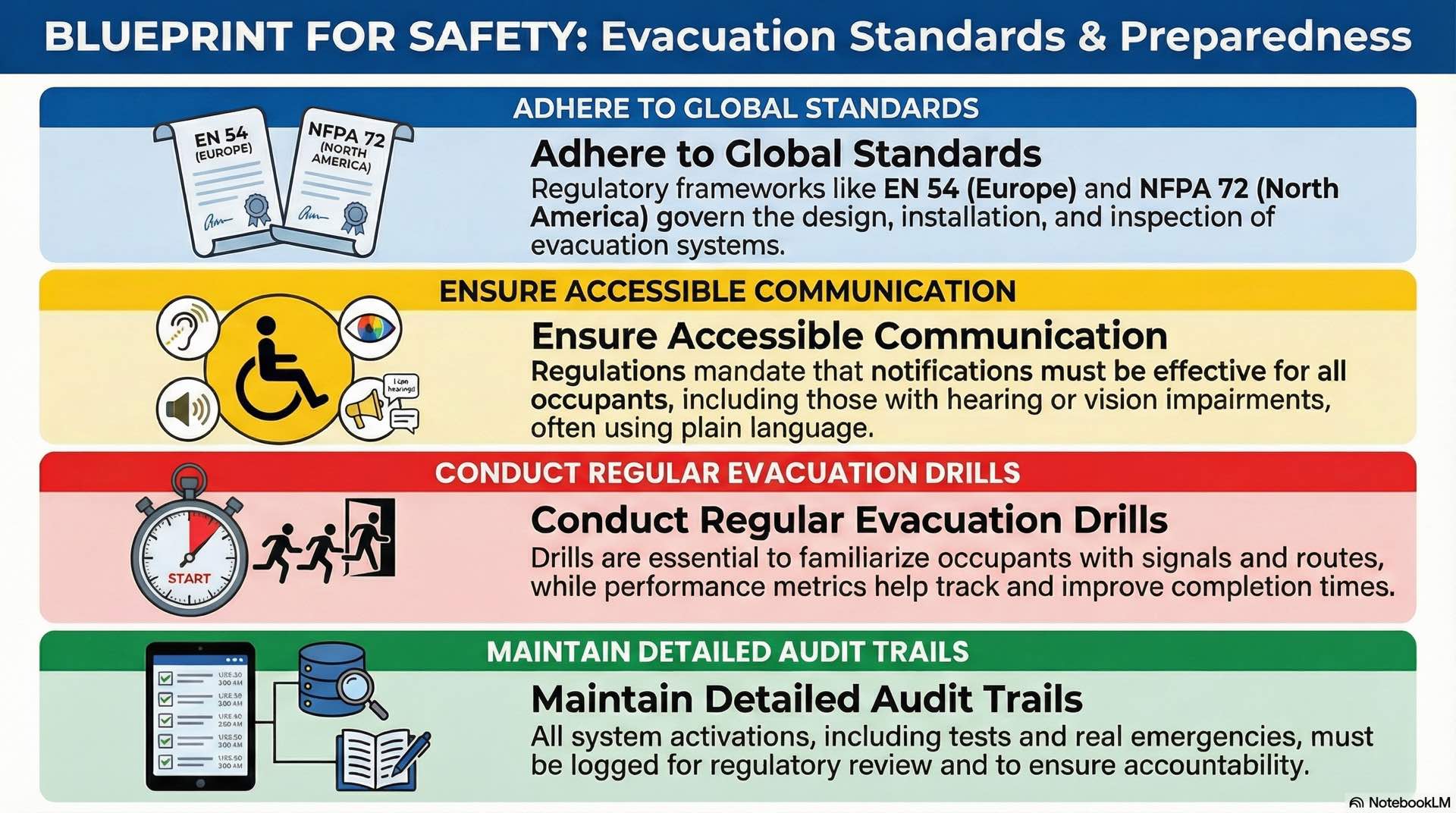
EN 54 provides the European regulatory framework for fire detection and voice alarm systems. NFPA 72 serves as the primary standard in the United States. Local authorities having jurisdiction interpret and enforce applicable codes.
Occupant notification and communication obligations
Regulations define what information must be communicated during emergencies. The evacuation system must deliver intelligible messages reaching all occupied areas. Content requirements may specify message format and language.
Accessibility compliance including ADA and EN standards
Accessibility regulations require emergency notifications reach all occupants regardless of sensory abilities. Visual notification appliances serve individuals who are deaf or hard of hearing. Design verification ensures accessibility features function correctly.
Evacuation drills and documentation practices
Regular drills train occupants in safety procedures and validate system effectiveness. Drill documentation records participation, duration, and identified improvements. Post-drill reviews guide procedural refinements.
Incident logs and audit trail requirements
Event logging creates permanent records of all system activity. Audit trail requirements specify data retention periods. Log analysis supports incident investigation and compliance verification.
Emergency preparedness and safety policies
Organizational policies establish responsibilities for emergency preparedness and coordinated response across all facility operations. Integration with broader emergency management ensures evacuation systems support organizational safety objectives and align with local requirements. These policies designate personnel responsible for system operation, maintenance, and emergency coordination to protect occupant safety during critical events. Policy review procedures keep documentation current as facilities and regulations evolve.