
Learn how to plan and install satellite TV in apartment buildings with a shared SMATV system and multiswitch network for clear reception in every apartment.
Installing satellite reception in multi-dwelling units requires careful planning of a shared SMATV infrastructure that serves every apartment through a central multiswitch and TV distribution network. Unlike single-family homes, apartment buildings benefit from a single dish installation. That dish feeds all units through coaxial risers and floor branches. This approach eliminates the need for individual dishes on balconies, reduces facade clutter, and provides consistent signal quality across the building.
Property managers and system integrators face distinct challenges when designing these systems. The roof must have clear line of sight to the orbital satellites. The building’s vertical and horizontal cable pathways must support the signal distribution. Each unit also needs adequate signal strength for reliable viewing. A well-designed installation balances initial equipment costs with long-term reliability and future upgrade paths.
Satellite TV and SMATV basics for apartment buildings
Shared dishes vs individual apartment dishes
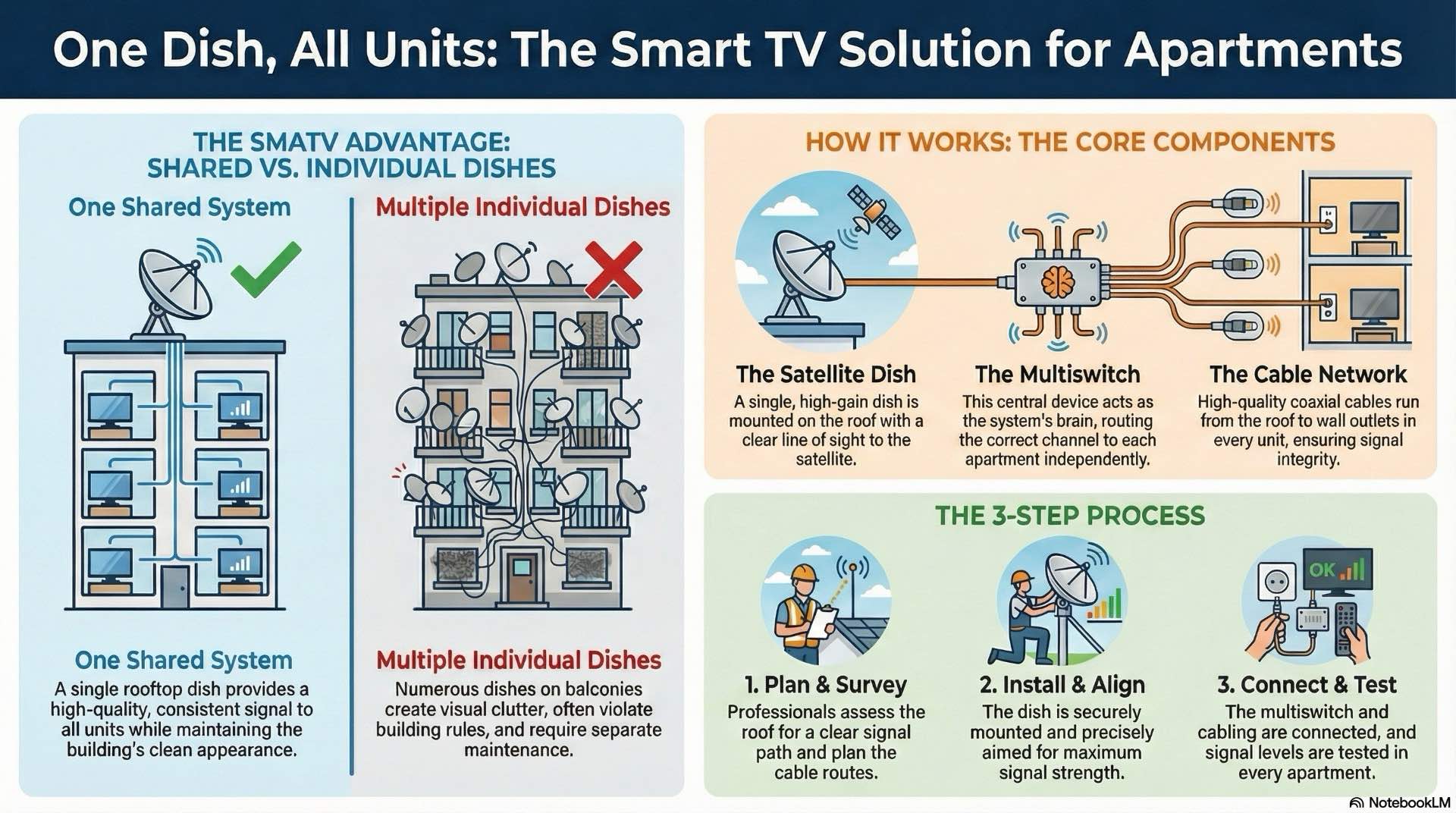
Single dishes mounted on a building rooftop serve all apartments through a satellite master antenna television distribution network. This centralized approach contrasts with allowing each tenant to install their own dish on balconies or exterior walls. Building owners prefer shared systems because they maintain architectural appearance, comply with local regulations, and reduce ongoing maintenance complexity.
Individual dishes create visual clutter and often violate homeowners’ association rules or municipal codes. They also suffer from alignment drift over time as mounting hardware loosens. A shared system locks the dish in place with professional-grade mounting brackets and weatherproofing. Tenants get reliable service without managing their own equipment.
From a technical perspective, one quality dish with a high-gain LNB outperforms multiple small consumer-grade dishes. The shared approach also simplifies troubleshooting. When signal issues occur, technicians check one roof location rather than inspecting dozens of individual installations scattered across the building.
Main components of an apartment SMATV system
The system consists of several interconnected elements. The parabolic dish captures signals from orbital satellites, typically positioned at specific geostationary slots visible from the building’s location. The low-noise block down converter amplifies and frequency-shifts the received signals for transmission through coaxial cable.
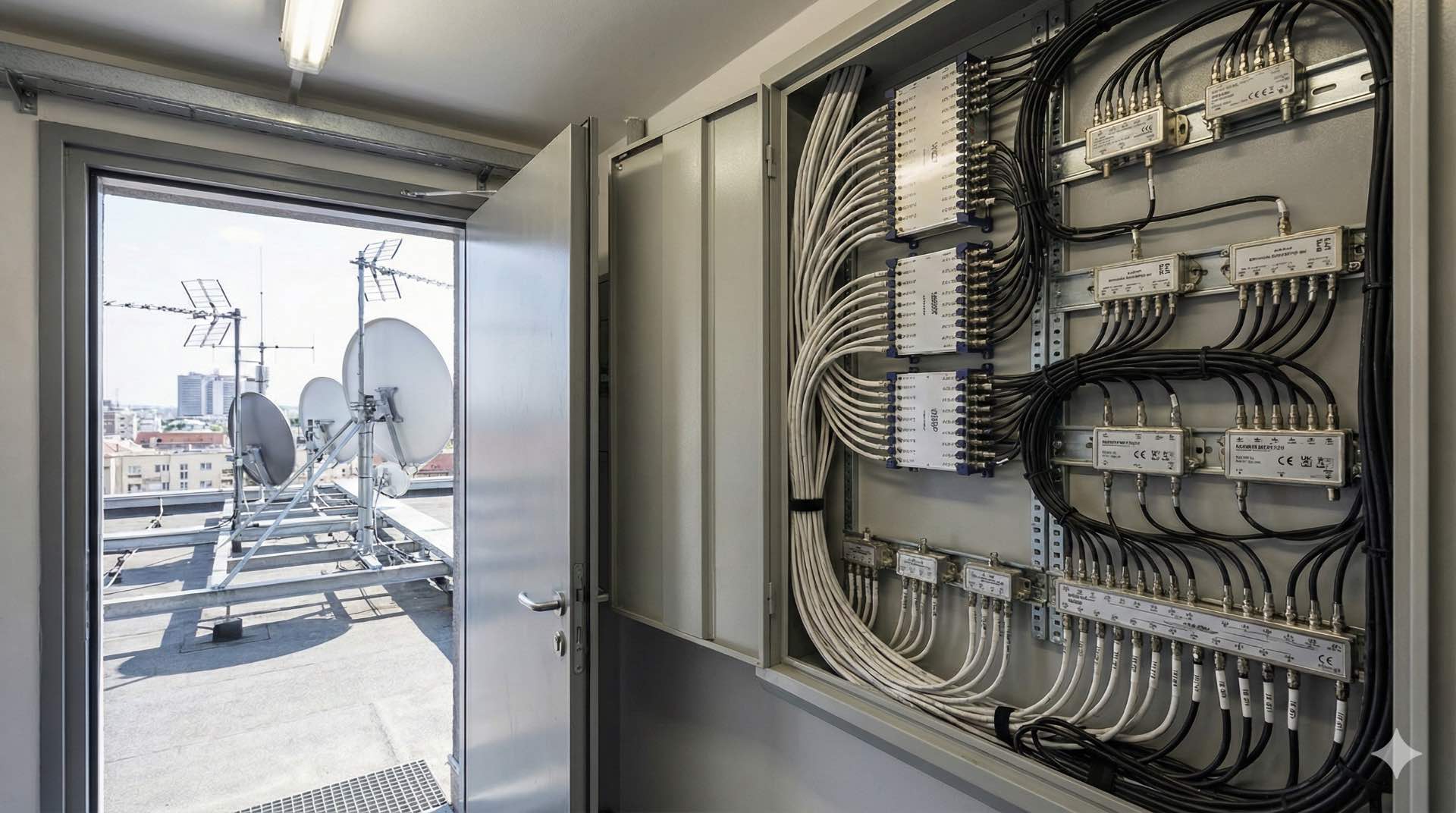
A multiswitch sits at the heart of the distribution network. This device takes the multiple polarizations and frequency bands from the LNB and allows individual receivers to select channels independently. Older systems used passive splitters, but modern multiswitches actively route signals based on control tones from each receiver. This eliminates conflicts when different apartments want different channels simultaneously.
Coaxial cables carry signals from the multiswitch to each apartment outlet. Vertical risers run through building shafts, and horizontal branches connect to individual units on each floor. F-connectors terminate the cables at both the equipment rack and wall plates. The entire SMATV path must maintain signal integrity through proper shielding and impedance matching.
Planning a satellite TV project for an apartment block
Site survey, building constraints and line of sight
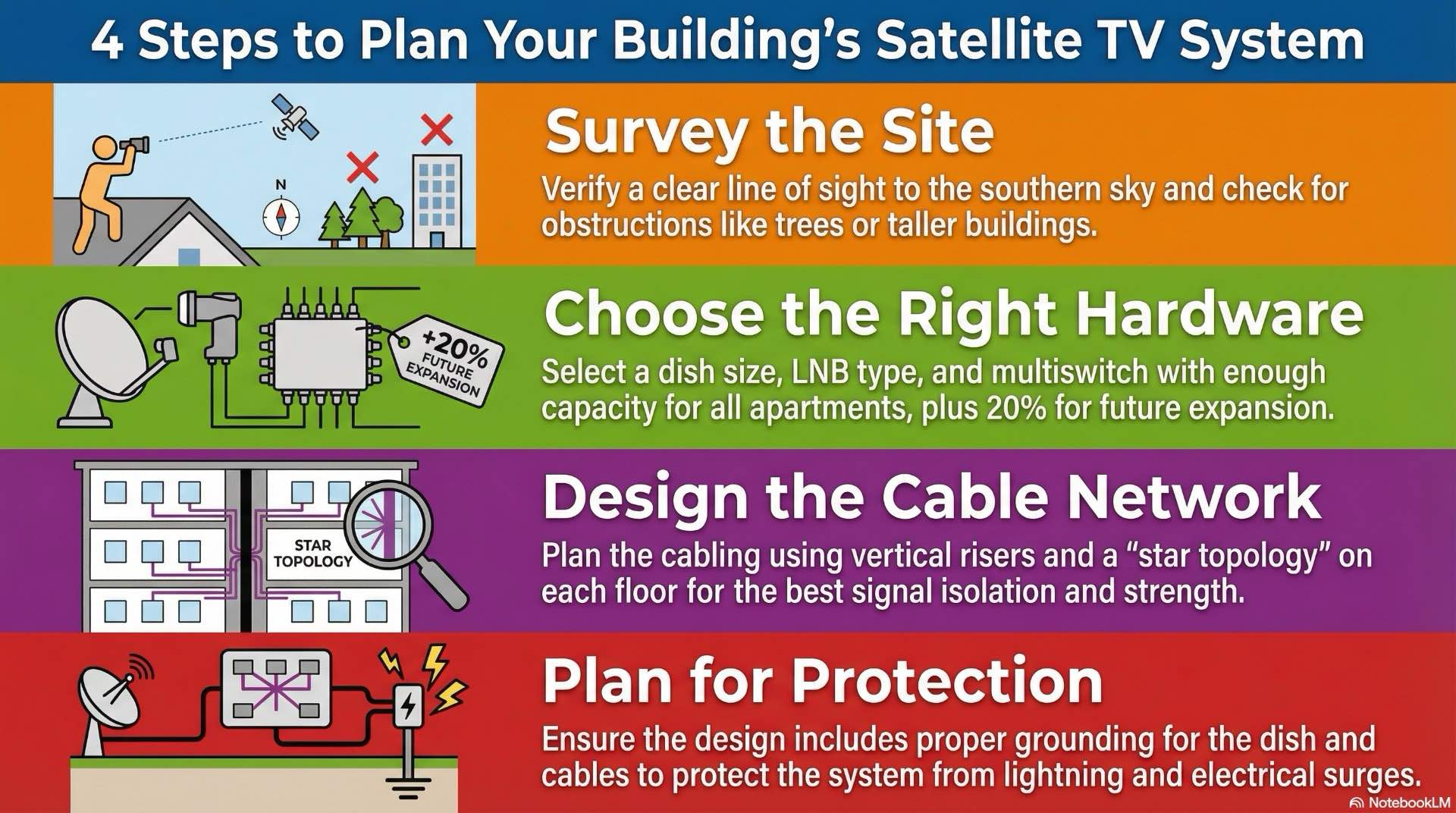
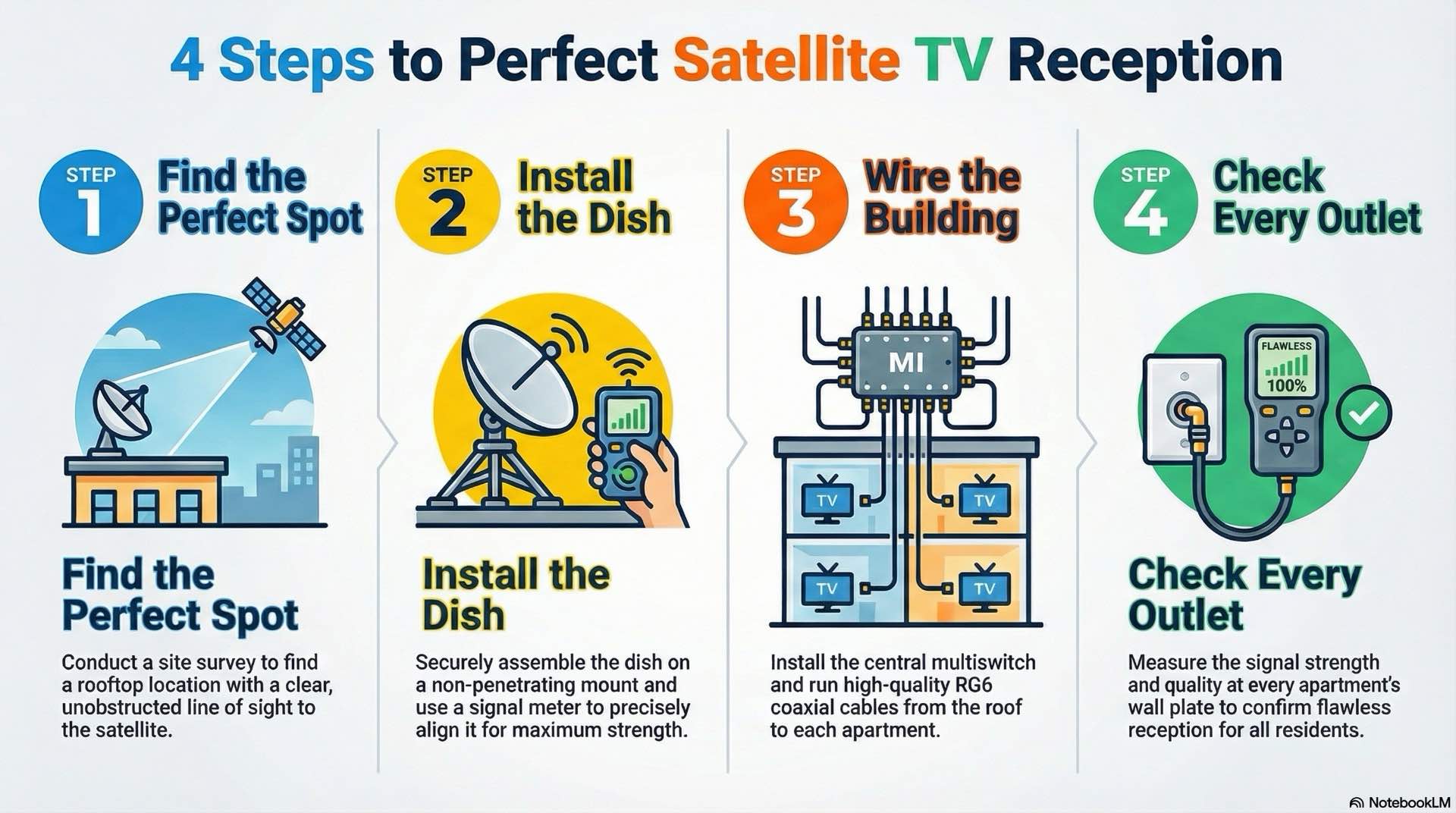
Start by visiting the building during daylight to assess the roof structure and southern exposure. In the northern hemisphere, dishes point generally south toward the equator where most broadcast satellites orbit. Trees, taller neighboring buildings, or the building’s own mechanical penthouses can block the signal path.
Use a satellite finder app or compass to identify the exact azimuth and elevation angles for your target satellites. Stand at potential mounting locations and verify nothing obstructs the line of sight. The dish needs about 5 degrees of clearance on all sides of the target direction. Even a small tree branch can cause intermittent signal loss, especially during wind or after snow accumulation.
Check building access for future maintenance. Roof hatches should accommodate carrying a replacement dish or multiswitch. Consider safety railings, anchor points for technician harnesses, and clear pathways to the equipment. Document existing cable penetrations, conduit routes, and electrical service locations. This information drives the final design and installation plan.
Choosing dish, LNB and multiswitch hardware
Dish size, LNB type and multiswitch capacity
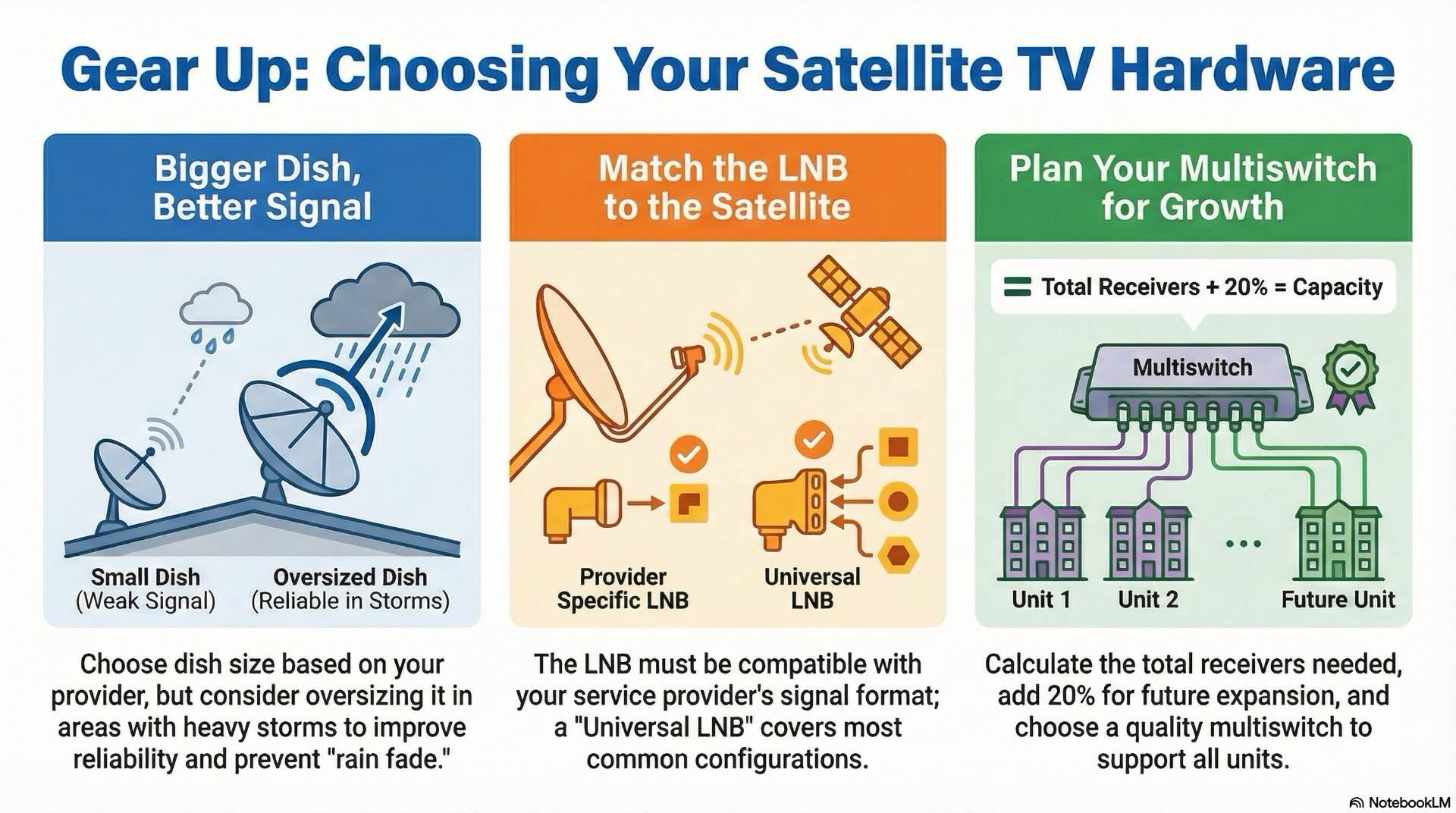
Dish diameter depends on the satellite service provider and local climate. Standard installations use 18 to 36-inch dishes for adequate gain. Larger dishes provide more margin against rain fade and allow reception of weaker transponder signals. In areas with frequent heavy storms, oversizing the dish by one step improves reliability.
The LNB must match the satellite configuration. A universal LNB covers both low and high band frequencies used by most providers. For receiving signals from multiple orbital positions, a multi-output LNB or separate dishes may be required. Verify compatibility with your service provider’s transmission format before purchasing equipment.
Multiswitch selection depends on the number of apartments and receivers. A basic 5×8 multiswitch supports eight receivers from one quad LNB. Larger buildings require cascaded multiswitches, with a main unit feeding secondary units on each floor. Calculate total receiver count, add 20 percent for future expansion, and select equipment rated for that load. Quality multiswitches include built-in amplifiers to compensate for cable losses in long distribution runs.
Designing the SMATV and multiswitch distribution network
Cabling topology for risers, floors and apartments
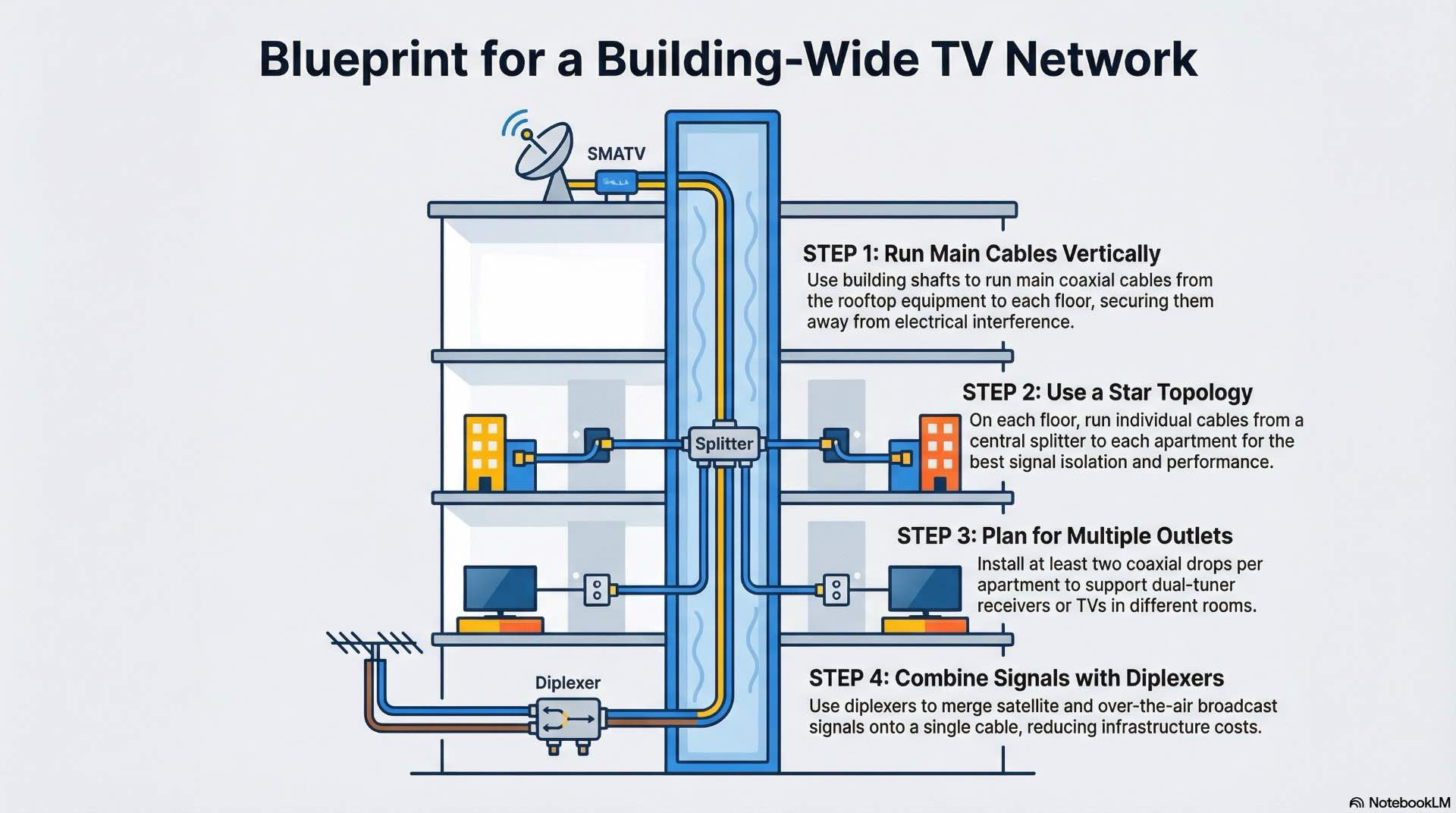
Vertical risers carry signals from the rooftop equipment room to each floor. Use existing building shafts when possible, running cables in dedicated conduit or cable tray. Avoid routing near electrical feeders or elevator motor rooms where electromagnetic interference can degrade signals. Secure cables every meter to prevent sagging, and leave service loops at each floor for future modifications.
Horizontal distribution on each floor follows a star topology or daisy-chain configuration. Star configurations run individual cables from a floor-mounted splitter to each apartment, providing the best isolation and signal levels. Daisy-chains use fewer cables but introduce more loss and potential failure points. For buildings with more than six units per floor, star topology is preferred.
Each apartment receives one or more coax drops terminating at wall plates. Two drops per unit support dual-tuner receivers or separate bedroom televisions. Plan drop locations during construction or renovation when walls are open. Retrofit installations may require surface-mount raceways or fishing cables through existing walls, which increases labor costs significantly.
Combining satellite and terrestrial TV in one network
Many installations deliver both satellite and over-the-air broadcast channels through the same coax infrastructure. A diplexer combines the two signal types at different frequency ranges. Satellite signals occupy 950 to 2150 MHz, while terrestrial broadcasts use 47 to 862 MHz. The combined signal travels over a single cable, and receivers use internal diplexers to separate the bands.
This approach reduces cabling costs and simplifies apartment wall plates. However, it requires careful attention to frequency planning and filter quality. Cheap diplexers introduce signal loss and can allow interference between the satellite and terrestrial paths. Specify diplexers with at least 25 dB of isolation between the bands.
Terrestrial antennas mount separately on the roof, with their signals fed to a combiner unit before mixing with the satellite feed. Amplify the terrestrial signal as needed to match the satellite signal level. Unbalanced levels cause receivers to struggle with weaker inputs. Test reception on both signal types during commissioning to verify clean separation and adequate strength.
Cabling, grounding and lightning protection
Coaxial cable selection, connectors and earthing
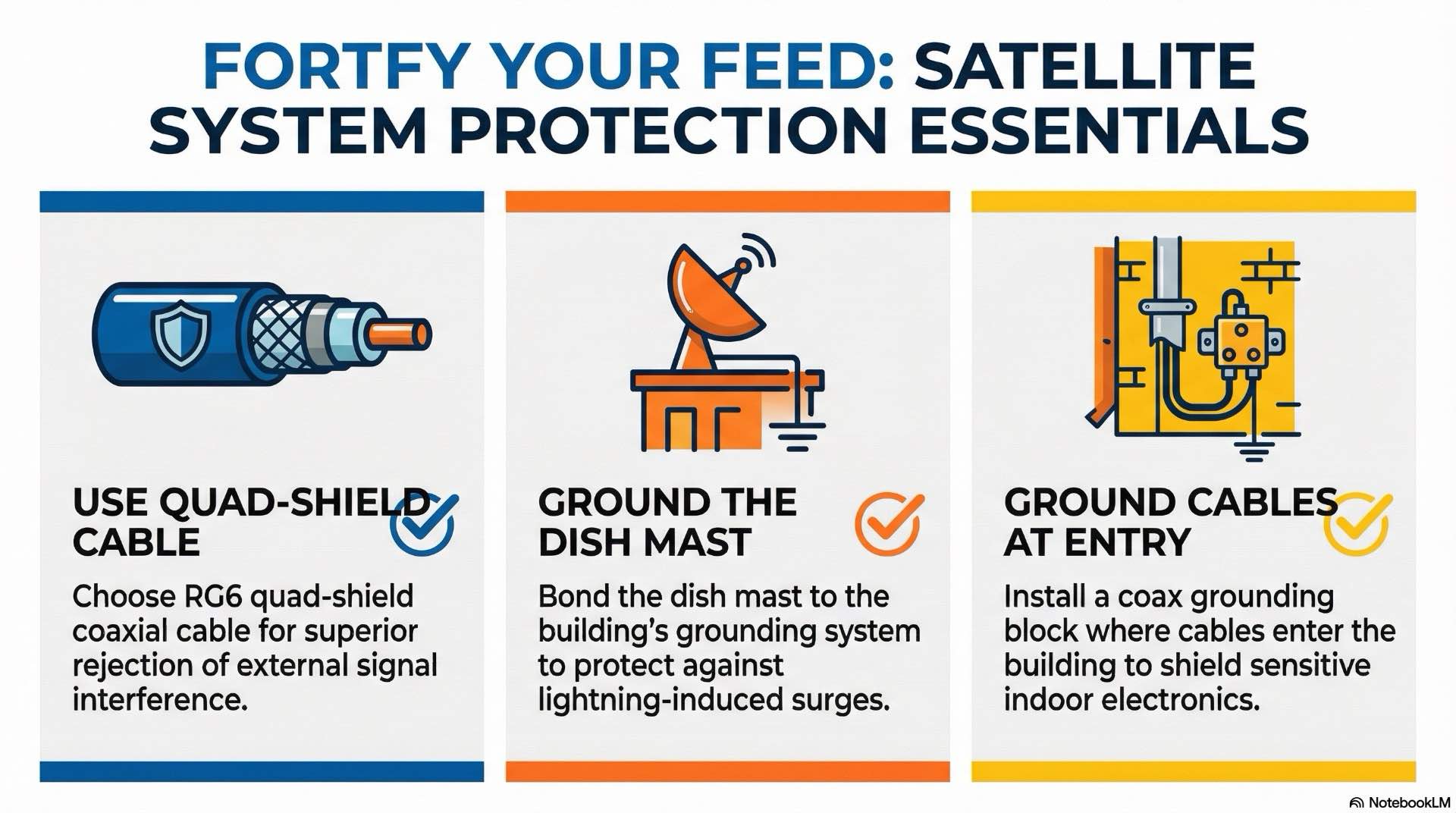
Use RG6 quad-shield coaxial cable for all permanent installations. This cable type provides better rejection of external interference compared to RG59 or dual-shield variants. The quad-shield construction includes two layers of foil and two layers of braided copper, creating a robust barrier against radio frequency noise from building electrical systems.
Cable runs longer than 100 meters require amplification to maintain signal levels. Calculate total path loss including cables, splitters, and connectors. Each F-connector introduces about 0.3 dB of loss, and splitters add 3.5 to 7 dB depending on the split ratio. If total loss exceeds 15 dB, insert a line amplifier with sufficient gain to restore signal to the receiver’s required input range.
Grounding protects equipment from lightning-induced surges and reduces noise in the system. Bond the dish mast to the building’s grounding system using 10 AWG copper wire. Install a coax grounding block where cables enter the building, connecting it to the same ground point. This creates a path for static discharge and surge currents that bypasses sensitive electronics. Check local electrical codes for specific grounding requirements, as these vary by jurisdiction.
Step-by-step satellite TV installation on site
Dish mounting, alignment and SMATV room setup
Begin by assembling the dish mount on the roof. Use a non-penetrating mount weighted with concrete blocks. Alternatively, bolt through the roof membrane with proper flashing and sealant. The mount must withstand wind loads specified for your building’s height and exposure category. Most jurisdictions require engineered calculations for rooftop antenna installations on buildings over three stories.
Point the dish to the calculated azimuth using a compass, then adjust elevation to the target angle. Tighten the mount bolts to finger-tight only at this stage. Connect a portable signal meter and receiver to the LNB output. Slowly sweep the dish left and right while watching the signal meter. When signal appears, make fine adjustments to maximize both signal strength and quality readings.
Inside the equipment room, mount the multiswitch on a wall or in a rack cabinet. Connect LNB outputs to the multiswitch inputs, observing correct polarization assignments. Run output cables to the floor distribution points, labeling each cable clearly. Power the multiswitch and verify LED indicators show normal operation. The room should have adequate ventilation, as amplified multiswitches generate heat that can shorten component life in hot enclosed spaces.
Testing, troubleshooting and optimisation
Measuring signal levels and fixing common issues
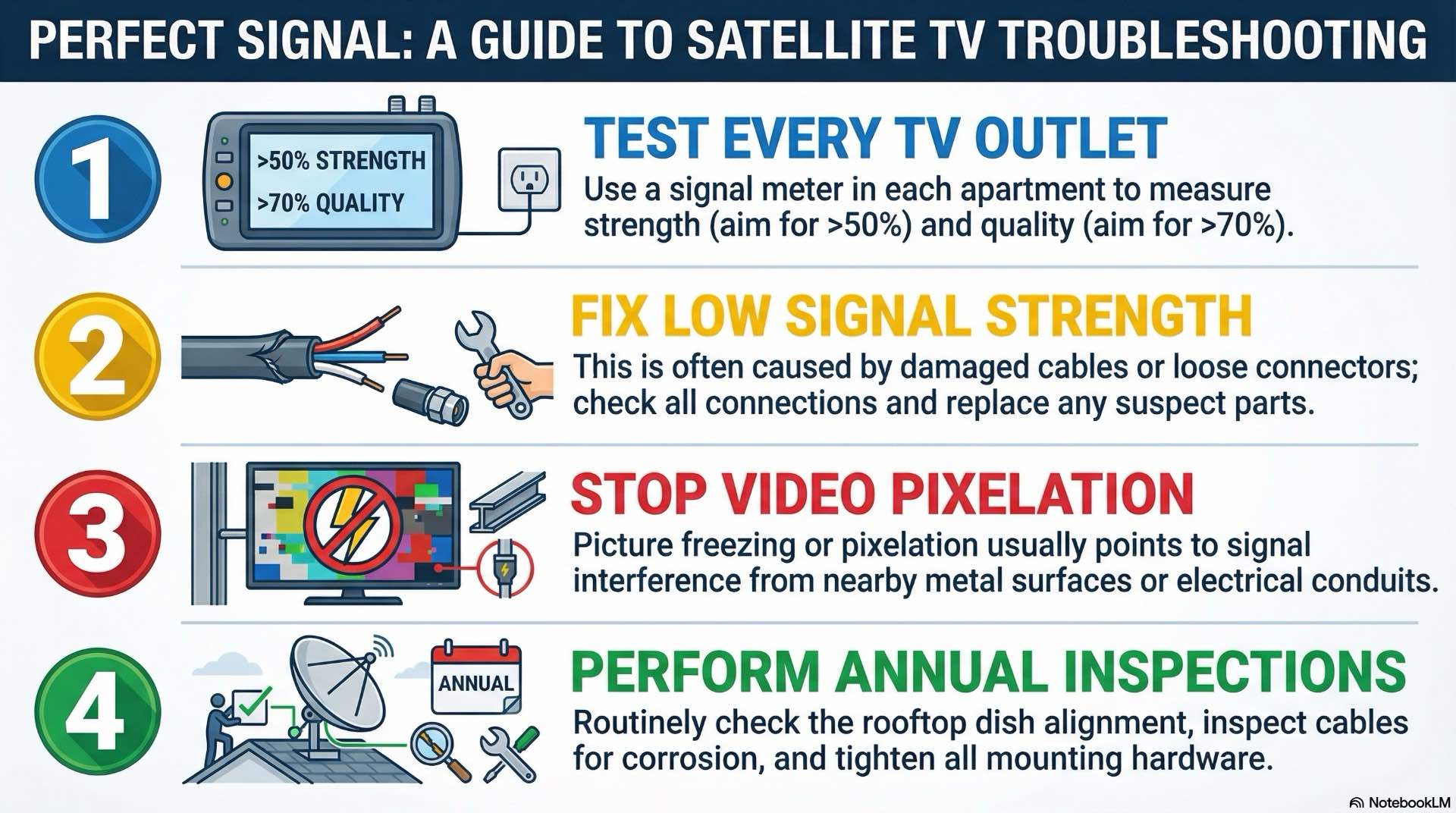
Test every apartment outlet using a receiver or spectrum analyzer. Measure satellite signal strength, quality, and bit error rate. Acceptable ranges vary by provider, but generally, you want strength above 50 percent and quality above 70 percent on the receiver’s built-in meters. Document readings for each outlet and flag any below threshold.
Low signal strength often indicates cable damage, poor connectors, or excessive run length. Check all F-connectors for proper compression and center conductor protrusion. Loose connectors allow moisture ingress that corrodes the cable shield over time. Replace any suspect cables or connectors immediately, as intermittent problems worsen during temperature swings and humidity changes.
Pixelation or freezing video despite good signal strength points to interference or multipath reflections. Verify the dish is not receiving reflected signals from nearby metal surfaces. Check that all cables maintain proper spacing from electrical conduits and fluorescent lighting. In severe cases, relocating the dish by even a few meters can eliminate the interference source.
Maintenance, upgrades and future-proofing
Routine checks, common faults and system upgrades
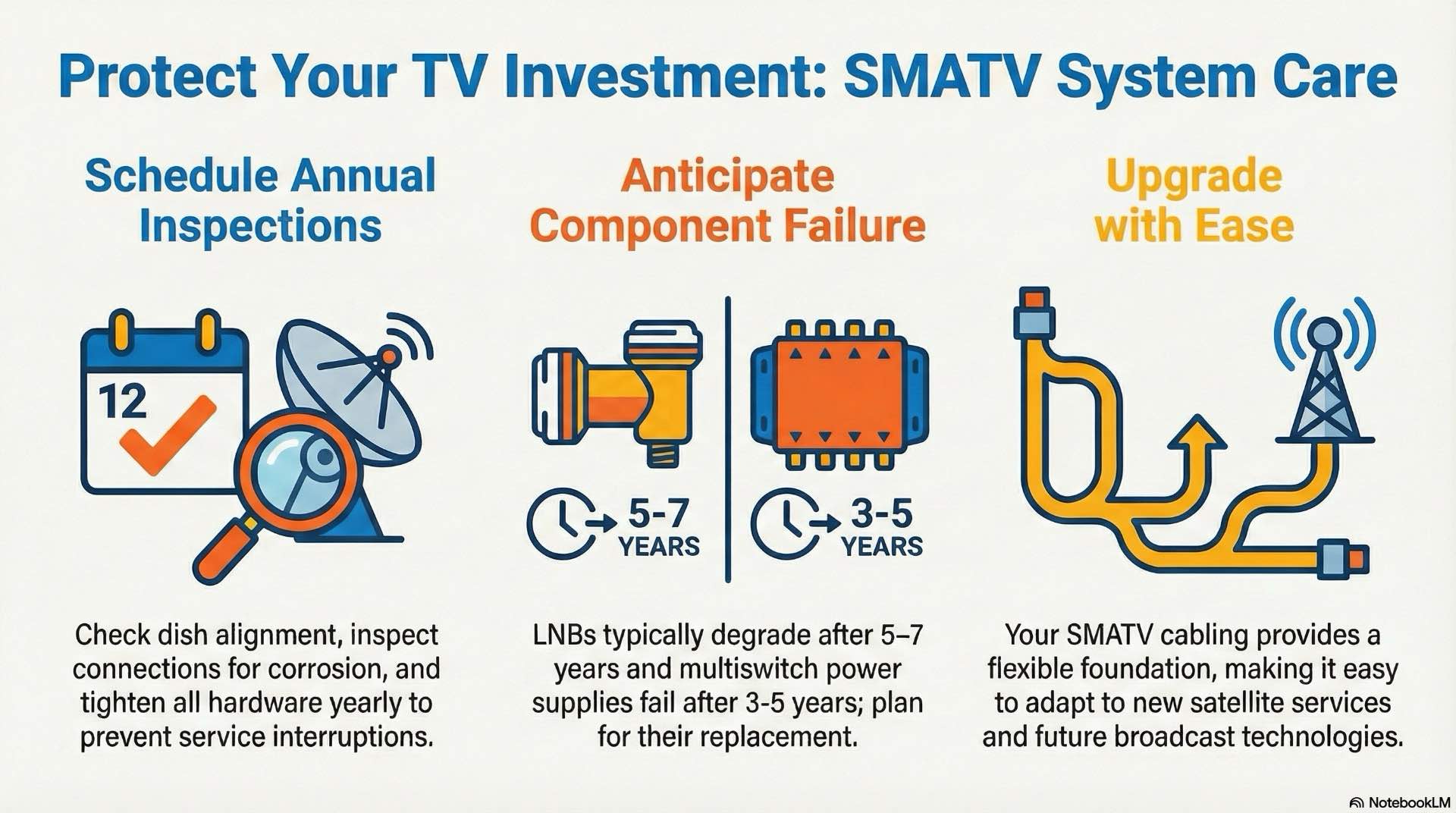
Schedule annual inspections of the rooftop equipment. Check dish alignment using a signal meter, as thermal expansion and wind can shift the mounting over time. Inspect cable connections for corrosion, especially at the LNB where temperature extremes stress the connectors. Tighten all mounting hardware and verify weather seals remain intact.
Common long-term failures include LNB degradation and multiswitch power supply failure. LNBs typically last five to seven years before noise figures increase beyond acceptable limits. Keep a spare LNB on hand for rapid replacement when signal quality drops across all apartments. Multiswitch power supplies should be replaced every three to five years as electrolytic capacitors degrade. Regular SMATV maintenance prevents service interruptions and extends equipment life.
When upgrading to new satellite services or adding orbital positions, the existing cabling and multiswitch network often supports the change with minimal modifications. This SMATV infrastructure provides flexibility that individual apartment dishes cannot match, making the TV system adaptable to evolving broadcast technologies and tenant preferences.